A Billion-Dollar Deal: A Turning Point for the U.S. Battery Market?
Sila and Panasonic sign a billion-dollar silicon-carbon anode supply deal, reflecting a turning point in U.S. next-gen battery commercialization.
Sila and Panasonic Energy signed a silicon-carbon anode materials supply agreement potentially worth more than a billion dollars, injecting confidence into the U.S. next-generation battery industry after several startup failures. Silicon-carbon anodes have far higher theoretical gravimetric capacity than graphite, enabling smaller, lighter batteries and higher energy density. The deal endorses Sila and reflects U.S. battery supply chain localization, potentially driving upstream silicon, equipment, and recycling investment and providing a commercialization reference for lithium-metal and solid-state routes. However, volume expansion, cycle life, and mass-production challenges remain.
The U.S. next-generation battery industry, after years in the doldrums and the collapse of star startups, has finally received some confidence-boosting news. Sila has signed an agreement with global battery manufacturer Panasonic Energy to supply silicon-carbon anode materials, which are seen as key to enabling smaller, lighter batteries. According to Sila, the deal could be worth more than a billion dollars. This transaction is not only an endorsement of a startup but also reflects deeper shifts in the technology roadmap and commercialization of the U.S. battery supply chain.
Silicon-Carbon Anodes: The Key to Next-Generation Batteries
Silicon-carbon anode materials have attracted attention because their theoretical gravimetric capacity is far higher than that of traditional graphite anodes. Replacing graphite with silicon-carbon allows more energy to be stored in the same volume, making batteries smaller and lighter, or increasing range without adding weight. For electric vehicles and consumer electronics, this means significantly greater design freedom.
The core of Sila's supply agreement with Panasonic Energy is precisely the scaled supply of this material. As a major global battery manufacturer, Panasonic Energy's choice is a bellwether. If silicon-carbon anodes can be mass-produced stably and meet performance requirements, it will propel high-energy-density batteries from the lab to mainstream vehicle models.
Theoretical gravimetric capacity is a key metric for measuring an anode material's lithium storage capability, expressed in mAh/g. The theoretical gravimetric capacity of traditional graphite anodes is about 372 mAh/g, already close to its practical application limit; while the theoretical gravimetric capacity of silicon is as high as about 4200 mAh/g, more than ten times that of graphite. This means that at the same mass, silicon can store more lithium ions. However, silicon's volume expansion during lithium intercalation can reach 300%, far exceeding graphite's roughly 10%, which leads to particle pulverization, electrode structure damage, and repeated growth of the solid electrolyte interphase (SEI) film, thereby shortening cycle life. Therefore, silicon-carbon anodes are not pure silicon but rather nano-silicon dispersed in a carbon matrix to buffer expansion and maintain a conductive network.
Energy density is usually expressed in Wh/kg (gravimetric energy density) or Wh/L (volumetric energy density), and directly determines how much charge a battery can store at the same weight or volume. Increasing anode gravimetric capacity is one effective way to raise energy density, because the anode accounts for a large proportion of a battery's total mass. Replacing graphite with silicon-carbon can increase cell energy density without changing the cathode material, thereby giving electric vehicles longer range at the same battery pack weight, or making consumer electronics thinner and lighter. Currently, mainstream graphite-anode cells have an energy density of about 250-300 Wh/kg, and silicon-carbon anodes are expected to push it above 300 Wh/kg, but cycle life and cost must be balanced.
From the Shadow of Failure to a Billion-Dollar Deal
Over the past few years, the U.S. next-generation battery sector has not been calm. Several heavily hyped startups encountered setbacks or even failed, causing capital markets to become cautious about the sector for a time. Sila's deal is therefore seen as a signal of industry sentiment recovering.
The statement that the agreement is "potentially worth more than a billion dollars" comes from Sila. Although the specific terms have not been disclosed, this magnitude indicates that Panasonic Energy has made a substantive commitment to the silicon-carbon anode route. For a materials supplier, securing a long-term order from a leading global battery manufacturer is a key step across the "valley of death."
The "valley of death" in the context of hard-tech commercialization refers to the funding and engineering gap between laboratory validation of a technology and large-scale mass production. For battery materials startups, this stage requires heavy investment in production lines, customer certification, and stable yields, while revenue often has not yet ramped up, leading to tight cash flow. Many next-generation battery star companies collapsed at precisely this stage. Securing a long-term supply agreement with a leading battery manufacturer is equivalent to locking in future orders and revenue expectations, helping to attract subsequent financing and share the risks of capacity construction, and is therefore regarded as a key milestone for crossing the "valley of death."
Signals of Reconstruction in the U.S. Battery Supply Chain
The significance of this transaction goes beyond a single company. The U.S. battery industry has long relied on overseas supply for key materials such as cathodes and anodes, and localization pressure persists. Silicon-carbon anodes belong to a segment with high technical barriers, and if large-scale capacity can be established domestically in the U.S., it will strengthen supply chain resilience.
The cooperation between Sila and Panasonic Energy may drive supporting investment in upstream silicon materials, equipment manufacturing, and recycling. At the same time, it provides a commercialization reference for other next-generation battery technology routes (such as lithium-metal anodes and solid electrolytes): leading manufacturers are willing to bet on validated materials innovation.
Commercialization Still Faces Engineering Tests
The challenges of silicon-carbon anodes are not small. Silicon expands significantly in volume during charge and discharge, easily causing electrode structure deterioration and affecting cycle life. Materials companies need to suppress expansion through nanostructure design, carbon coating, and binder optimization while controlling costs.
A supply agreement is a starting point, not the finish line. From sample submission and validation to large-scale mass production, there are multiple hurdles in between, including capacity ramp-up, yield improvement, and customer certification. Whether Sila can deliver on time and with the required quality will determine how much value this agreement ultimately realizes and will also affect Panasonic Energy's subsequent procurement strategy.
Carbon coating is a commonly used surface modification method for silicon-carbon anodes: forming an amorphous carbon layer on the surface of nano-silicon particles, which can buffer silicon's volume expansion, prevent particle agglomeration, improve electronic conductivity, and reduce direct side reactions between silicon and the electrolyte. Binder optimization is equally critical. Traditional polyvinylidene fluoride (PVDF) binders struggle to withstand silicon's enormous expansion, while new binders such as polyacrylic acid (PAA) can maintain electrode structural integrity through stronger hydrogen bonding or covalent bonding. In addition, prelithiation, electrolyte additives, and electrode porosity design also affect the cycle life and first-cycle efficiency of silicon-carbon anodes. These engineering details determine whether the material can move from gram-scale samples to ton-scale mass production.
Potential Impact on the Industry Landscape
If silicon-carbon anodes scale smoothly, the cost curve for high-energy-density batteries may shift downward, accelerating the EV range race and the thinning of consumer electronics. For Panasonic Energy, incorporating Sila's materials helps differentiate its products, especially in the high-end cylindrical battery market.
For the U.S. battery industry, this billion-dollar-level agreement is a signal: despite failures and adjustments, innovation in next-generation batteries has not stopped, and capital and manufacturers are still betting on technological breakthroughs. The real test lies in engineering and scale-up, and this is also the key to whether the U.S. battery market can truly reach a turning point.
One-line Summary
Sila and Panasonic sign a billion-dollar silicon-carbon anode supply agreement, reflecting a turning point in U.S. next-generation battery commercialization.
Paragraph Summary
Sila and Panasonic Energy signed a silicon-carbon anode materials supply agreement potentially worth more than a billion dollars, injecting confidence into the U.S. next-generation battery industry, which has been sluggish after the failures of several startups. Silicon-carbon anodes have a theoretical gravimetric capacity far higher than graphite, can make batteries smaller and lighter, and improve energy density, making them a key material for next-generation batteries. The agreement is not only an endorsement of Sila but also reflects the localization trend in the U.S. battery supply chain, potentially driving supporting investment in upstream silicon materials, equipment, and recycling, and providing a commercialization reference for technology routes such as lithium-metal anodes and solid electrolytes. However, silicon-carbon anodes still face engineering tests such as volume expansion, cycle life, and large-scale mass production, and the realization of the agreement depends on capacity ramp-up, yield improvement, and customer certification.
Related articles

Gemini 4 Hydrogen vs Sonnet Comparison Test: Uses Only 1% of Weekly Quota, Performance on Par
Hands-on test: Gemini 4 Hydrogen vs Sonnet on the same CRUD task—Hydrogen used only 1% weekly quota with comparable performance and better UI details, while Anthropic's model used 7%. Developer says daily tasks don't require expensive models.
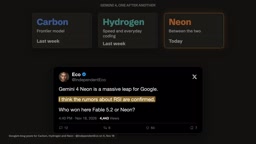
Gemini 4 Neon Released: Beats Opus 5.5 on Multiple Benchmarks, Google Returns to the Top Tier
Google DeepMind releases Gemini 4 Neon: 61 on the Artificial Analysis intelligence index (3rd) and 1st on the coding index, beating Opus 5.5 on multiple benchmarks. $3/$15 per million tokens; available in the Gemini API and AI Studio.
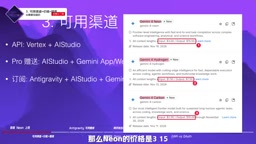
Gemini 4 Neon Review: Benchmark Scores Rival Carbon, API Cost-Performance Analysis
Full review of Google Gemini 4 Neon: benchmark scores rival Carbon, API priced at 2x Hydrogen, yet Antigravity quota consumption is only 1x (vs Carbon's 3x). Real tests show it replaces 90% of Carbon use cases. Includes channel restrictions, ban risks, and combination strategy analysis.