Gemini 4 Neon Released: Beats Opus 5.5 on Multiple Benchmarks, Google Returns to the Top Tier

Google released three models in a week; Gemini 4 Neon ranks third overall and first on the coding index, with standout value for money.
In just over a week, Google DeepMind released Carbon, Hydrogen, and Gemini 4 Neon in quick succession — an unusual pace. Neon is positioned as upper mid-range, balancing frontier intelligence with fast task completion. It ranks third on the Artificial Analysis intelligence index with 61 points, ahead of Opus 5.5, and takes first place on the coding index. On coding benchmarks, it scores 65.4% on Cursor Bench 4.1 versus Opus 5.5's 58.1%, falling slightly behind only on Terminal Bench and Frontier Code; it also leads in knowledge work and cybersecurity. Priced at $3 input / $15 output per million tokens with a 1M token context, its per-task cost is about half that of Opus 5.5. Hands-on tests show clearly improved UI and design taste, with the gap to Fable 5.2 narrowed to the point of being hard to distinguish in blind tests. The author believes Google has pushed OpenAI out of the way to take the second seat.
Google DeepMind's recent release cadence has been somewhat unusual. According to a rundown by the YouTube channel World of AI, following last week's Carbon and Hydrogen models, Gemini 4 Neon launched this week. Three models in just over a week — a density rarely seen from Google. The video's author also says outright that many people (himself included) had been disappointed with Google's 2026 performance, and that in hindsight it looks more like a concentrated release after a period of "quiet R&D."
Positioning of Gemini 4 Neon: Between Mid-Range and Flagship
Neon is defined as a model that balances frontier intelligence with fast end-to-end task completion. The video's author classifies it as "upper mid-range": it isn't trying to go head-to-head with top-tier models like Fable, and its intended rivals are Opus and Sonic.
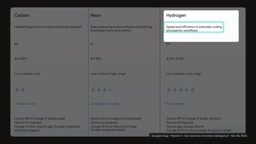
This positioning is visible in Google's own product line. Carbon targets the hardest long-horizon projects and deep research, effectively the frontier model; Neon focuses on software engineering, knowledge work, and deep reasoning in scientific domains; Hydrogen takes on the speed and efficiency tasks in everyday coding and GenTech workflows. You may not have noticed, but Argon — released just a few weeks ago — no longer appears in the official positioning chart. Releases are so fast that the previous generation gets turned over quickly.
Benchmarks: Third Overall, But First on the Coding Index
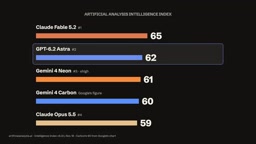
On the Artificial Analysis intelligence index, Neon scores 61, placing third — behind Fable 5.2 and GPT 6.2 Astra (62), released just the day before — but ahead of Opus 5.5's 59. Interestingly, Google's own Carbon, released last week, scores only 60 and is overtaken by Neon.
What really excited the video's author is the Artificial Analysis coding index — Neon took first place.
Specifically for coding benchmarks:
- Cursor Bench 4.1: Neon 65.4%, Opus 5.5 at 58.1%
- Terminal Bench 4.1: Neon 65.5, just 0.6% behind Opus 5.5
- Frontier Code 2.0: Neon 46.2%, Opus 5.5 at 47.3%
In other words, in a direct comparison with Opus 5.5, Neon wins nearly across the board, falling slightly behind only on Terminal Bench and Frontier Code.
The gap is even more pronounced in knowledge work scenarios: on Automation Bench, Neon scores 56.3%, while Opus 5.5 sits at just over 40. In cybersecurity, Neon also outperforms Opus 5.5 and GPT 6.2 Sol, and Google claims better alignment — a notable bright spot among models in this tier.
The Artificial Analysis intelligence index is a third-party model evaluation aggregator that produces a single composite score by weighting and aggregating multiple standardized benchmarks (such as MMLU, GPQA, HumanEval, etc.), making it easy to compare models from different vendors side by side. Its coding index focuses on tasks like code generation, debugging, and terminal operations, with weights skewed toward software engineering capability. Because vendors release on different schedules, index rankings change frequently, and different versions may use different evaluation sets, so small differences in scores (e.g., 1-2 points) generally shouldn't be over-interpreted — pay more attention to specific sub-scores.
Price and Speed: Expensive for Good Reason, Fast Like Flash
Neon is priced at $3 per million input tokens and $15 per million output tokens, with a 1 million token context window. Placed within the product line: Carbon sits at the $4.20 tier (currently on promotion at $2 input / $10 output), and Hydrogen is the cheapest at $1.50 input / $7.50 output.
On per-task cost, Fable 5.2 comes to about $26, Neon to $6.44, and GPT 6.2 Astra is cheaper still at just $4.
In a same-prompt test against Opus 5.5 (both set to the highest reasoning tier): Neon took about 20 minutes and cost $3.50; Opus took 18 minutes and cost $7.20. Opus was two minutes faster but twice the cost. The video's author rates Neon's output detail richness as the best in the Gemini 4 family, even better than Carbon and Hydrogen.
On speed, Hydrogen remains the fastest in the family, but Neon strikes a better balance between intelligence and speed — in the author's words, "the best of both." On thinking tiers, Neon supports four levels — extra-high, high, medium, and low — while Carbon, oddly, lacks an extra-high mode.
Context window refers to the maximum number of tokens a model can process in a single call. One million tokens means you can input roughly 750,000 English words or an entire medium-sized codebase at once — suitable for long-document analysis, multi-file code review, and similar scenarios. Note, however, that a long context doesn't equal effective utilization — models typically recall information in the middle of the window less reliably than at the beginning and end, so inputs still need to be organized sensibly in practice. In addition, pricing is billed separately for input and output tokens, with output usually more expensive because generation involves more computation; task cost is also affected by reasoning tier, since enabling extra-high thinking mode produces more internal reasoning tokens and thus drives up costs.
Hands-On Demos: Design Taste Has Clearly Improved
In the Voxel Pagoda test (extra-high thinking tier), the author describes Neon's interface design capability and attention to detail as "on another level," with elements like flames rendered more realistically — a marked improvement over the roughness typical of previous Google models. In the 3D seaplane test, UI issues have reportedly been fixed — this was once a weak spot for DeepMind models.

On one-shot coding mini-tests like a Flappy Bird clone, Neon produces results in five minutes, faster than Hydrogen, consistent with its higher-intelligence positioning.
Of course, in a head-to-head against Fable 5.2, Fable still edges ahead, with a more cohesive overall character feel. But the author thinks the gap is no longer large — "in a blind test, most people probably couldn't tell which is which." And in the 3D scene test, the author personally prefers Carbon's output.
Tests like Voxel Pagoda and the 3D seaplane fall into the "one-shot coding" or "visual generation" category of evaluation: the model is given a single natural-language description and asked to output directly runnable HTML/JS or 3D scene code. These tasks offer no opportunity for iterative debugging, so they give a fairly intuitive picture of a model's grasp of UI layout, lighting, and physical intuition. The Flappy Bird clone tests rapid prototyping ability. It should be noted that such demos are highly subjective, and differences in output style between models can be misread as capability gaps — only batch blind testing carries real statistical weight.
Availability and Competitive Landscape
Neon is available through the Gemini API (paid tier), Google AI Studio, and Android Studio; Google AI Pro and Ultra subscribers can also try it in Anti-Gravity. Carbon is limited to Google AI Ultra, while Hydrogen is open to all users.
The author's read on the landscape is blunt: Google has pushed OpenAI out of the way to take the second seat, with the current order being Anthropic, Google DeepMind, OpenAI. That conclusion is clearly personal, but combined with the release cadence of three models in a week, Google has indeed returned to the center of the table.
Whether this pace can be sustained, and whether there's a deeper methodology behind it (the video even half-jokingly mentions "recursive self-improvement"), there are no answers yet. But at least judging from benchmarks and hands-on tests, Neon is a model worth adding to your everyday toolchain.
The paid and free tiers of the Gemini API differ in rate limits, available models, and context length; Google AI Studio is a web-based debugging environment for developers to call models directly and adjust parameters; the Android Studio integration makes it convenient for mobile developers to use the model in built-in assistant scenarios. Anti-Gravity is Google's experimental entry point for subscribers, typically used for early access to new models. Splitting the product line by subscription tier (Carbon exclusive to Ultra, Neon available to Pro and above, Hydrogen open to all) is a common commercialization strategy aimed at using flagship models to drive high-end subscriptions while using mid-range models to expand the user base.
One-line Summary
Google released three models in one week; Gemini 4 Neon ranks third overall and first on the coding index, with standout value for money.
Paragraph Summary
In just over a week, Google DeepMind released three models in succession — Carbon, Hydrogen, and Gemini 4 Neon — an unusual pace. Neon is positioned as upper mid-range, balancing frontier intelligence with fast task completion. On the Artificial Analysis intelligence index it ranks third with 61 points, ahead of Opus 5.5, and takes first place on the coding index. Among coding benchmarks, it scores 65.4% on Cursor Bench 4.1, well ahead of Opus 5.5's 58.1%, falling slightly behind only on Terminal Bench and Frontier Code; it also leads in knowledge work and cybersecurity. Priced at $3 per million input tokens and $15 per million output tokens, with a 1 million token context, its per-task cost is about half that of Opus 5.5. Hands-on tests show clearly improved UI and design taste, narrowing the gap with Fable 5.2 to the point of being hard to distinguish in blind tests. The author believes Google has pushed OpenAI out of the way to take the second seat.
Related articles

Gemini 4 Hydrogen Hands-On: Google's Fastest and Cheapest AI Model
Hands-on with Gemini 4 Hydrogen: the fastest, cheapest model in the Gemini 4 family. We break down the Carbon/Argon/Hydrogen split, API pricing traps, free-tier limits, and the cost trade-offs of four thinking levels—with a real bug-debugging demo.

Gemini 4 Hydrogen vs Sonnet Comparison Test: Uses Only 1% of Weekly Quota, Performance on Par
Hands-on test: Gemini 4 Hydrogen vs Sonnet on the same CRUD task—Hydrogen used only 1% weekly quota with comparable performance and better UI details, while Anthropic's model used 7%. Developer says daily tasks don't require expensive models.
Gemini 4 Neon Review: Benchmark Scores Rival Carbon, API Cost-Performance Analysis
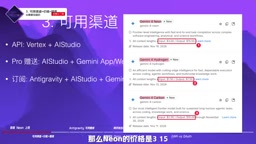
Full review of Google Gemini 4 Neon: benchmark scores rival Carbon, API priced at 2x Hydrogen, yet Antigravity quota consumption is only 1x (vs Carbon's 3x). Real tests show it replaces 90% of Carbon use cases. Includes channel restrictions, ban risks, and combination strategy analysis.