A Breath of Fresh Air in the AI Era: Human Mathematician Claims Proof of the Generalized Riemann Hypothesis
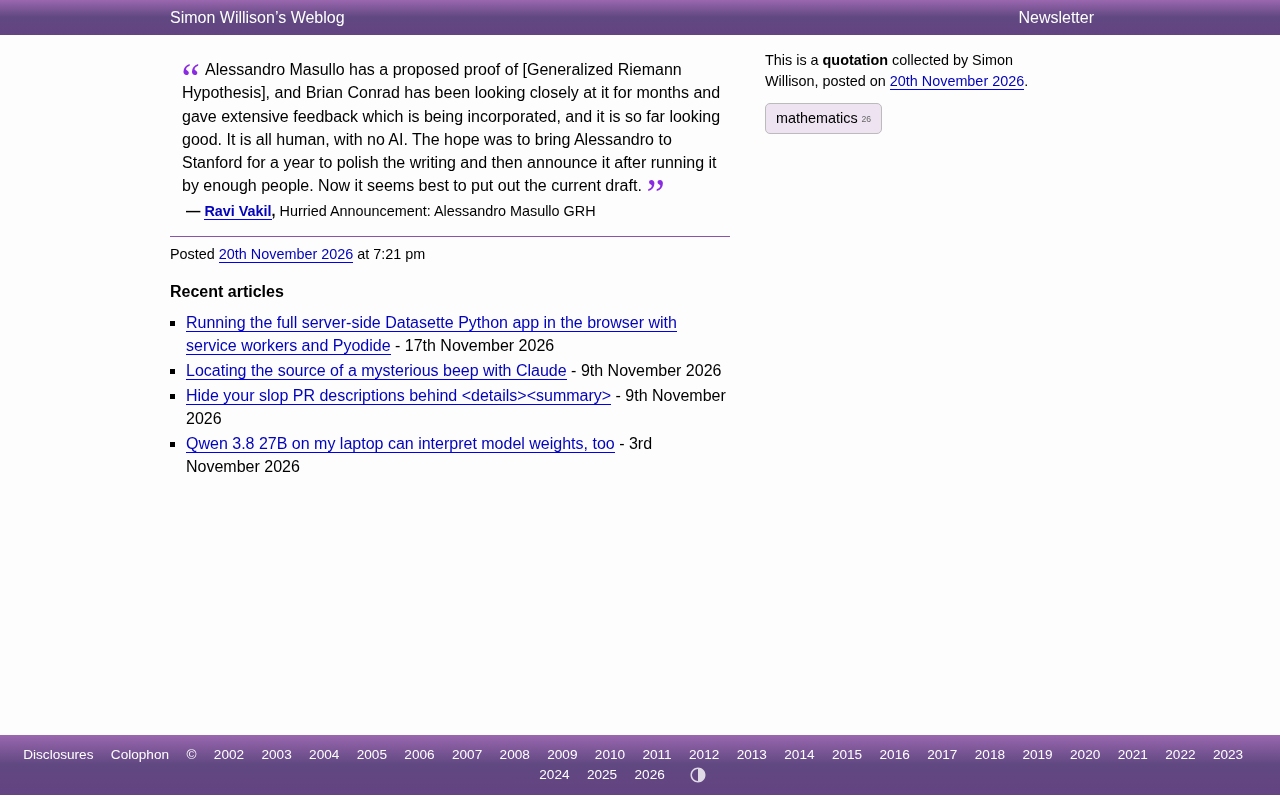
Mathematician Alessandro Masullo proposed a proof of the Generalized Riemann Hypothesis, done entirely by humans without AI.
Ravi Vakil announced on his blog that Alessandro Masullo has given a proof of the Generalized Riemann Hypothesis (GRH), emphasizing that it was completed entirely by humans without AI. Brian Conrad has carefully reviewed it for months and provided extensive feedback, which is being incorporated; Vakil says it is "so far looking good." The original plan was to invite Masullo to Stanford for a year of polishing before announcing, but they decided to release the current draft early. GRH is a conditional premise for many theorems in modern number theory and has far-reaching influence. The proof still needs further community review, and Vakil's wording is cautious. The affair has also sparked discussion about the roles of human intelligence and AI tools in mathematics.
When the Math World Hears News of a "Human Proof"
At a time when AI seems to make new breakthroughs almost every week, mathematician Ravi Vakil posted an "urgent announcement" on his personal blog: Alessandro Masullo has proposed a proof of the Generalized Riemann Hypothesis (GRH). What makes this news most striking is not the weight of the conjecture itself—that is already recognized as a top-tier problem in mathematics—but a line Vakil specifically emphasized: "This is entirely a human achievement, with no AI used."
In today's context, that sentence carries a particular resonance. Over the past while, AI's presence in mathematics has grown increasingly strong: from assisting with conjecture generation to formal proof verification, all kinds of tools keep emerging. Vakil's statement reads like drawing a clear boundary around this AI boom—at least this time, human intelligence stands alone at center stage.
The Review Process Behind the Proof
According to Vakil's description, this was not a spur-of-the-moment affair. Brian Conrad—a mathematician known for his rigor—has "studied it carefully for several months" and provided extensive feedback, which is currently being incorporated into the proof. Vakil's exact words were "so far looking good."
This detail is worth savoring. Reviewing a mathematical proof is never an easy task, especially for a conjecture as far-reaching as GRH. Conrad's months of investment and "extensive feedback" indicate that this proof is undergoing quite rigorous peer scrutiny rather than being released hastily. Vakil's choice of "looking good" is cautious wording—it expresses confidence while leaving room for doubt.
In the mathematics community, peer review is the key step by which research results gain recognition. Unlike many disciplines, reviewing a mathematics paper often requires reviewers to deeply understand and verify every step of the proof's logic, making it extremely time-consuming—especially for major conjectures. Typically, the review cycle for a top-tier mathematics paper can last one to two years. For a problem like GRH, reviewers must check whether the proof implicitly relies on unproven assumptions, whether there is circular reasoning, and whether the key steps are reproducible. As an authority in number theory, Brian Conrad's months of investment and extensive feedback reflect the mathematics community's cautious attitude toward major results. In addition, the mathematics community has an informal "community review" mechanism: before formal publication, drafts of proofs circulate within a small circle for informal peer scrutiny. This mechanism helps uncover potential problems as early as possible.
Why Go Public "Hastily"
In his announcement, Vakil revealed the original plan: invite Masullo to Stanford for a year, polish the writing, and then formally announce after enough people had reviewed it. That is a fairly prudent path, consistent with the mathematics community's customary caution toward major results.
But plans can't keep up with changes. Vakil did not elaborate on what prompted them to change their minds, only saying that "the best thing to do now seems to be to put the current draft out." Behind this "haste" may be a concern about priority, or a hope to involve the community as early as possible. Whatever the reason, this decision means the outside world will see a version that is not yet fully polished—the writing may not be refined enough, but the core ideas are already on the table.
The Weight of the Generalized Riemann Hypothesis
For readers unfamiliar with number theory, it is worth explaining the weight of GRH. The Riemann Hypothesis itself concerns the distribution of the non-trivial zeros of the Riemann zeta function, and the Generalized Riemann Hypothesis extends it to a broader class of L-functions. It is a conditional premise for many results in modern number theory—a large number of theorems begin with "assuming GRH holds."
If Masullo's proof stands up to scrutiny, its impact will far exceed a single conjecture and could shake the foundations of algebraic number theory, analytic number theory, and even cryptography. This is also why Vakil's announcement, though brief, attracted attention in the mathematical community.
An L-function is a broad generalization of the Riemann zeta function, constructed from so-called "local factors" via an Euler product, where these local factors encode local information at the primes. The most typical example is the Dirichlet L-function, which is associated with Dirichlet characters modulo q. More generally, automorphic L-functions (such as those associated with modular forms) occupy a central place in the Langlands program. GRH asserts that for all these L-functions, their non-trivial zeros lie on the critical line Re(s)=1/2. Unlike the classical Riemann Hypothesis, verifying GRH requires handling infinitely many L-functions, and the analytic properties of each L-function (such as the functional equation and analytic continuation) must be established separately. This makes proving GRH in some sense far harder than the classical Riemann Hypothesis, because it demands unified treatment of a huge class of objects.
The Divide Between Human Intelligence and AI Tools
Back to that phrase "no AI." Today, as AI-assisted proof tools mature, this sentence is both a statement of fact and an expression of attitude. It reminds people that the core of mathematical proof—insight, intuition, deep understanding of structure—remains the territory of the human mind.
Of course, this does not mean AI is insignificant in mathematics. Formal verification, large-scale computation, conjecture search—AI has already shown its value in these areas. Vakil's emphasis is more like saying: this breakthrough is owed to human mathematicians' months of thought and polishing, not to algorithmic output.
Formal verification refers to using computer programs (such as the proof assistants Coq, Lean, Isabelle, etc.) to translate mathematical proofs into machine-checkable formal code, thereby ensuring that every step of logical deduction is strictly correct. In recent years, AI has shown potential in formal verification, for example by using machine learning to assist automated theorem proving. However, formal verification itself does not generate new mathematical insights; it only verifies the correctness of existing proofs. Conjecture search refers to using computational power and heuristic algorithms (including AI) to find patterns or counterexamples in massive data sets, such as searching in number theory for primes or zeros satisfying certain properties. Large-scale computation is often used for numerical verification, such as computing the positions of zeros of L-functions to test whether GRH holds within a finite range. These tools assist mathematicians in exploration, but the core construction of a proof—that is, discovering the ideas and structure of the proof—still depends on human creativity and intuition. Vakil's statement precisely emphasizes that the proof construction in this breakthrough did not rely on any of the above AI tools.
What Happens Next
The current draft is now public, and the most critical next step is community review. The history of mathematics is full of proofs that seemed valid but were eventually found to have gaps—all the more so for a problem like GRH. Conrad's feedback is being incorporated, and more eyes are about to join the scrutiny.
Vakil's announcement is restrained and candid: no overhyping, no dodging uncertainty. This attitude itself may be exactly how the mathematics community should treat major results—let the proof speak, let review test it, and let time give the answer.
For those interested in the intersection of AI and mathematics, this affair offers an interesting case study: when human intelligence alone achieves a major breakthrough, how should we view AI's place in it? The answer may not lie in either-or thinking, but in recognizing each side's strengths and boundaries.
One-line Summary
Mathematician Alessandro Masullo has proposed a proof of the Generalized Riemann Hypothesis, achieved entirely by humans without AI.
Paragraph Summary
Ravi Vakil announced on his blog that Alessandro Masullo has given a proof of the Generalized Riemann Hypothesis (GRH), specifically emphasizing that the proof was completed entirely by humans without AI. Brian Conrad has carefully reviewed it for several months and provided extensive feedback, which is currently being incorporated; Vakil says it is "so far looking good." The original plan was to invite Masullo to Stanford for a year of polishing before announcing, but they decided to release the current draft early. GRH is a conditional premise for many theorems in modern number theory and has far-reaching influence. The proof still requires further community review, and Vakil's wording is cautious. The affair has also sparked discussion about the respective roles of human intelligence and AI tools in mathematics.
Related articles

VP ≠ VNP: A Major Breakthrough in Computational Complexity Theory
A study claiming to prove VP ≠ VNP over every field sparks heated discussion on Hacker News. This article analyzes the algebraic complexity background of VP and VNP, the proof approach, community controversy, and its potential impact on computational complexity theory.

Developer Naming Woes: The Technical Names That Drive Us Crazy
Why is technical naming so maddening? From Nginx and Vite to Qt and Sudo, a YouTube creator rants about the chaos of developer naming and pronunciation, revealing the tug-of-war between creators' intentions and community habits, and the cultural roots behind spelling traps like PyPI and GNOME.

Figma Workplace Scandal: Employee Sues CEO for Forcing Confrontation with Harasser
Figma and its CEO are sued by a current employee alleging sexual harassment and discrimination, and forcing the victim to confront her harasser. This article outlines the background, potential impact, and industry reflection.