Developer Naming Woes: The Technical Names That Drive Us Crazy

Technical tool naming and pronunciation are chaotic, with frequent disputes between creators and community habits.
Through real cases, the article reveals common pronunciation traps in technical naming. From Nginx, Vite, Qt to Sudo, GIF, PyPI, and GNOME, the "correct" pronunciations often differ greatly from popular habits, and even creator-defined pronunciations spark lasting controversy. The chaos stems from personal preferences, abbreviation games, global accents, and lack of acronym rules, increasing learning and communication costs. But these controversies also form part of tech culture, becoming community fodder. Ultimately, developers aren't bad at naming—they're too good at creating names with stories.
Title
Developer Naming Woes: The Technical Names That Drive Us Crazy
Meta Description
Why is technical naming so maddening? From Nginx and Vite to Qt and Sudo, a YouTube creator rants about the chaos of developer naming and pronunciation, revealing the tug-of-war between creators' intentions and community habits, and the cultural roots behind spelling traps like PyPI and GNOME.
Article Content
There's a saying in tech circles: the two hardest problems in computer science are cache invalidation and naming. And developers have clearly stumbled on the latter. Recently, a YouTube creator used a series of real-world examples to rant about the laughably confusing pronunciation traps in technical naming. From Nginx to Vite, from Qt to Sudo, these tools we use every day often have their names mispronounced—even by their creators themselves.
Pronunciation Controversies: When Even Creators Get It Wrong
The video opens with a classic case: Nginx. This web server powering a large chunk of the internet is commonly pronounced "Engine-X," but the creator points out it should actually be pronounced "Nginx"—of course, that itself is a pronunciation joke. Even more surprising is Vite, the beloved front-end build tool. Many people say "Vite" (rhyming with "kite"), but the correct pronunciation is "Veet" (like the French word for "fast").
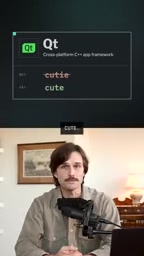
Similarly, there's Qt, the C++ desktop application framework. Most people split it into the letters "Q-T," but the official pronunciation is actually "Cute." This naming logic leaves beginners baffled but helpless.
The name Nginx originates from its early developer Igor Sysoev, where "ng" is often interpreted as an abbreviation of "engine," and "inx" is a Unix-like suffix. Although the official pronunciation was never formally specified, the community widely adopted "Engine-X," which is actually a pun based on reading the letters literally. In fact, Sysoev himself said in an interview that he originally wanted to name it "ngin-x" (like "en-gin-X"), but when finalizing Nginx, he didn't insist on a specific pronunciation. So the so-called "correct pronunciation" is more a result of community convention than an official mandate. This ambiguity is precisely a common phenomenon in technical naming: the creator gives the name a vague semantic starting point, and users reinterpret it based on intuition and habit.
Creators' Obsessions: The "Official Pronunciations" of GIF and Sudo
If spelling rules can still be guessed, then creators stepping in to define pronunciation makes things even more tangled. The video mentions that the creator of Sudo allegedly pronounces it "Sudo" (like "soo-doh"), while the general public says "soo-doo." It's like the inventor of GIF insisting on "Jif" (like the peanut butter brand), but the whole world says "GIF" (with a hard G).
Behind such controversies is actually a tug-of-war between technical community conventions and original naming intent. Creators have the right to define, but user habits are often stronger.
The GIF pronunciation controversy is arguably one of the most famous "naming wars" in tech. GIF stands for Graphics Interchange Format, and its creator Steve Wilhite stated in a 2013 New York Times interview that it should be pronounced "Jif" (like the peanut butter brand Jif), because his design inspiration came from Jif's slogan "choosy mothers choose Jif." However, since the hard G sound (as in "gift") is more common in English, and GIF is an acronym, the public generally leans toward the hard "GIF." This controversy even prompted public figures and institutions like Obama and the UK Prime Minister's Office to weigh in. From a linguistic perspective, acronym pronunciation usually follows the principle of "readability first": if spelling out the letters is smoother, people choose letter sounds; if pronouncing it as a word is more natural, they choose that. GIF happens to fall in between, so the controversy persists.
Spelling Traps: The Confusion of PyPI, GNOME, and Omachi
The video also lists several examples where spelling and pronunciation are completely disconnected. The Python Package Index, PyPI, is often read as "Py-Py," but the creator points out that PyPI is another project, and this should be pronounced "Pie-Pie-Eye." This ambiguity in letter combinations makes beginners stumble frequently when searching.

The Linux desktop environment GNOME, based on the GNU project, should logically be pronounced "Guh-Nome" (like "guh-nohm"), but the public habitually says "Nome" (like "nohm"). The creator quips, "I completely don't understand why tech people are so bad at pronouncing GNU."
There's also Omachi (or Omarki?). The creator himself admits he tends to say "Omarki," but the correct pronunciation is supposedly "Omachi." Ultimately he chooses "Omachi" as a compromise—which perfectly reflects the art of compromise in technical naming.

The GNU project's name is itself a recursive acronym (GNU's Not Unix), pronounced "Guh-NOO" (hard G), as explicitly specified by Richard Stallman when he launched the project in 1983. GNOME, as part of the GNU project, should also follow the hard G pronunciation, i.e., "Guh-NOME." However, since the "gn" combination at the beginning of a word is usually pronounced "n" in English (as in the word gnome itself, pronounced "nome," meaning "dwarf"), the public naturally leans toward "Nome." This conflict stems from the mismatch between English spelling rules and the project's naming intent. Stallman has repeatedly emphasized the hard G pronunciation of GNU, but with little effect, reflecting the limits of creator authority in the face of community habits. Similarly, PyPI's official pronunciation is "Pie-Pee-Eye," i.e., reading each letter, but many mistakenly think it's "Py-Py" (like "pie-pie"), because the abbreviation "Py" for Python is often read as "pie." This ambiguity indeed easily causes confusion in search and verbal communication.
The Roots and Impact of Naming Chaos
Why is technical naming so chaotic? On one hand, project names often stem from creators' personal preferences, abbreviation games, or cultural memes, lacking unified standards; on the other hand, accent differences in global communities amplify disagreements. This chaos is not harmless: it increases learning costs, leads to communication misunderstandings, and even affects search efficiency.
But viewed from another angle, these pronunciation controversies have also become part of tech culture. Like the GIF "Jif" debate, every discussion sparks a wave of community interaction. Perhaps developers aren't "bad at naming," but rather too good at creating names with stories—it's just that these stories require a bit of humor to digest.
The chaos in technical naming is also related to the lack of "acronym pronunciation rules." In English, acronyms are usually read in two ways: letter by letter (like API, CPU) or as a word (like NASA, LASER). The choice often depends on pronunciation convenience and community habit, not a unified standard. For example, SQL's official pronunciation is "S-Q-L," but many say "Sequel," the latter stemming from its predecessor SEQUEL's pronunciation. This divergence leads to the common phenomenon in tech communities of "different pronunciations but same reference," increasing friction in cross-cultural communication. Moreover, in a globalized context, accent differences among non-native English speakers further amplify pronunciation divergence—for instance, Japanese speakers might say Vite as "维特" (wēitè), while French speakers are closer to "Veet." These factors combined make technical naming a topic full of stories and controversy.
One-line Summary
Technical tool naming and pronunciation are chaotic, with frequent disputes between creators and community habits.
Paragraph Summary
Through a series of real cases, the article reveals common pronunciation traps in technical naming. From Nginx, Vite, Qt to Sudo, GIF, PyPI, and GNOME, the "correct" pronunciations of these everyday tools often differ greatly from popular habits, and even pronunciations defined by creators themselves spark lasting controversy. The article points out that naming chaos stems from creators' personal preferences, abbreviation games, global accent differences, and the lack of acronym pronunciation rules, increasing learning and communication costs. But from another perspective, these controversies also form part of tech culture, becoming fodder for community interaction. Ultimately, the article humorously reminds readers: perhaps developers aren't bad at naming—they're just too good at creating names with stories.
Related articles

VP ≠ VNP: A Major Breakthrough in Computational Complexity Theory
A study claiming to prove VP ≠ VNP over every field sparks heated discussion on Hacker News. This article analyzes the algebraic complexity background of VP and VNP, the proof approach, community controversy, and its potential impact on computational complexity theory.

Figma Workplace Scandal: Employee Sues CEO for Forcing Confrontation with Harasser
Figma and its CEO are sued by a current employee alleging sexual harassment and discrimination, and forcing the victim to confront her harasser. This article outlines the background, potential impact, and industry reflection.

Jensen Huang and Nvidia: Elite Privilege Behind the Revolving Door of Business and Politics
An opinion piece uses Jensen Huang's reappointment as Nvidia CEO to examine business-government ties and elite impunity, questioning free-market ideals and AI industry governance.