A Complete Guide to Building an Open-Source AI Agent for Automated Video Generation from Scratch
A complete guide to building an automated video generation pipeline using open-source AI models and Agent frameworks.
This guide walks through building an AI Agent that automatically generates videos using open-source models. It covers the full architecture — from data scraping with tools like SearxNG, to script generation with Llama 3/Qwen2.5, to video synthesis using CogVideoX, Stable Diffusion, and FFmpeg. It compares Agent orchestration frameworks (LangGraph, CrewAI, AutoGen), clarifies the difference between video understanding and generation models, and provides a practical minimum viable path for developers to get started.
Automated Video Generation: An AI Automation Challenge Worth Exploring
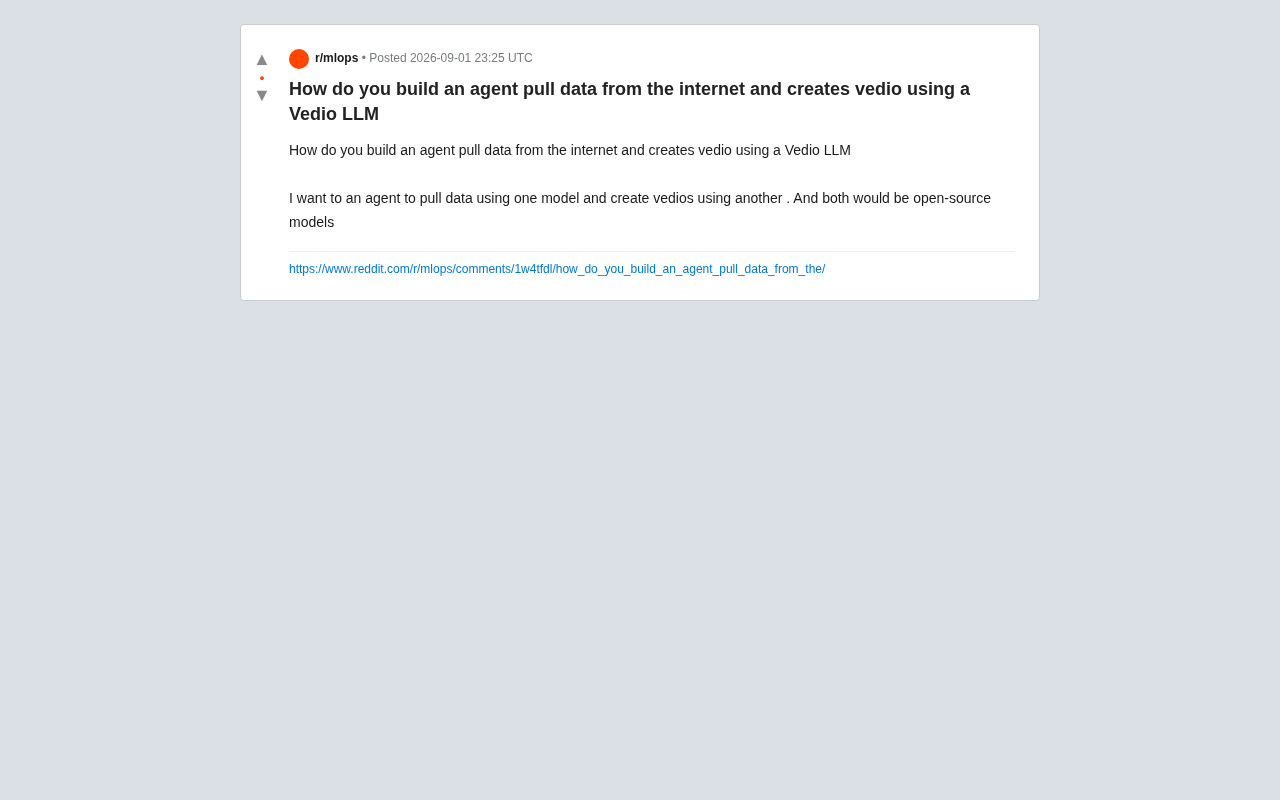
I recently came across a highly representative question on the Reddit community: how to build an AI Agent that can scrape data from the internet and automatically generate videos using a Video LLM? The poster specifically emphasized that the entire pipeline should be based on open-source models — one model for data collection and another for video generation.
This requirement sounds simple, but it actually touches on some of the hottest areas in AI engineering today: Agent orchestration, multimodal generation, and the composability of the open-source ecosystem. This article will break down how to build such an automated video production pipeline from an architectural design perspective.
Overall Architecture Design for an AI Video Generation Agent
The core idea behind building this type of Agent is to decompose the overarching goal of "from data to video" into several independently executable, orchestratable subtasks. A typical video generation pipeline usually includes the following stages:
Data Collection Layer: Gathering Raw Materials from the Internet
This layer is responsible for scraping raw information from the internet. You can accomplish this through search APIs, RSS feeds, web crawlers, or by calling tools with internet search capabilities (such as SearxNG, Serper, etc.).
SearxNG is an open-source metasearch engine that doesn't maintain its own index but simultaneously queries multiple search engines (Google, Bing, DuckDuckGo, etc.) and aggregates the results. Users can self-host it to protect their privacy. Serper is a commercial Google Search API wrapper service that provides structured JSON search results, making it ideal for tool calls within Agent workflows. RSS (Really Simple Syndication) is a standardized content subscription protocol still supported by numerous news sites and blogs, serving as a cost-effective means of continuously obtaining domain-specific content updates.
In practice, the data collection layer often needs to handle anti-scraping mechanisms, rate limiting, and data deduplication. These seemingly trivial engineering details often determine the stability of the entire pipeline. The output from this step is typically text, image links, or structured data.
Understanding & Planning Layer: Generating Video Scripts with Language Models
The raw data collected is usually messy and disorganized, requiring a language model to clean, summarize, and scriptify the content. Open-source models like Llama 3, Qwen2.5, and Mistral are all well-suited for this role — they're responsible for distilling raw information into a video script (storyboards, narration copy, key scene descriptions).
Llama 3 is an open-source large language model series released by Meta in 2024, available in multiple parameter sizes including 8B and 70B. It excels in reasoning, coding, and text generation tasks, and its permissive license has made it one of the most active foundation models in the open-source community. Qwen2.5 is a model series from Alibaba's Tongyi Qianwen team, covering parameter ranges from 0.5B to 72B. It's particularly strong in bilingual Chinese-English tasks and features dedicated optimizations for long-context processing. The Mistral series, developed by French AI company Mistral AI, employs architectural innovations such as Sliding Window Attention and Grouped Query Attention (GQA), enabling the model to achieve performance close to much larger models at smaller parameter counts. All three model series support local deployment via inference frameworks like Ollama and vLLM, giving developers the option to operate independently of cloud APIs.
Video Generation Layer: The Core Step from Text to Video
This is the most critical and technically challenging component. True "Video LLMs" are still in a rapid development phase, and the available open-source options include:
-
Text-to-Video: Open-source video diffusion models like CogVideoX, Open-Sora, and Mochi can directly generate short video clips from text prompts. CogVideoX is a video generation model open-sourced by Zhipu AI, built on a 3D causal VAE and expert Transformer architecture, supporting both text-to-video and image-to-video generation modes. Open-Sora is an open-source project by the HPC-AI Tech team aimed at replicating OpenAI Sora's technical approach, using a DiT (Diffusion Transformer) architecture that models video as spatiotemporal token sequences. Mochi, open-sourced by Genmo, was among the first models to introduce Asymmetric Diffusion Transformer architecture to video generation. The underlying principle of all these models is based on Diffusion Models — learning to generate data through a progressive denoising process — but extending this from 2D images to 3D spatiotemporal domains causes computational and memory requirements to grow by orders of magnitude.
-
Image + Voiceover Synthesis: A more reliable approach is to first generate keyframes using text-to-image models (Stable Diffusion / FLUX), then generate narration using TTS (such as Coqui, Bark), and finally stitch everything together into a video using FFmpeg. Stable Diffusion is a text-to-image generation model open-sourced by Stability AI, based on Latent Diffusion technology that first encodes images into a low-dimensional latent space before performing denoising generation, significantly reducing computational costs. FLUX is a next-generation text-to-image model from Black Forest Labs, founded by former core members of the Stable Diffusion team, offering significant improvements in image quality, text rendering, and prompt adherence over its predecessors. In the TTS space, Coqui TTS is an open-source speech synthesis framework supporting multiple languages and voice cloning, built on end-to-end speech synthesis architectures like VITS. Bark is a text-to-audio generation model open-sourced by Suno AI that can generate not only speech but also laughter, sighs, and even background music, using a GPT-like autoregressive Transformer architecture to predict audio tokens. FFmpeg is the Swiss Army knife of audio-video processing — virtually every video editing software relies on its encoding and decoding capabilities under the hood.
A Reality Check on Video LLMs
The term "Video LLM" mentioned in the original question is a concept that can easily lead to misunderstanding and deserves some clarification. Strictly speaking, video large models fall into two categories:
The Difference Between Video Understanding Models and Video Generation Models
The first category is video understanding models (such as Video-LLaVA, Qwen-VL), which take video as input and output text, excelling at "understanding what a video is about." Video-LLaVA is a multimodal model extended from the LLaVA (Large Language-and-Vision Assistant) architecture, introducing temporal modeling capabilities into the visual encoder so that the language model can understand dynamic information in videos. Qwen-VL is the vision-language version of Tongyi Qianwen, supporting multimodal understanding of both images and video, capable of answering complex questions about video content. The core technical challenge for both model types lies in how to efficiently compress a video's many visual frames into token sequences that a language model can process — common methods include uniform keyframe sampling, Temporal Pooling, and dynamic resolution encoding.
The second category is video generation models, which take text or images as input and output video footage. What the original poster wants is clearly the latter. Understanding the distinction between these two model types is crucial for architecture design: video understanding models can be used to analyze and annotate existing video assets, while video generation models are the core component for producing new content. In a complete video generation Agent, the two can complement each other — generation models create content while understanding models handle quality assessment and automated review.
Currently, open-source video generation models still have notable limitations in duration, resolution, and coherence — most can only generate a few seconds of footage and have high memory requirements (often requiring 24GB+ of GPU VRAM). Mainstream open-source video generation models typically produce clips of 2-10 seconds at 480p-720p resolution, which is the core reason why segmented stitching approaches are commonly used in practice. Therefore, in engineering practice, a hybrid approach of "multi-segment stitching + narration voiceover" tends to be more pragmatic and stable than pursuing end-to-end pure video generation.
Orchestrating Multimodal Video Generation Workflows with Agent Frameworks
With model selections in place for each layer, you still need a "brain" to coordinate their invocation order, handle exceptions, and pass intermediate results. This is exactly where Agent frameworks provide value.
Comparison of Popular Open-Source Agent Orchestration Tools
-
LangGraph / LangChain: Ideal for building stateful, multi-step workflows that can clearly define the node relationships of "scrape → summarize → generate → synthesize." LangGraph is a framework within the LangChain ecosystem specifically designed for building stateful, cyclical Agent workflows. It borrows from the concept of directed graphs (DAGs), defining each processing step as a node in the graph, with data flow and conditional branching between nodes connected via edges. Unlike traditional LangChain chain-style calls, LangGraph natively supports conditional routing, loop execution, and Human-in-the-Loop capabilities, making it well-suited for scenarios like video generation that require multiple iterations and error retries.
-
CrewAI: Designed around the concept of "multi-role collaboration," you can define a "Researcher" Agent responsible for gathering materials and a "Director" Agent responsible for generating the video, with clear separation of duties. CrewAI introduces a role-playing paradigm where each Agent is given a specific role definition, goals, and backstory. This design makes complex task decomposition more intuitive — for example, a "Researcher" Agent focuses on information gathering and fact-checking, while a "Director" Agent focuses on creative decisions and visual style control.
-
AutoGen: A multi-Agent conversation framework from Microsoft, suitable for complex scenarios requiring multiple models to negotiate back and forth. AutoGen's core design philosophy is to solve problems through multi-turn conversations between Agents. It supports dynamic code execution and tool use during conversations, making it particularly suitable for scenarios where multiple specialized models need to negotiate decisions, such as determining video style or iterating on script modifications.
With these frameworks, the entire system can organically orchestrate internet search, text models, image models, video models, and audio models together in the form of "tool calls." It's worth noting that the choice of Agent framework should be based on specific needs — if the workflow is relatively fixed, LangGraph's graph structure is the clearest; if you need flexible task decomposition and role collaboration, CrewAI is more intuitive; if there's extensive inter-model interaction and iterative optimization involved, AutoGen's conversation mechanism has the advantage.
Minimum Viable Path: Quickly Building a Video Generation Agent
For developers looking to quickly validate their ideas, it's recommended to start with a minimum viable approach rather than pursuing a fully open-source, fully automated perfect solution from the outset:
-
Data Retrieval: Use a search tool + locally deployed Qwen2.5 model for information retrieval and summarization. Local deployment can be done with a single click via Ollama, a tool designed specifically for running large language models locally. It wraps the entire process of model downloading, quantization, and inference serving, allowing developers to spin up a local inference endpoint compatible with the OpenAI API format with just one command.
-
Script Generation: Have the same language model output storyboard scripts and narration text. The key here is designing a well-structured output format (such as JSON Schema) to ensure that subsequent stages can automatically parse the visual description and corresponding narration for each scene.
-
Image Generation: Use FLUX or Stable Diffusion to batch-generate keyframe images. To ensure visual style consistency, you can include a unified style description in the prompts, or use control mechanisms like IP-Adapter or ControlNet to constrain the generated results.
-
Video Synthesis: Use open-source video models to generate dynamic clips, or directly use FFmpeg to combine image sequences + TTS narration into a video. While FFmpeg's command-line operations have a steep learning curve, its flexibility is unmatched — from simple image slideshows to complex transition effects, subtitle overlays, and audio track mixing, everything can be achieved through parameter combinations.
-
Orchestration & Scheduling: Use LangGraph to define the above workflow as an automatically executing graph. The graph can include conditional branches (e.g., automatic retries when generation quality falls below a threshold) and parallel nodes (e.g., simultaneously generating images for multiple scenes to improve efficiency).
Every component of this approach can be replaced with open-source models, satisfying the original poster's commitment to "open source" while ensuring feasibility on consumer-grade hardware. Hardware recommendations: a 12GB VRAM GPU (such as RTX 3060/4070) can run quantized language models and Stable Diffusion, while running video generation models requires at least 24GB VRAM (such as RTX 3090/4090).
Conclusion
Building an AI Agent for automated video generation is essentially an exercise in multimodal model orchestration engineering, not a search for some all-powerful "Video LLM." Today's open-source ecosystem already provides a rich enough set of building blocks — language models handle thinking, image and video models handle visualization, and Agent frameworks handle scheduling. The real challenge isn't in the capability of any single model, but in how to reliably and stably chain them together into an end-to-end pipeline.
From a broader perspective, this multi-model orchestration paradigm is becoming the mainstream trend in AI engineering. Rather than waiting for an omnipotent super model to emerge, it's better to learn how to combine multiple specialized models into a powerful system — this "Composite AI" approach applies not only to video generation but also to automated report generation, intelligent customer service, content moderation, and many other scenarios. For any developer looking to get into AI-powered automated content production, this is an excellent hands-on project to start with.
Related articles

Python 3.15 New Feature: Is the sentinel Type Better Than None?
Python 3.15 adds the sentinel type, using named unique sentinel objects to replace None and bare object(), resolving confusion among missing values, explicit emptiness, and invalid input while avoiding type hint failures.

Deep Learning's Three Architectures and the Universal Approximation Theorem: A Complete Guide to MLPs, CNNs, and Transformers
Explaining the inductive bias differences among MLP, CNN, and Transformer, the existence meaning of the Universal Approximation Theorem (UAT), and the role of Taylor expansion in approximation analysis, while clearing up common misconceptions.

GitLab Emergency Patch Release: Analysis of Critical Security Fixes
GitLab releases critical patch 19.5.1, sparking 355 points of discussion on Hacker News. This article analyzes the background, upgrade steps for self-hosted instances, and verification points to help DevOps teams respond quickly to security updates.