A Custom Font Based on the Jamaican Flag Alphabet: An Open-Source Type Design Experiment

An open-source conceptual experiment turning Jamaican flag elements into a custom font, emphasizing symbolic reinterpretation over practical typesetting.
This article covers a custom font project on Hacker News Show HN based on the Jamaican flag alphabet. It abstracts the flag's black, green, and gold colors and intersecting diagonals into glyph skeletons filled with triangular color blocks, prioritizing conceptual completeness over typographic practicality. The article analyzes why such projects appear on Hacker News and outlines the three-step technical path from flag elements to font files, along with common toolchains. Community feedback is limited (5 points, 1 comment), consistent with niche creative projects. It also discusses the subcultural and educational significance of open-source font experiments, noting that the original material is sparse and analysis relies on commonalities among similar projects.
A Custom Font Based on the Jamaican Flag Alphabet: An Open-Source Type Design Experiment
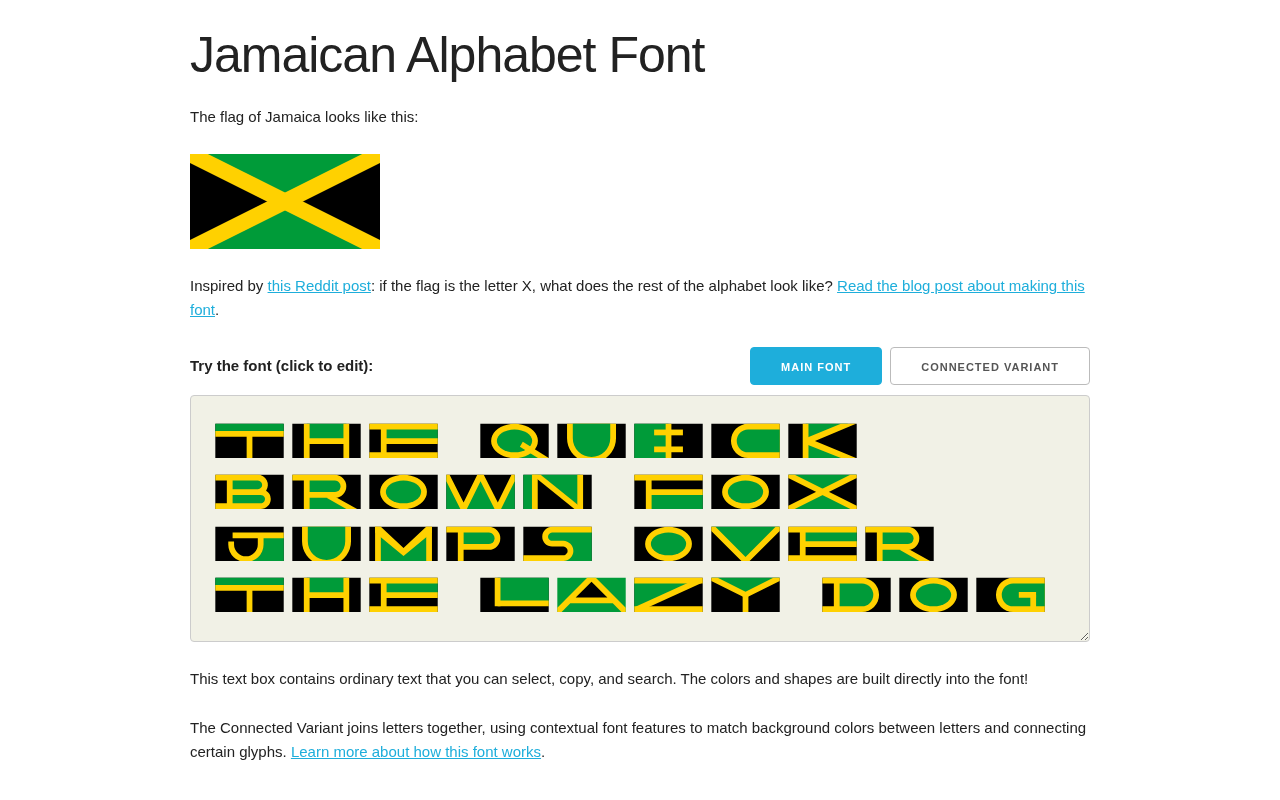
On Hacker News' Show HN section, a project called "A custom font based on the Jamaican flag alphabet" has drawn modest attention. The project transforms the visual elements of the Jamaican flag—black, green, and gold, along with the intersecting diagonals—into a complete alphabet and packages it as an installable font file. For type design enthusiasts and the open-source community, the value of such experiments lies not in commercial usability but in exploring the boundaries between symbol systems and visual language.
Why a Font Project Appears on Hacker News
Show HN has always been a window for developers to showcase side projects. Font design may seem far removed from the "hacker" ethos, but the underlying logic is the same: using technical means to solve a self-imposed constraint problem. The core idea of this project is to abstract the geometric structure of the flag into glyph skeletons, then generate the font library through font editing tools.
According to the project's release information, the font is directly inspired by the "alphabet" concept of the Jamaican flag—reinterpreting Latin letters using elements from the flag's design (such as the crossed X shape and triangular color blocks). The fun of this approach is that it forces the designer to maintain letter readability within an extremely limited visual vocabulary.
Judging from community feedback, the project received 5 points and 1 comment, indicating limited discussion. This is typical for niche creative projects on Show HN: narrow audience but precise. The few interactions in the comments also focused on technical details of font generation tools and character mapping.
Show HN is a subsection of the Hacker News community dedicated to showcasing personal projects. Users post with the prefix "Show HN:" to share works, experiments, or tools they have developed. The convention is that projects must be posted by their creators, with accessible links or descriptions so community members can try them and give feedback. Unlike the main Hacker News site, which emphasizes tech news and in-depth discussion, Show HN encourages hands-on practice and creative exploration, covering open-source software, hardware hacks, data visualization, and even font design. Community evaluation is usually reflected in upvotes (points) and comment counts; niche projects receiving single-digit points is common, but interactions from a precise audience tend to be more constructive.
How Flag Elements Are Transformed into Glyphs
Converting a flag into a font typically involves three steps: extracting the visual motif, defining glyph rules, and generating the font file. The Jamaican flag features gold intersecting diagonals that divide the field into four triangles—green on top and bottom, black on left and right. This font evidently uses the diagonals as core strokes and fills the counters with triangular color blocks.
The advantage of this design strategy is high recognizability—anyone who has seen the Jamaican flag can immediately make the visual connection. The cost is that differentiation between glyphs may be insufficient, especially for structurally similar letters (such as O and Q, C and G). The word "alphabet" in the project name suggests that the designer prioritized conceptual completeness over typographic practicality.
For developers wanting to replicate similar experiments, common toolchains include FontForge, Glyphs, or Python-based font generation libraries. The project did not disclose specific tools in the original information, but font projects on Show HN tend to favor open-source solutions to lower the barrier to community participation.
FontForge is an open-source font editor supporting Windows, macOS, and Linux. It can create and edit fonts in TrueType, OpenType, and other formats, and provides scripting interfaces (based on Python or its built-in scripting language) for batch operations. Glyphs is commercial font design software for macOS, known for its intuitive interface and smart components, widely used in professional type design. Python-based font generation libraries include fontTools (for reading and writing OpenType font files) and defcon (for manipulating the UFO source format), suitable for programmatically generating glyph outlines or automating build processes. The choice of toolchain usually depends on the project's requirements for open-source, cross-platform, and automation.
The Community Significance of Open-Source Font Experiments
Font design has long been considered the domain of professional designers, but open-source tools and scripted generation are changing this landscape. Font projects based on flags, emblems, or specific cultural symbols appear from time to time on GitHub and Show HN, collectively forming a "conceptual font" subculture: not pursuing the rigor of commercial typefaces, but using fonts as a medium to express a visual viewpoint.
Another layer of value in such projects is educational. For beginners, generating a font from scratch is an excellent exercise in understanding character encoding, glyph outlines, and the rendering pipeline. Compared to directly modifying existing font libraries, constraint-based design starting from flag elements better trains sensitivity to glyph structure.
One caveat: the original material contains quite limited information—only a title, 5 points, and 1 comment, with no project homepage link, no tech stack description, and no author's own account. Therefore, the analysis in this article is based more on commonalities among similar projects than on this project's unique details. Readers who want to learn more are advised to search for the project title directly to find the original release page.
Character encoding is a standard system that maps characters to numeric code points. Unicode is currently the most universal character encoding standard, assigning a unique code point to virtually every character in the world's writing systems. The font rendering pipeline refers to the complete processing flow from character code points to screen pixels, typically including: character mapping (finding glyphs via the cmap table), glyph outline parsing, font metrics application, rasterization (converting vector outlines to pixels), and anti-aliasing and hinting (fine-tuning rendering to improve clarity at small sizes). Understanding this pipeline helps type designers anticipate how glyphs will display at different sizes and on different devices, and is essential knowledge for beginners making fonts from scratch.
Conclusion
The custom font based on the Jamaican flag alphabet is a typical niche creative project: concept-first, technically lightweight, with limited community discussion. It reminds us that fonts are not only typesetting tools but also vehicles for re-creating cultural symbols. For developers interested in open-source tools and type design, such experiments are worth a look, but one should not expect them to become everyday usable typefaces.
Background Notes
In font technology, a "glyph" refers to the specific visual representation of a character in a particular font, while a "character" is an abstract encoding unit. One character can correspond to multiple glyphs (such as ligatures or language variants), and font files associate Unicode code points with glyph outlines through a character mapping table (cmap). Glyph outlines are typically described by quadratic or cubic Bézier curves and follow basic type design metrics: baseline, x-height, cap height, and ascender/descender. Designers must ensure all letters share a consistent metric system; otherwise, typesetting will suffer from inconsistent sizes and misalignment.
Related articles

Gemini 4 Helium Coming Soon? Signals of Google Loosening Subscription Restrictions
Google team member hints releases will continue; community speculates Gemini 4 Helium (Flash Lite) may be next. Subscription ban controversy gets a response as product lead says "Soon," suggesting restrictions may be lifted. This article covers Gemini developments, OpenAI Coding Agent and risk management, Doubao real-time audio-video API, and compute business dynamics.

AI-Assisted React Development in Practice: Optimizing a Video App and Handling Errors
A 14-year veteran developer demonstrates AI-assisted React video app optimization: compressing video from 80MB to 5MB (~94%) via ImageKit, plus reliable error handling and retry mechanisms. Includes planning, code understanding, and verification methods for working with AI.

Incident Response in the Age of AI Attackers: A 6-Month Retrospective and the Four Pillars
AI attackers are making attacks on AI infrastructure more frequent. This article explains MarkTechPost's four-pillar incident response playbook based on a 6-month retrospective, with Fireworks AI and Klue case studies on implementation.