Gemini 4 Helium Coming Soon? Signals of Google Loosening Subscription Restrictions

Community speculates Gemini 4 Helium will launch, Google may relax subscription restrictions, in-house compute heats up
This article rounds up several recent AI developments. Based on the chronological order of an animated video from a Google team, the community speculates that Gemini 4 Helium (the rumored Flash Lite) may be the next model released, though this is unconfirmed. Amid the subscription ban controversy, the Gemini subscription product lead responded "Soon" to requests for using subscription services in third-party tools, interpreted as a possible relaxation. Google AI Studio launched a model selection interface presented as a periodic table-style grid. OpenAI released a report on Coding Agent accelerating R&D and announced staged safety reviews and a Control Room intervention mechanism. Domestically, Tencent reviewed Yuanbao's underperformance, and Volcano Engine launched the Doubao Seed Realtime 1.0 API. OpenCode said its own GPUs handled 44% of tokens that day, and Microsoft's cloud contract talks with MOMO drew attention.
Community Speculation: Gemini 4 Helium May Be the Next Model Released
A Google team member posted that "releases will continue," accompanied by an animated video. A blogger then reposted and analyzed it, inferring from the chronological order of the animation that Gemini 4 Helium (the rumored Flash Lite) is expected to be the next model released. This claim has not been officially confirmed, but it has already sparked a wave of speculation in the community.
This kind of "teaser-style" release via animated video is not uncommon in Google's recent model marketing—using cryptic visual cues to provoke community interpretation often ignites discussion earlier than a formal announcement. It's worth noting that directly equating the animation's chronological order with release order is essentially still community inference; the official stance remains vague.
Subscription Ban Controversy and "Soon": Will Google Relax Gemini Usage Restrictions?
Recently, some users reported that using other programming tools led to their Gemini and Antigravity subscription accounts being banned. In response, a Google DeepMind team member said they are working on it. More importantly, when asked about "using subscription services in other tools," the Google Gemini subscription product lead replied with just one word: Soon.
This brief response has been interpreted by the community as a sign that Google may lift restrictions—no longer requiring subscribers to use Gemini for development exclusively through Antigravity. If this interpretation holds, it would be a clear boon for the third-party programming tool ecosystem; however, "Soon" itself carries very little information, and the final policy details remain to be seen.
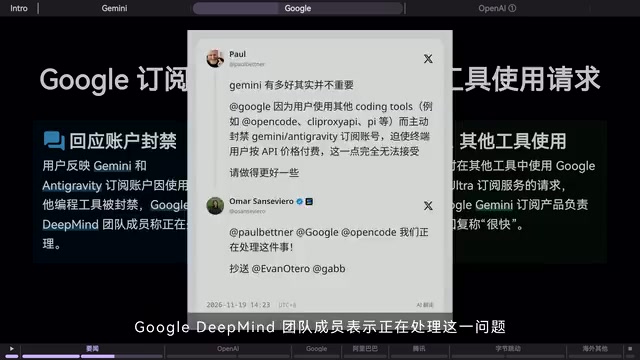
Antigravity is Google's agent-first integrated development environment, deeply tied to Gemini subscriptions. Subscribers were previously required to use Gemini for development within Antigravity, and calling subscription quotas across tools could easily trigger risk controls.
Why subscriptions are tied to tools There are two common business rationales: one is to amortize model inference costs by binding tools, and the other is to ensure a closed loop of user experience and telemetry data. For third-party programming tools, whether they can reuse subscription quotas directly affects their user acquisition costs, which is why a vague statement like "Soon" attracts so much attention.
Google AI Studio Launches New Model Selection Interface
A Google AI Studio team member confirmed that the model selection feature is now officially live. The new interface displays multiple Gemini series models in a periodic table-style grid. According to the team, the idea was inspired by a meme video from a user—user community creativity directly influenced the product form, an interaction that is becoming increasingly common in recent AI product iterations.
Google AI Studio is a browser-based model experimentation and prototyping environment for developers, offering free or pay-as-you-go access to Gemini series models, parameter adjustment, and export of API call code. It sits between a Playground and a production API. The form of the model selection interface directly affects how efficiently developers can choose models.
"Periodic table-style grid" typically refers to organizing model options in a flat grid like the periodic table of elements, making it easier to present multiple models and their version relationships simultaneously within limited space, and facilitating horizontal comparison more than a dropdown menu.
OpenAI Updates: Coding Agent R&D Acceleration, Frontier Risk Management
OpenAI released a research progress report detailing how Coding Agent accelerates and transforms its AI R&D processes based on internal measurements. The report supplements quantitative and qualitative information on research, investment, work processes, and changes in model capabilities. However, OpenAI also explicitly stated that this information still represents only part of the research changes.
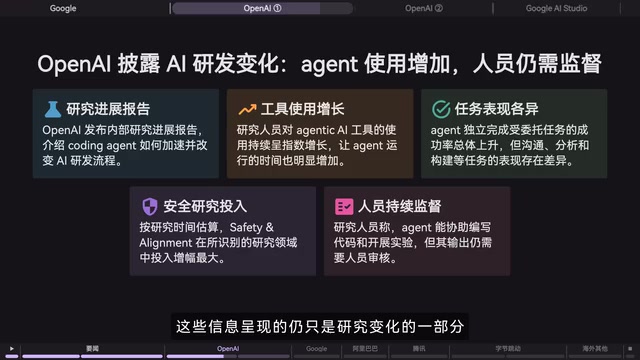
At the same time, OpenAI announced frontier AI risk management measures: safety reviews at each stage of model research, internal use, and public deployment, and deployed a Control Room to quickly stop model output from research tasks when intervention is needed. Accelerated R&D and risk control advancing in tandem constitute two sides of this update.
Domestic Developments: Tencent Yuanbao Review, Doubao Real-time Audio-Video API Launch
Tencent President Liu Zhiping admitted at an earnings conference that the AI assistant Yuanbao "did not achieve the expected success." The company is no longer focusing solely on user scale, shifting its focus back to improving model capabilities, adding an AI search feature, and significantly cutting related investment. This was a remarkably candid public review.
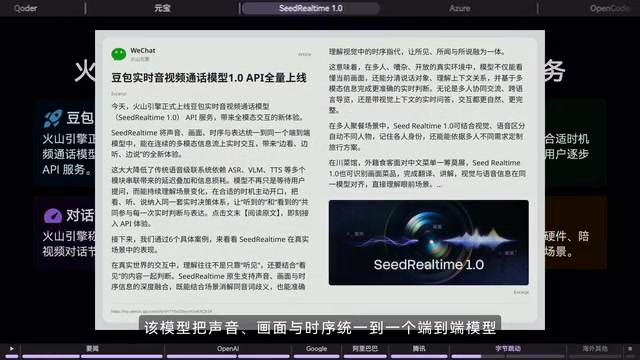
Volcano Engine, meanwhile, launched the API service for the Doubao real-time audio-video call model Seed Realtime 1.0. The model unifies audio, video, and temporal information into a single end-to-end model, supporting seeing, hearing, and speaking simultaneously, and can proactively initiate conversation. End-to-end unified multimodal temporal modeling is a major technical route for recent real-time interaction models.
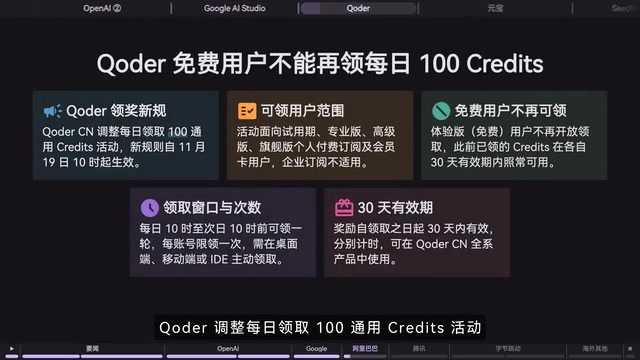
Coder also adjusted its activity rules: for the daily 100 general Credits claim activity, starting from 10:00 on November 19, free users of the trial version will no longer be able to claim; the activity is only open to trial-period users, individual paid subscribers, and membership card users.
End-to-end real-time multimodal models differ from traditional "speech recognition—large model—speech synthesis" cascade solutions by encoding audio, video, and temporal signals into a single model, reducing latency and information loss from intermediate steps, thereby enabling simultaneous seeing, hearing, and speaking, and proactive conversation at appropriate moments. The cost is higher requirements for training data, compute, and temporal alignment, which is why this route is currently concentrated among leading manufacturers.
Compute and Business: OpenCode's Own GPUs, Microsoft and MOMO Contract Controversy
OpenCode stated that its own GPUs handled 44% of total tokens that day, reaching 16 trillion, and that 10x more hardware will come online in the coming months. The team revealed it already holds 1,000 GB300 and B300 GPUs—building in-house compute is becoming an important means for some AI programming tools to control costs and supply.
On the business side, MOMO is reportedly in talks with Microsoft for an approximately $500 million Asher cloud services contract, primarily for calling OpenAI models, which has displeased OpenAI. The U.S. House Judiciary Committee has asked Microsoft to brief on the matter, while Microsoft said it does not comment on confidential customer negotiations. The boundary issue of cloud providers reselling model capabilities is moving from business friction into regulatory view.
GB300 and B300 are NVIDIA server-grade GPUs for large-scale AI training and inference, representing currently supply-constrained high-end compute resources with high per-unit costs and long procurement cycles. An AI programming tool team claiming to hold over a thousand such GPUs means its capital expenditure is approaching the scale of infrastructure providers.
The significance of in-house compute lies in converting the marginal cost of per-token billing into fixed investment while reducing dependence on a single cloud provider; however, it also brings operational, utilization, and depreciation risks—whether the hardware can be fully utilized is the key variable.
Observation: Teasers, Loosening, and In-house Compute—Three Threads
Looking at these pieces of information together reveals three directions. First, model releases increasingly rely on community-interpretation-style preheating; the Gemini 4 Helium rumor is a product of this pattern. Second, the boundary between subscriptions and third-party tools is being re-discussed; Google's "Soon" response is a loosening signal, but it has not yet materialized. Third, in-house compute and cloud contract games are heating up simultaneously; OpenCode's GPU data and Microsoft's contract controversy both point to the same thing: competition in model capabilities is sinking down to the infrastructure layer.
Related articles

Gemini 4 Neon Review: Benchmark Scores Rival Carbon, API Pricing and Quota Breakdown
Google Gemini 4 Neon is now live, benchmark scores closely tracking Carbon, API pricing 3/15 at twice Hydrogen's rate. This article compiles Bilibili creator testing: Neon can replace 90% of Carbon scenarios, AntiGravity quota consumption is only one-third of Carbon, plus subscription channel restrictions and 2API ban risks.

AI-Assisted React Development in Practice: Optimizing a Video App and Handling Errors
A 14-year veteran developer demonstrates AI-assisted React video app optimization: compressing video from 80MB to 5MB (~94%) via ImageKit, plus reliable error handling and retry mechanisms. Includes planning, code understanding, and verification methods for working with AI.

Incident Response in the Age of AI Attackers: A 6-Month Retrospective and the Four Pillars
AI attackers are making attacks on AI infrastructure more frequent. This article explains MarkTechPost's four-pillar incident response playbook based on a 6-month retrospective, with Fireworks AI and Klue case studies on implementation.