A Data Engineer's AI Tool Experiments: From Databricks to Building in Public

Data engineers are bringing AI tools and building in public into their workflows, starting with high-frequency tasks.
Using a data engineer's DEV community introduction as a sample, the article observes how traditional data stack practitioners are adopting AI tools and building in public. Databricks, PySpark, SQL, and Power BI remain a typical combination, with daily work centered on pipelines, data quality, and reporting; meanwhile, AI agents and automation are seeping in as efficiency supplements, valuable only if embedded in existing steps. The piece also analyzes building in public as a way to force understanding, gain feedback, and build a professional network, then offers three actionable suggestions.
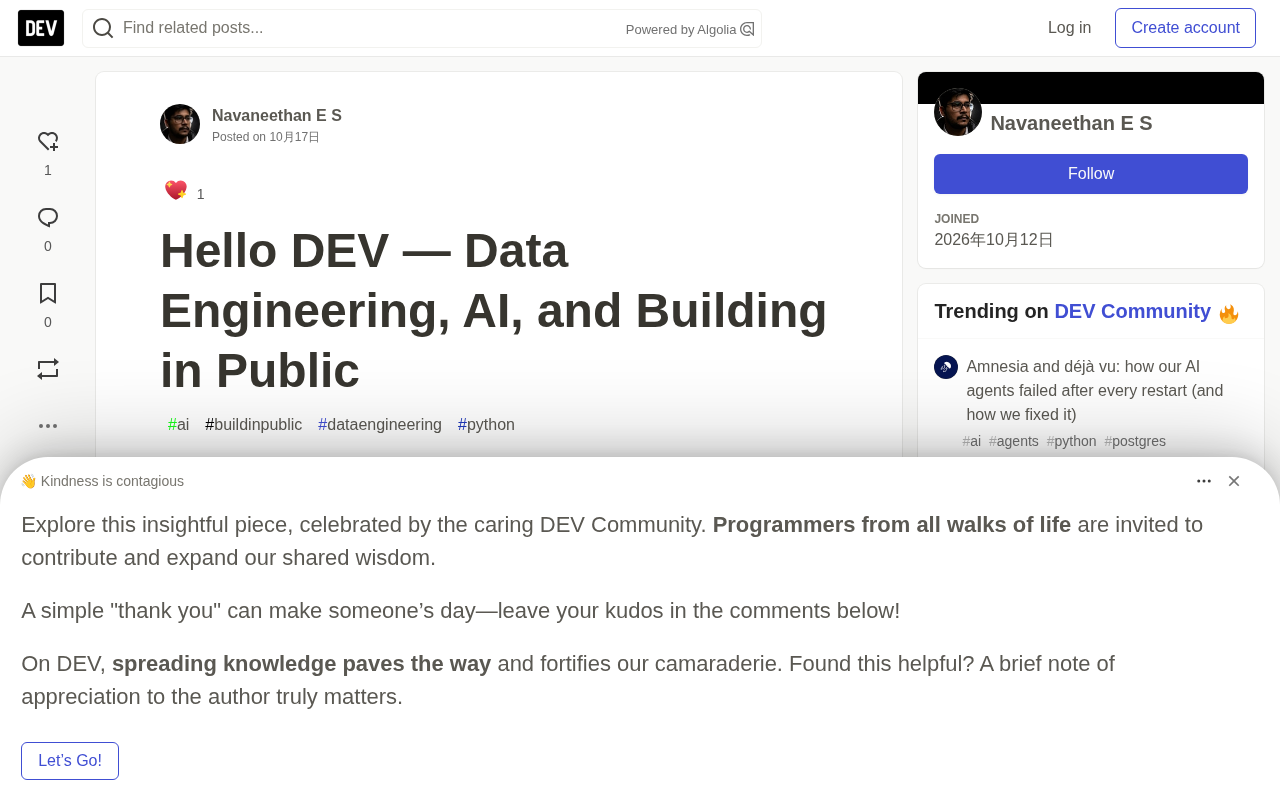
A post by a data engineer on the DEV community reveals a spreading trend: practitioners from traditional data stacks are starting to bring AI tools, automation, and building in public into their daily workflows. Naveen's self-introduction is short but dense with information—he works daily with Databricks, PySpark, SQL, and Power BI, while exploring AI agents, developer tools, and automation.
This kind of crossover isn't driven by interest alone. There's a natural interface between data engineering and AI tools: data processing is a prerequisite for AI applications, and AI tools in turn can accelerate the repetitive work of data engineering. By choosing to publicly document his learning process on DEV, Naveen is essentially using "building in public" to turn fragmented experience into reusable content assets.
The Current State of a Data Engineer's Tech Stack: Databricks + PySpark Still Dominate
The stack Naveen lists—Databricks, PySpark, SQL, Power BI—is a very typical combination in mid-to-large data teams today. Databricks handles lakehouse compute and governance, PySpark handles large-scale data transformation, SQL serves as the universal query layer, and Power BI delivers results to the business side.
The stability of this stack means that data engineers' daily tasks still center on pipeline building, data quality, performance tuning, and report delivery. Naveen plans to share PySpark and SQL tips, which shows that these seemingly basic skills still have plenty of details worth capturing in real work; for those aiming for senior data engineer roles, this kind of frontline experience is often more valuable than tutorials.
Lakehouse is the architecture concept championed by Databricks, referring to layering transactions, schema management, and performance optimization directly on top of low-cost object storage (such as S3 or ADLS), giving a data lake data-warehouse-level query and governance capabilities. It attempts to solve the problems of redundant data movement and inconsistent metadata in traditional "separate lake and warehouse" architectures. For data engineers, a lakehouse means the same data can serve BI reports, machine learning, and exploratory analysis simultaneously, reducing redundant steps in the ETL chain—which is one of the core reasons Databricks is widely adopted in mid-to-large teams.
AI Tools Are Seeping into Data Engineering Workflows
The more noteworthy part of the post is Naveen's exploration of AI agents, developer tools, and automation. He doesn't provide a specific tool list, but judging from the phrasing "how AI makes technical work faster," his focus is on efficiency gains rather than model training itself.
Data engineering has plenty of steps that can be automated: SQL generation and review, PySpark code completion, data pipeline documentation, anomaly detection and alert explanation. The value of AI agents in these scenarios depends on whether they can be embedded in existing workflows rather than existing as standalone applications. Naveen's exploration is essentially about finding the seams between data engineering and AI tools.
For peers, the reference value of this exploration is: you don't have to build an AI system from scratch—first see whether AI can shorten the time it takes to complete existing tasks.
AI Agent refers to an LLM-driven system capable of autonomously breaking down tasks, calling external tools (such as databases, code execution environments, retrieval interfaces), and iterating across multiple steps to accomplish a goal. Unlike single-turn Q&A chat, the key to an agent lies in its "tool calling" and "task orchestration" capabilities: it can first generate SQL, then execute and validate it, and automatically correct based on errors. In data engineering scenarios, this characteristic gives it the potential to take on work that previously required repeated manual trial and error, such as pipeline debugging and anomaly attribution—but only if it can be securely integrated into existing permission systems and workflows rather than existing as an isolated application.
Why Building in Public Works for Data Engineers
Naveen mentions that he joined DEV for Hacktoberfest but plans to stay and keep sharing. This shift itself shows that building in public exerts a pull on technical people: the act of writing forces understanding, and reader feedback corrects direction.
The content he plans to share covers data engineering learning, PySpark and SQL tips, AI tool experiments, small projects, and senior role preparation. What these topics have in common is that "the process is recordable"—data engineering debugging processes, AI tool usage experiences, and interview preparation retrospectives are all suited to being captured in short posts or tutorials.
Another layer of value in building in public is connection. At the end of the post, Naveen proactively invites practitioners in data engineering, AI, cloud, and open source to connect, consistent with his interests in AI, robotics, startups, and future technology. For data engineers, public output is becoming a low-cost way to build a professional network.
Hacktoberfest is an open source contribution event launched every October by organizations such as DigitalOcean, where participants who submit a required number of pull requests within a month receive rewards. It lowers the barrier for newcomers to participate in open source and has given many developers their first exposure to open source community collaboration workflows. Naveen joining the DEV community because of this event illustrates precisely that such events often become the starting point for technical people to shift from "consuming content" to "publishing publicly," and their subsequent retention often depends on whether community feedback can form a positive loop.
Three Actionable Directions for Fellow Travelers
From this brief self-introduction, several actions with practical reference value for data engineers can be distilled.
Bring AI tools into daily experiments. No systematic research is needed—start with high-frequency tasks like SQL generation, code completion, and document automation, and record which scenarios actually save time.
Keep documenting frontline tips. PySpark tuning parameters, SQL window function syntax, Databricks cluster configuration—these details recur in both interviews and real work, and writing them down creates a personal knowledge base.
Use building in public to replace learning behind closed doors. Post your learning process, project progress, and lessons from mistakes—you'll get feedback and let peers know what you're working on. Naveen's post itself is a lightweight sample: no grand narrative, just a clear listing of what he knows, what he's learning, and whom he wants to connect with.
The intersection of data engineering and AI is still changing rapidly, but one thing is already clear: engineers willing to publicly share their tool experiments and workflow improvements will find reusable methods faster than those who only tinker in private.
One-line Summary
Data engineers are bringing AI tools and building in public into their workflows, starting with high-frequency tasks to boost efficiency.
Paragraph Summary
Using a data engineer's self-introduction on the DEV community as a sample, the article observes new trends among practitioners of traditional data stacks. The author notes that Databricks, PySpark, SQL, and Power BI remain a typical combination in mid-to-large data teams, with daily tasks centered on pipeline building, data quality, and report delivery; meanwhile, AI agents, developer tools, and automation are seeping into workflows as efficiency supplements, with their value depending on whether they can be embedded in existing steps like SQL generation, code completion, and document automation. The article also analyzes the significance of building in public for data engineers: writing forces understanding, reader feedback corrects direction, and it becomes a low-cost way to build a professional network. Finally, it offers three actionable suggestions: bring AI tools into high-frequency task experiments, keep documenting frontline tips, and use building in public to replace learning behind closed doors.
Related articles

Chain of Thought Isn't Just for AI: How Humans Can Use CoT to Improve Thinking Quality
Chain of Thought isn't just a prompt trick for large models. Starting from a Hacker News discussion, this article analyzes why CoT works for human thinking too, breaks down actionable ways to transfer it, and highlights the key differences between human CoT and machine CoT.
Cloudflare Teams Up with OpenAI: Closi…
Cloudflare Teams Up with OpenAI: Closing the Loop from Vulnerability Discovery to Defense with AI
Cloudflare uses OpenAI Daybreak to investigate security vulnerabilities and generate reviewable remediation plans, while developers use Codex to boost coding efficiency and quality.

Orca Multi-Agent Orchestration in Practice: A Guide to Parallel Collaboration with Claude and Codex
Orca is Stable AI's free open-source agent workbench supporting 34 agents like Claude Code and Codex in parallel. Learn its Git worktree isolation, multi-model orchestration, and mobile management.