A Deep Dive into Building Adaptive Intelligent Cybersecurity Systems with NVIDIA Nemotron
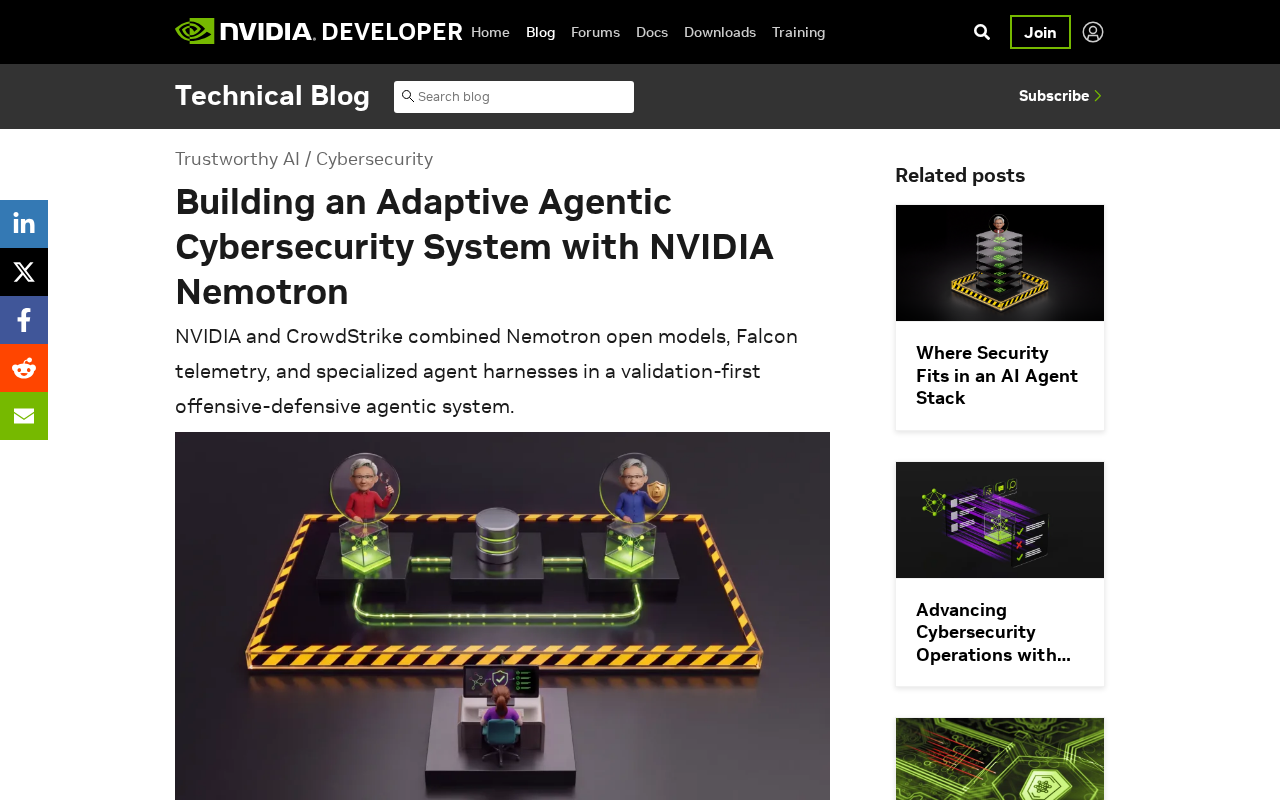
NVIDIA Nemotron enables adaptive AI agents that transform cybersecurity defense through autonomous reasoning.
This article explores how NVIDIA's Nemotron models power adaptive intelligent cybersecurity systems using multi-agent collaboration architectures. It covers the perceive-reason-act closed-loop mechanism, the role of specialized AI agents in threat hunting, forensic analysis, and response orchestration, and discusses both the practical benefits for SOC efficiency and the emerging risks such as prompt injection and model poisoning.
AI Is Reshaping the Cybersecurity Offense-Defense Landscape
Cybersecurity has long faced a fundamental asymmetry: attackers only need to find a single vulnerability to succeed, while defenders must protect every possible entry point. As AI technology matures—especially with the rise of agentic systems—this balance of power is undergoing a profound shift.
According to a recent post on the NVIDIA Developer Blog, adaptive intelligent cybersecurity systems built on Nemotron models can coordinate multiple tasks and pursue complex objectives over extended timeframes. This means security teams no longer need to rely on static, singular detection rules. Instead, they can deploy AI agents with reasoning and autonomous decision-making capabilities to address a constantly evolving threat landscape.
The core of this transformation lies in the word "adaptive." Traditional security systems depend on preset rules and signature matching, making them severely lag behind when facing zero-day vulnerabilities and novel attack techniques.
A zero-day vulnerability refers to a security flaw that the software vendor or security community has not yet discovered or patched. Once attackers gain knowledge of a zero-day vulnerability, they can launch attacks while defenders are completely unprepared—which is why zero-days are often called the "nuclear weapons" of cybersecurity. Traditional signature-based security systems must first obtain attack samples, analyze characteristics, and update rule databases—a process that typically takes days or even weeks. During this window, attacks exploiting zero-day vulnerabilities can operate unimpeded. Newer attack methods such as fileless attacks and supply chain attacks further highlight the limitations of static rule-based systems by abusing legitimate system tools or exploiting trust relationships to bypass traditional detection.
Agentic systems, however, can dynamically adjust their strategies based on environmental feedback, continuously learning and evolving within a closed loop of detection, analysis, and response.
Core Concepts of Agentic Cybersecurity
From Passive Defense to Active Coordination
An agentic system refers to an AI system capable of autonomously planning tasks, invoking tools, and maintaining coherent objectives across multiple steps. Unlike traditional large models that can only handle single question-and-answer interactions, agents can decompose a high-level goal (such as "investigate this suspicious login event") into a series of subtasks: collecting logs, correlating threat intelligence, assessing risk levels, and providing remediation recommendations.
This capability is especially critical for Security Operations Centers (SOCs). A Security Operations Center (SOC) is the command hub of an enterprise's cybersecurity defense, responsible for 24/7 monitoring, detection, and response to security threats. However, modern SOCs face a severe "alert fatigue" problem: various security tools generate thousands of alerts daily, with false positive rates exceeding 95%. Security analysts must evaluate each alert individually, searching for real threat signals amid massive noise. This high-intensity, repetitive work is not only inefficient but also leads to analyst burnout—and potentially causes real threats to be overlooked due to fatigue. According to Ponemon Institute research, SOC teams take an average of several hours to perform initial triage on a single alert, meaning many real attacks have already caused substantial damage by the time they're discovered.
Agentic systems can take on frontline triage work, automatically filtering, enriching, and classifying alerts, then escalating only genuinely high-risk events that require human intervention to analysts—dramatically alleviating the alert fatigue that has long plagued SOC teams.
The Role of Nemotron Models in Security Scenarios
NVIDIA's Nemotron series is an open-source model family optimized specifically for enterprise applications. Nemotron is NVIDIA's open-source large language model series, optimized for enterprise application scenarios. Unlike general-purpose models such as GPT or Claude, the Nemotron series has been deeply customized for specific industry needs, excelling in tasks like code generation, technical document comprehension, and domain-specific reasoning. In cybersecurity scenarios, Nemotron serves as the agent's "reasoning engine"—responsible for understanding threat context, generating analytical conclusions, and driving subsequent actions. It can parse complex log formats, interpret threat intelligence reports, and correlate security events from different sources.
Compared to general-purpose large models, Nemotron models fine-tuned for specific domains offer advantages in both accuracy and cost efficiency. Deploying Nemotron in on-premises or private cloud environments also satisfies compliance requirements for keeping security data within organizational boundaries, meaning enterprises can run models in private environments to ensure sensitive security data is never transmitted to external cloud services—meeting the compliance requirements of highly regulated industries such as finance and healthcare. Additionally, its open-source nature allows security teams to fine-tune the model on their own data, further improving accuracy in specific environments—which is crucial for security scenarios involving sensitive logs and internal enterprise data.
Technical Architecture of the Adaptive Security System
The Perceive-Reason-Act Closed Loop
A complete adaptive intelligent security system typically consists of three core components:
- Perception Layer: Continuously collects security signals from various data sources (network traffic, endpoint logs, identity authentication systems, etc.)
- Reasoning Layer: Powered by models like Nemotron, performs correlation analysis and risk assessment on collected information
- Action Layer: Executes appropriate measures based on reasoning results, such as isolating hosts, blocking accounts, or triggering incident tickets
These three components form a continuously operating closed loop. After each response action, the system evaluates its effectiveness and feeds the results back to the reasoning layer, creating a positive cycle of learning and optimization. This is the technical essence of "adaptive"—the system's behavior is not static but continually improves as experience accumulates.
Multi-Agent Collaboration Architecture
Complex security tasks often require multiple specialized agents working in concert. A typical multi-agent collaboration architecture includes:
- Threat Hunting Agent: Proactively searches for potential threats and anomalous behavior across the network
- Forensic Analysis Agent: Conducts in-depth investigation into the details and impact scope of security incidents
- Response Orchestration Agent: Coordinates various systems to execute remediation actions, ensuring response consistency
These agents exchange information through standardized protocols, each performing its designated role while collaborating with the others—simulating how an efficient human security team operates. This multi-agent collaboration model is the core architectural innovation of AI-driven security operations.
Practical Value and Real-World Challenges
Dual Improvements in Efficiency and Scale
The most direct value of agentic security systems lies in efficiency gains. They can operate 24/7 without interruption, process data far faster than humans, and are unaffected by fatigue. For security teams struggling with staffing shortages, this is equivalent to gaining a team of tireless junior analysts, freeing up valuable human resources to focus on more strategic work.
At the same time, these systems offer excellent scalability. Whether monitoring hundreds or thousands of servers, or responding to sudden large-scale attack events, agentic systems can elastically scale their processing capacity—something that traditional labor-intensive security operations models simply cannot match.
Security Risks That Cannot Be Ignored
However, delegating autonomous decision-making to AI systems also introduces new risk dimensions:
Misjudgment and Business Disruption Risk: If an agent incorrectly isolates a critical business system, it could cause severe business disruptions. Therefore, in practice, high-risk actions typically still require a "human-in-the-loop" approval mechanism as a safeguard.
Security of the AI System Itself: AI systems themselves can become attack targets. As AI systems are deployed in critical domains, attack techniques targeting AI are also continuously evolving. Prompt injection is a novel attack method where adversaries manipulate an AI system's behavior through carefully crafted input text, causing it to ignore original instructions or execute malicious operations—similar to traditional SQL injection attacks. For example, an attacker might embed special instructions in logs to trick a security agent into incorrectly marking malicious activity as normal behavior.
Model poisoning involves implanting backdoors or biases during the AI model's training phase, causing the model to produce incorrect judgments under specific conditions. In cybersecurity scenarios, a poisoned threat detection model might systematically fail to detect certain types of attacks, or turn a blind eye to a specific attacker's activities. These novel AI-targeted attack techniques could be exploited to manipulate agent behavior. This requires building security protections into the system architecture from the design phase, including input validation, output auditing, model behavior monitoring, and other multi-layered defense mechanisms—giving rise to the entirely new security challenge of "AI that protects AI."
Summary and Outlook
NVIDIA's approach to building adaptive intelligent cybersecurity systems based on Nemotron represents a significant direction in the security industry's evolution toward intelligence. As attackers also begin leveraging AI to enhance their offensive capabilities, defenders must counter agents with agents to maintain the initiative in this ever-escalating offense-defense game.
The future of security operations will be a model of deep collaboration between human experts and AI agents—with AI handling high-intensity, repetitive analytical work while humans focus on strategic decisions and complex judgments. For enterprise security teams, understanding and planning for agentic security systems as early as possible will be key to building next-generation cyber defense capabilities.
Related articles
The Dude System: How Dual-Detection Multi-Agent AI Catches Inconsistencies Between Papers and Code
Dude is the first dual-detection multi-agent system for paper-code discrepancy detection, using granularity-aligned negotiation and two-stage salience filtering to boost recall and precision by up to 22.8%.
Implicit Instruction Following in Full-Duplex Voice Assistants: DSB-IFEval Benchmark Analysis
In-depth analysis of the DSB-IFEval benchmark reveals full-duplex voice assistants' capability gaps in implicit instruction following, persona reasoning, and conflict resolution. Covers comparative testing of six voice systems and examines behavioral vs. content trade-offs driven by architectural differences.
Personalizing AI Teaching Assistants with Prompt Engineering: A Deep Dive into the Six-Dimension Learner Profile Framework
Explore a prompt engineering framework for AI teaching assistants using six-dimension learner profiles and Bloom's Taxonomy to deliver 96 personalized teaching styles without model retraining.