Personalizing AI Teaching Assistants with Prompt Engineering: A Deep Dive into the Six-Dimension Learner Profile Framework
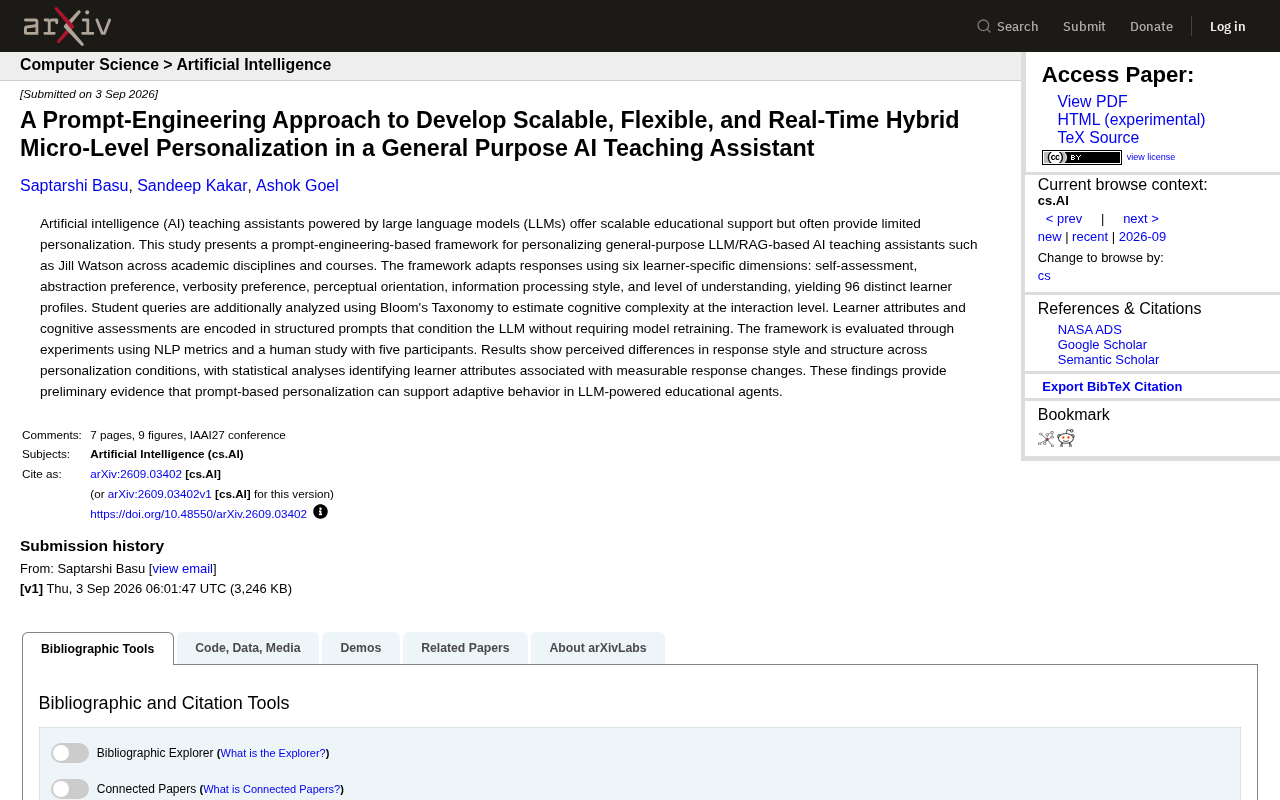
A prompt engineering framework enables 96 personalized AI teaching styles via six-dimension learner profiles.
A recent study proposes a prompt engineering framework that personalizes AI teaching assistants without model retraining. By profiling learners across six dimensions and combining static profiles with dynamic Bloom's Taxonomy cognitive assessment, the system generates 96 distinct personalized response styles. This scalable, flexible, and real-time approach lowers the technical barrier to educational AI personalization, offering a pragmatic path for EdTech deployment.
The Personalization Dilemma for AI Teaching Assistants
With the rise of large language models (LLMs), AI-based teaching assistants like Jill Watson have brought unprecedented scalable support to education. They can respond to student questions around the clock, serve massive numbers of learners, and dramatically lower the marginal cost of quality educational resources.
Large language models (LLMs) are deep learning models built on the Transformer architecture and pre-trained on massive text corpora. Notable examples include GPT-4, Claude, and Gemini. They possess strong natural language understanding and generation capabilities, enabling multi-turn dialogue, text summarization, code generation, and more. In educational settings, LLMs are often combined with RAG (Retrieval-Augmented Generation) technology — the system first retrieves relevant passages from course materials, textbooks, and other knowledge sources, then injects this context into the LLM's prompt to generate more accurate, domain-specific answers, effectively mitigating the LLM "hallucination" problem.
It's worth noting that Jill Watson was an AI teaching assistant developed in 2016 by Professor Ashok Goel's team at Georgia Institute of Technology. Originally deployed in an online master's course forum, it automatically answered common student questions about syllabi, assignment deadlines, and similar topics. Its landmark achievement: students went an entire semester without realizing they were interacting with an AI rather than a human teaching assistant. This case became one of the most widely recognized success stories in AI education — and it also revealed a core contradiction: while AI assistants can efficiently handle FAQ-type questions, they still struggle with teaching interactions that require deep understanding of individual learner differences.
However, these general-purpose AI assistants have a notable weakness: limited personalization. Whether a student is a graduate researcher skilled in abstract thinking or a beginner who needs concrete examples, AI tends to respond with the same "standard answer," ignoring each learner's unique cognitive style and comprehension level. Truly excellent human teachers know how to tailor instruction to each student, and current AI assistants remain clumsy in this regard.
Recently, a study published on arXiv (arXiv:2609.03402v1) proposed a framework based on prompt engineering that attempts to achieve real-time, flexible, and scalable micro-personalization of general-purpose LLM/RAG teaching assistants — without retraining the model. This approach offers a highly practical engineering pathway for deploying educational AI.
Core Framework: How Six Dimensions Generate 96 Personalized Profiles
The Design Logic Behind Six Key Dimensions
The core innovation of this research framework lies in characterizing each user across six learner-specific dimensions:
- Self-Assessment: The learner's perception of their own proficiency level
- Abstraction Preference: Whether they prefer abstract concepts or concrete examples
- Verbosity Preference: Whether they prefer concise answers or detailed explanations
- Perceptual Orientation: Information reception tendencies such as visual or auditory
- Information Processing Style: Linear versus divergent thinking patterns
- Level of Understanding: Current mastery of the subject matter
Through the combinatorial permutations of these six dimensions, the framework can generate a total of 96 distinct learner profiles. This means that for the same question, the AI teaching assistant can produce 96 different responses varying in style and structure based on different student profiles. This design transforms a "one-size-fits-all" general assistant into an adaptive teaching system capable of serving each learner individually.
These six dimensions were not chosen arbitrarily — they draw on multiple classic theories of learning styles from educational psychology. For example, "Perceptual Orientation" and "Information Processing Style" are closely related to the Felder-Silverman Learning Style Model, which has been widely used in engineering education since its introduction in 1988, classifying learners along four dimensions: sensing/intuitive, visual/verbal, active/reflective, and sequential/global. Meanwhile, "Self-Assessment" and "Level of Understanding" incorporate the perspective of metacognitive theory — a learner's awareness of their own cognitive state is one of the key factors influencing learning efficiency.
Dynamic Cognitive Assessment with Bloom's Taxonomy
Beyond static learner profiles, the framework also incorporates a classic educational theory: Bloom's Taxonomy. The system analyzes each student's question during every interaction to estimate the cognitive complexity it reflects.
Bloom's Taxonomy was first proposed by American educational psychologist Benjamin Bloom in 1956 and later revised by Anderson and Krathwohl in 2001 into its current form. The revised version divides cognitive processes into six levels, from lowest to highest: Remember, Understand, Apply, Analyze, Evaluate, and Create. It is one of the most widely used instructional objective classification tools in education worldwide, applied extensively in curriculum design, exam development, and teaching assessment. Introducing Bloom's Taxonomy into AI teaching assistants essentially gives the system "metacognitive" ability — it not only answers the question itself but also judges which cognitive level the questioner is operating at, thereby providing guidance strategies matched to their stage of cognitive development.
For example, a question like "What is recursion?" falls at the Remember/Understand level, while "How can I optimize this algorithm using recursion and evaluate its time complexity?" involves higher-order cognitive activities such as Apply, Analyze, and even Evaluate. By identifying the cognitive level of a question, the AI assistant can dynamically adjust the depth and guidance strategy of its response, rather than relying solely on the learner's static profile.
This hybrid design combining "static profiles + dynamic cognitive assessment" is precisely why the framework is called "hybrid micro-personalization." It enables the AI teaching assistant to understand both "who the student is" and "what the student is thinking right now."
Technical Approach: Prompt Conditioning Without Model Retraining
Three Key Advantages of Structured Prompt Engineering
The most engineering-valuable aspect of this framework is that it completely bypasses the high costs of model fine-tuning or retraining. Learner attributes and cognitive assessment results are encoded into structured prompts that serve as conditional constraints for LLM response generation.
Prompt engineering refers to the practice of carefully designing text instructions (i.e., "prompts") fed to an LLM to guide the model toward producing desired outputs — without modifying the model's internal parameters. This technique gained widespread attention around 2020 with the release of GPT-3. From simple few-shot prompting to chain-of-thought reasoning, role-playing, and system prompt configuration, prompt engineering has developed a rich set of techniques. Its core value lies in transforming the problem of "tuning the model" into "tuning the instructions," dramatically lowering the barrier to AI application development.
To appreciate the value of this technical approach, consider the costs of the alternative. Fine-tuning involves further training a pre-trained model's parameters on domain- or task-specific labeled data to improve performance on a target task. This process typically requires GPU clusters, high-quality labeled data, and a specialized machine learning engineering team, with costs ranging from thousands to hundreds of thousands of dollars. For educational institutions, fine-tuning a model separately for each course or discipline is simply impractical. By contrast, the cost of prompt engineering is nearly negligible — it only consumes API call token fees. That said, the two approaches are not entirely interchangeable: fine-tuning can deeply alter a model's behavioral patterns, while prompt engineering can only orchestrate within the boundaries of the model's existing capabilities. This study's choice of prompt engineering reflects a "good enough" engineering pragmatism that prioritizes deployment feasibility.
This prompt engineering-based approach delivers three significant advantages:
- Scalable: No need to train a separate model for each course or discipline — the same prompt framework can be reused across subjects
- Flexible: Adjusting personalized teaching strategies only requires modifying prompt templates, enabling rapid iteration
- Real-Time: Prompts are assembled on the fly during conversations, with no offline training cycle required
For institutions looking to rapidly deploy educational AI, this prompt engineering-based approach is highly attractive in terms of both cost and deployment efficiency. It reflects an important trend in current LLM application development: replacing model modification with prompt design, dramatically lowering the technical barrier to educational AI personalization.
Experimental Evaluation: Dual Validation Through NLP Metrics and Human Studies
Quantitative Analysis and User Perception Feedback
The research team evaluated the framework through two pathways. On one hand, they used natural language processing (NLP) metrics to quantitatively analyze responses generated under different personalization conditions. On the other hand, they conducted a human study with five participants to collect real user feedback on perceived personalization effectiveness.
In the field of natural language processing, commonly used metrics for evaluating text generation quality include: text length and lexical diversity (measuring verbosity and richness), readability metrics such as the Flesch-Kincaid grade level (measuring comprehension difficulty), cosine similarity (measuring semantic similarity or difference between responses), and reference-based matching metrics such as BLEU and ROUGE. In this study, NLP metrics were used to quantify "whether responses generated under different personalization conditions are actually different" — if the 96 learner profiles produce responses with no statistically significant differences, it would indicate that prompt engineering failed to work effectively. This quantitative verification provides objective data support for subjective perceptions.
The results showed that under different personalization conditions, the AI teaching assistant's responses did exhibit perceptible differences in style and structure. Statistical analysis further identified which learner attributes were associated with measurable response variations. This demonstrates that the framework is not merely theoretical — it produces meaningful differentiation in actual outputs.
Current Limitations and Future Directions
It should be noted objectively that this is still a preliminary study. The human study with only five participants has a small sample size, limiting the statistical power of its conclusions. It is not yet sufficient to fully demonstrate that personalization improves actual learning outcomes (as opposed to merely perceived differences). In educational technology research, distinguishing between "learner satisfaction" and "actual learning effectiveness" is a longstanding challenge — students may prefer a certain teaching style, but that doesn't necessarily mean they learn more or retain knowledge better under that style. This phenomenon is known in educational psychology as the "Learning Preference Fallacy" — learners' subjective preferences don't always align with optimal learning paths.
Future research directions may include:
- Expanding the scale of user studies to strengthen the credibility of conclusions
- Introducing long-term learning outcome tracking metrics, such as pre-test/post-test score comparisons and knowledge retention rates
- Validating the discriminative power of the 96 profiles in real teaching scenarios and assessing whether redundant dimensions exist
- Exploring automated learner profile inference mechanisms (rather than relying on explicit input), such as automatically constructing profiles by analyzing students' historical question patterns, quiz records, and interaction behaviors
A Pragmatic Path to Educational AI Personalization: Lessons from Prompt Engineering
The significance of this research lies not in proposing a groundbreaking model architecture, but in demonstrating a pragmatic, replicable engineering pathway: through carefully designed prompt engineering, general-purpose LLM teaching assistants can achieve micro-level personalization without incurring the costs of retraining.
In an era of increasingly powerful large models, the question of how to bridge the "last mile" to real educational deployment — ensuring every learner receives guidance tailored to their cognitive characteristics — is a far more grounded proposition than simply pursuing larger parameter counts. The combination of six-dimension learner profiles + Bloom's Taxonomy cognitive analysis + structured prompts presented in this paper offers a compelling answer to this proposition.
From a broader industry perspective, this research also reflects a paradigm shift underway in the EdTech sector: moving from "one-size-fits-all" standardized digital education toward adaptive learning. Adaptive learning is not a new concept — as early as the 2010s, platforms like Knewton and DreamBox attempted to dynamically adjust learning content difficulty and sequencing through algorithms. But the emergence of LLMs has given adaptive learning an entirely new dimension: not only can "what content to deliver" be personalized, but "how to express and explain that content" can also be finely tuned to each learner's characteristics.
For teams building AI-powered educational products, this framework offers more than just a theoretical reference — it provides a clear insight: the key to personalized teaching may not lie in the model itself, but in how we describe "who this student is" to the model.
Related articles

Uber Deploys ChatGPT Work Company-Wide: AI in the Workplace Enters the Scaled Implementation Phase
Uber deploys ChatGPT Work to 30,000+ employees, extending it from engineering to all roles. We analyze its expert-engineer pairing, end-to-end automation, and questions of AI control and power concentration—insights for scaling AI in the workplace.

Shift at Midnight Hands-On: When "ID Verification" Becomes Alien Hunting
Shift at Midnight blends ID verification with horror survival in a four-player co-op game. We break down its inspection mechanics and chaotic humor.

Zelensky Recounts the Outbreak of War: I Need Ammunition, Not a Ride
Zelensky recalls the first day of war in a YouTube interview: farewell to family, rejecting Biden's evacuation offer with "I need ammunition, not a ride," and how Bucha shaped his stance on compromise and peace talks.