A Deep Dive into Claude Meetings: CTO Calls Tool Calling a Game Changer

A fund CTO says Claude Meetings is underrated—its tool calling cut his workweek from 50 to 25 hours.
A CTO at an investment fund shared on Reddit that Claude Meetings, though mocked at launch, is severely underrated. His team runs almost entirely on Anthropic, with everyone working inside Claude. The feature connects via Google Meet and identifies speakers, but its core value is tool calling: during a 30-minute meeting, Claude listened in real time, updated project status in Notion, called MCP to update bid info, and sent a post-meeting report of completed work and to-dos. He says tool calling is the real game changer, cutting his weekly hours from 50 to 25. The team spends about $2,500 a month, half on Fable 5.2. The article also flags the architecture lock-in risk of deep single-vendor dependence.
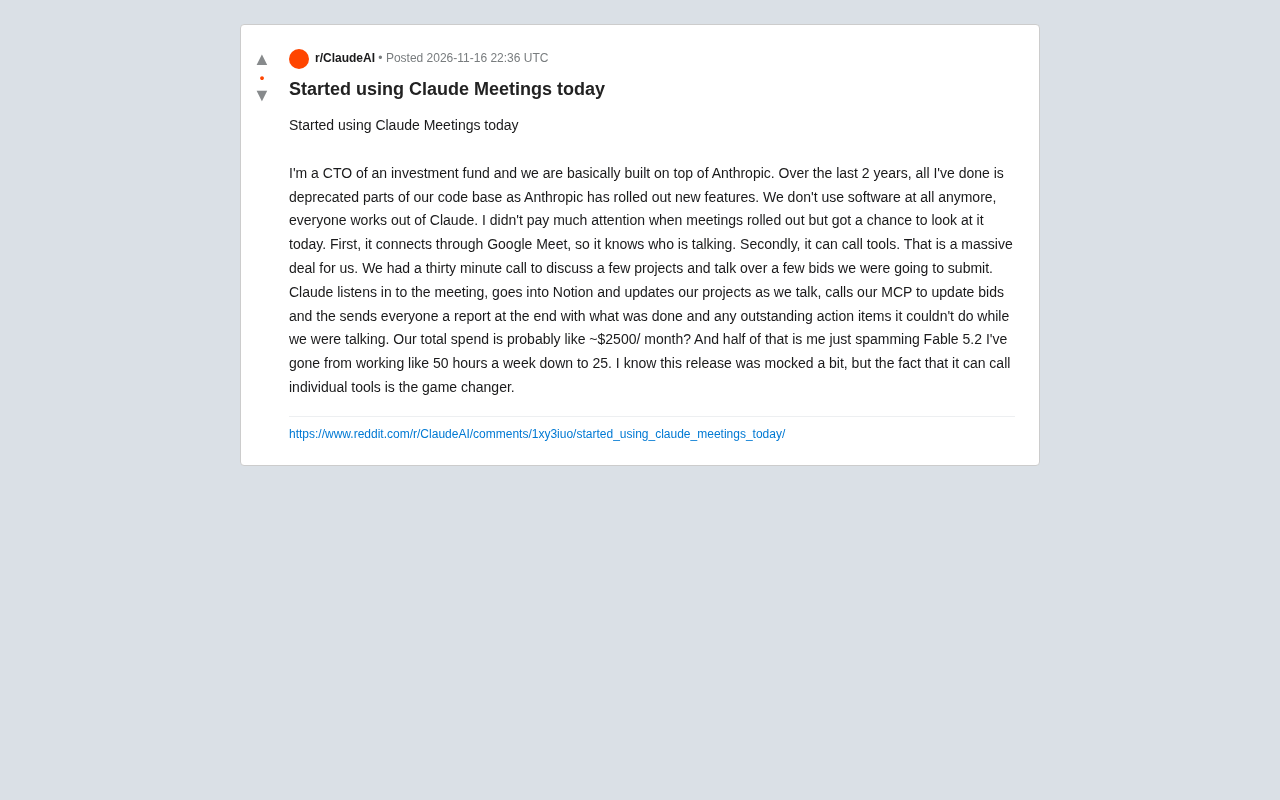
A CTO at an investment fund shared his experience using Claude Meetings on Reddit, saying the feature is underrated. His team is built almost entirely on Anthropic, and over the past two years they've repeatedly scrapped their own codebase as Anthropic rolled out new features. Today, the team no longer uses other software—everyone works inside Claude.
From Mocked to Indispensable: The Turning Point for Claude Meetings
Claude Meetings drew some mockery when it launched, but this CTO discovered its unique value once he actually used it. He noted that he hadn't paid much attention to the feature at first and only got a chance to look into it closely today. What he found was that Claude Meetings not only connects via Google Meet and identifies who is speaking—more importantly, it can call tools.
"This is huge for us," he wrote in the post. During a 30-minute conference call, the team discussed several projects and some bids that were about to be submitted. Claude listened in real time, went into Notion to update project status, called their MCP to update bid information, and at the end of the meeting sent everyone a report covering what had been completed and the other to-dos it couldn't finish during the call.
Tool Calling: The Key to the Efficiency Boost
The CTO emphasized that being able to call individual tools is the real game changer. He explained that the team's total spend is around $2,500 per month, half of which comes from his own heavy use of Fable 5.2. Since adopting Claude Meetings, his work hours have dropped from 50 hours a week to 25.
"I know the launch got a bit of a mocking, but the fact that it can call individual tools is the key," he added.
MCP (Model Context Protocol) is an open protocol introduced by Anthropic in late 2024, designed to standardize how AI models connect to external tools and data sources. Think of it as the "USB-C port" of AI applications: through a unified protocol specification, models can discover, call, and combine various services (such as databases, project management tools, and internal APIs) without having to write separate integration code for each tool. In the Claude Meetings scenario, MCP lets Claude in the meeting dynamically identify and call the team's own bidding system interface and write data in real time—this is precisely the technical foundation that makes the "tool calling" capability a reality. MCP's open-source nature has also helped it gradually become an industry standard, adopted by more and more third-party tools and frameworks.
Implications for Development Teams
This CTO's experience reveals the potential of AI assistants in meeting scenarios. Through deep integration with tools like Google Meet and Notion, Claude Meetings is not just a meeting-notes tool but an intelligent agent capable of proactively executing tasks. For teams that rely on the Anthropic ecosystem, this seamless tool-calling capability could significantly reduce the cost of manual operations and context switching.
However, this level of dependence also carries risk. The CTO mentioned that over the past two years they've been continually scrapping their own codebase because Anthropic keeps shipping new features. While this brings efficiency, it also means the team's architecture and processes are deeply tied to a single vendor.
Vendor lock-in refers to the risk state in which a company becomes so deeply dependent on a particular vendor's technology, platform, or service that migration costs rise significantly and its bargaining power declines. In the article, the team spent two years continually discarding its own code and shifting fully to the Anthropic ecosystem. While this bought efficiency, it also means their architecture, data flows, and business processes are highly coupled to a single vendor. If that vendor changes pricing, modifies its API, restricts features, or experiences an outage, the team will lack a smooth alternative path. Common mitigation strategies include: keeping abstraction interfaces at key integration layers, regularly evaluating competitors' capabilities, maintaining exportability of core data, and negotiating flexibility clauses into cost contracts. For teams that are highly dependent on an AI vendor, lock-in risk and efficiency gains need to be weighed at the architecture design stage.
Conclusion
The Claude Meetings case shows that AI's role in meetings is shifting from passive note-taking to proactive execution. Tool-calling capability lets AI truly participate in workflows rather than merely providing information. For teams looking to boost efficiency, this may be a direction worth watching.
One-line Summary
A fund CTO says Claude Meetings is underrated, and its tool-calling capability cut his weekly work hours from 50 to 25.
Paragraph Summary
A CTO at an investment fund shared on Reddit that although Claude Meetings was mocked at launch, it's severely underrated in practice. His team is built almost entirely on the Anthropic ecosystem, and now everyone works inside Claude. The feature connects via Google Meet and identifies speakers, but its core value is tool calling: in a 30-minute meeting, Claude listened in real time, went into Notion to update project status, called MCP to update bid information, and after the meeting sent everyone a report covering completed work and to-dos. The CTO says tool calling is the real game changer, and his weekly work hours dropped from 50 to 25. The team spends about $2,500 per month, half of it on Fable 5.2. The article also notes that this deep reliance on a single vendor carries architecture lock-in risk.
Related articles

Prompt Engineering for Beginners: From Writing Prompts to Engineering Thinking
Starting from the essence and four functions of prompts, this article systematically explains the six-step process, four success criteria, learning value, and practical limitations of prompt engineering to help you build a complete understanding.

Anthropic Launches Nasdaq IPO: AI Giant's Listing and Risk Disclosures
Anthropic officially launches its Nasdaq IPO under ticker ANT, with market valuation expected to potentially exceed SpaceX's record. The prospectus devotes nearly 100 pages to AI risks, while first-half revenue grew over 14x but net losses widened sharply, reigniting the AI bubble debate.

Rust cURL Clone Uses 4,832 unsafe Blocks—Is the Memory Safety Myth Broken?
A Rust cURL clone uses 4,832 unsafe keywords, challenging Rust's memory safety narrative. We analyze what unsafe really means, compare Fil-C, and examine rewrite motives.