A Deleted Reddit Post: Where Are the Boundaries of AI Content Moderation?
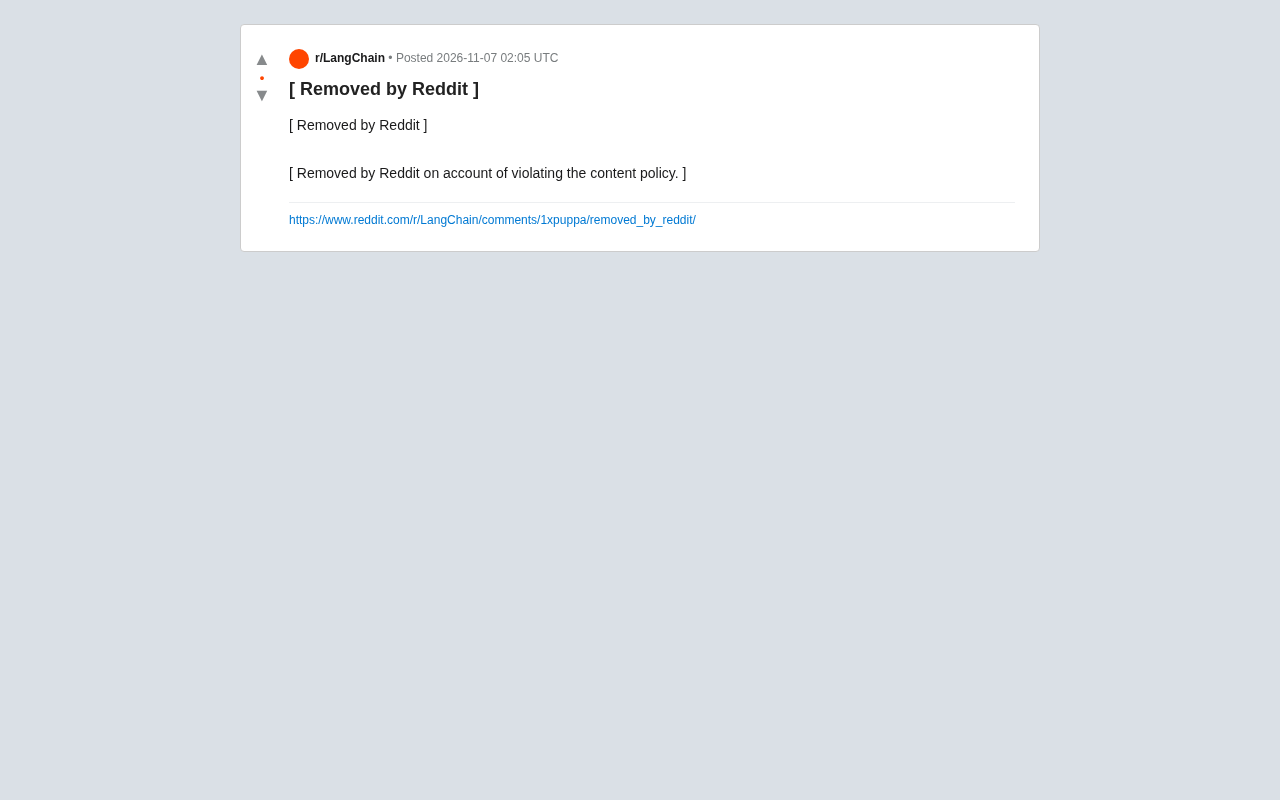
An entirely removed Reddit post reflects the deep tension in AI content moderation between black-box judgment and explainability.
The article begins with a Reddit screenshot showing only the notice "[ Removed by Reddit ]", noting the irony that a post discussing the boundaries of AI moderation disappeared precisely because of moderation. From this, the author reconstructs the typical platform moderation chain—automated initial screening, human or model review, and execution of removal—and points out that when judgment criteria are opaque and appeal channels are limited, users cannot distinguish genuine violations from model misjudgments. The article further summarizes the three inherent tensions of AI moderation: the trade-off between scale and precision, the semantic loss between natural-language rules and probabilistic model execution, and the conflict between efficiency and transparency. It concludes by discussing directions for improvement such as graduated enforcement, appeal transparency, and human review for high-risk cases, attributing the fundamental issue to the governance framework and external oversight.
A blank Reddit screenshot is becoming a new case study for discussing how AI content moderation mechanisms work.
When All That's Left of a Post Is "Removed"
On Reddit, a post originally meant to discuss the boundaries of AI content moderation has been reduced to two lines of system notice: [ Removed by Reddit ]. The original title, body, and the specific contents of the comment section are all invisible; the page retains only the explanation that it was "removed for violating content policy."
This is an irony in itself: a post discussing the boundaries of moderation lost its subject of discussion precisely because of moderation. For those studying AI governance and platform mechanisms, this "deleted metadata" carries more information than a typical 404 page—it at least shows that the platform's content judgment happens above the visible layer, and that the result is completely irreversible on the user side.
The Three-Layer Structure of Platform Moderation
From the publicly visible removal information, a typical platform moderation chain can be reconstructed: a user publishes content, an automated system performs initial screening, a human or model reviews it, and finally removal is executed. Reddit's mechanism is representative within the industry: automated models handle high recall, human teams handle high precision, and deletion is ultimately executed in the name of compliance.
The problem is that when the judgment criteria of automated systems are opaque and appeal channels are limited, users find it hard to distinguish "content that genuinely violates rules" from "model misjudgment." The line [ Removed by Reddit ] in the screenshot provides no category label, does not indicate which rule was triggered, and offers no review entry point. While this black-box approach improves platform efficiency, it also brings the explainability problem of AI moderation to the surface.
Recall and Precision are the two core metrics for evaluating content moderation models. Recall refers to the proportion of all actually violating content that the system successfully identifies, measuring how many "escapees" there are; precision refers to the proportion of content judged as violating that truly violates, measuring how much "collateral damage" there is. The two are inherently in tension: lowering the judgment threshold can improve recall, intercepting more suspicious content, but it will also wrongly flag a large amount of normal content and drag down precision; raising the threshold does the opposite. When facing massive content, platforms typically let automated models operate at a high-recall working point for initial screening, then hand off to humans or more refined models for review to improve precision—this is precisely the technical motivation behind the chain described in the article of "automated system initial screening, human or model review."
The Inherent Tensions of AI Moderation
Content moderation is one of the earliest and largest-scale applications of AI, but it has always faced threefold tension. The first is the contradiction between scale and precision: facing massive content, models must trade off between recall and false-positive rates, and any threshold setting will generate controversy in edge cases. The second is the misalignment between rules and semantics: content policies are written in natural language, while models execute via probability distributions, and the conversion between the two inherently involves loss. The third is the conflict between efficiency and transparency: platforms tend to delete quickly to avoid risk, but quick deletion often means fewer explanations and weaker appeal mechanisms.
These tensions are not unique to Reddit but are structural problems faced by all platforms that adopt AI content moderation. The reason this removed post is worth attention is not what it said, but that the way it disappeared happens to demonstrate how the above tensions manifest in actual products.
Explainability refers to the degree to which an AI system's judgment results can be explained and traced in a way humans can understand. In content moderation scenarios, explainability means the system can not only give a "violating/non-violating" conclusion, but also point out which policy was triggered, which textual features it relied on, and what the confidence level is. Models such as deep neural networks are often "black boxes," and their internal decision processes are hard to map directly to rule clauses written in natural language—this constitutes the technical root of the "misalignment between rules and semantics" mentioned in the article. The lack of explainability brings three consequences: users cannot effectively appeal, regulators find it difficult to conduct external audits, and platforms themselves struggle to locate and correct systematic misjudgments. The industry currently attempts to improve explainability by combining rule engines with models, outputting judgment basis labels, and retaining human review records.
Directions for Explainable Moderation
Discussions on improving AI moderation focus on several directions: first, graduated enforcement, using different measures such as warnings, rate limiting, and deletion instead of a one-size-fits-all approach; second, introducing appeal transparency, explaining to users which type of rule was triggered; third, retaining human review in high-risk judgments. These practices already exist in the industry, but the degree of implementation varies.
The more fundamental issue lies in the governance framework: who defines violations, who supervises the models, and who is responsible for misjudgments. When platforms are both rule-makers and enforcers, external audits and user feedback mechanisms become necessary. This deleted post does not provide answers, but through its absence it signals that the problem exists.
Graduated Enforcement is a common approach in platform governance that replaces "one-size-fits-all deletion," with typical tiers including: content takedown, reduced recommendation weight (rate limiting), warning labels, restriction of specific features, account warnings, and ultimately bans. Its logic is to match the corresponding action to the severity of the violation, the user's historical behavior, and the reach of the content, reducing excessive punishment in edge cases. Graduated enforcement relies on fine-grained classification of violation types and continuous risk assessment, placing higher demands on the judgment granularity of moderation systems; it also requires clearly communicating to users their current tier and escalation path, otherwise it will likewise fall into the trap of opacity.
Conclusion
A blank screenshot cannot support analysis of specific rules, but it is enough to serve as a starting point for discussion: as AI moderation systems intervene ever more deeply in public discourse, the visibility and appealability of their judgment processes will determine whether this mechanism is trusted or questioned. This removal action by Reddit is, fittingly, a footnote worth recording.
Related articles
 Tech Frontiers
Stylome Bot Slammed as Useless Junk: Why Do AI Detection Tools Keep Failing?
Reddit users test the Stylome AI detection bot: Gemini-rewritten text judged human-written, consistently low confidence. An analysis of AI text detection's technical dilemmas, privacy concerns, and credibility crisis in community governance.
 Tech Frontiers
When AI Becomes a Productivity Divide: Clarity or "AI Psychosis"?
A civil engineer's deep use of agentic AI boosted efficiency but bred contempt for peers who refuse to learn. Is this clarity or AI psychosis? An analysis of the cognitive and psychological challenges behind the AI productivity divide.
 Tech Frontiers
Opus 5.5 Benchmark Scores Climb, Community Says Its "Weights Are Blessed"
Reddit community discusses Opus 5.5's rising scores on the Benchmaxxing Bench, with users describing its performance as "weights are blessed." This article interprets the community reaction and cautions against conflating benchmark scores with real capability.