A Large-Scale Real-World Dataset: Automated Assessment of Central Venous Catheter Dressing Change Skills

Study releases central line dressing change video dataset from 365 nurses, validating AI video skill assessment feasibility.
To address manual, time-consuming, and hard-to-scale dressing change competency assessment for CLABSI prevention, this study collected central line dressing change (CLDC) videos from 365 registered nurses at Houston Methodist Hospital during the 2026 competency exam, building a large-scale clinical skill assessment dataset. Each video includes temporal annotations for 17 subtasks and clinical performance assessments; the pipeline covers pilot testing, annotation protocol design, and post-processing. Benchmark experiments with spatiotemporal deep learning models validated the feasibility of video-based automated skill assessment, while noting limitations such as a single data source and annotation subjectivity.
Central line-associated bloodstream infections (CLABSIs) are a leading cause of preventable morbidity and mortality in healthcare settings. Correctly performing the central line dressing change (CLDC) procedure is critical for infection prevention, yet current competency assessment methods rely primarily on manual observation by clinical educators, making assessment time-consuming, difficult to scale, and limited in consistency and granularity. These challenges highlight the need for AI-assisted skill assessment methods to support more objective, reproducible, and scalable evaluation of clinical performance. However, progress in this area has been constrained by the lack of large, clinically grounded datasets for developing and evaluating such methods.
Dataset Scale and Collection Background
According to a study published on arXiv, researchers collected a large-scale video dataset comprising recordings of 365 registered nurses during the 2026 annual competency exam at Houston Methodist Hospital. Each video is accompanied by subtask-level temporal annotations and clinical performance assessments covering the 17 subtasks of the procedure.
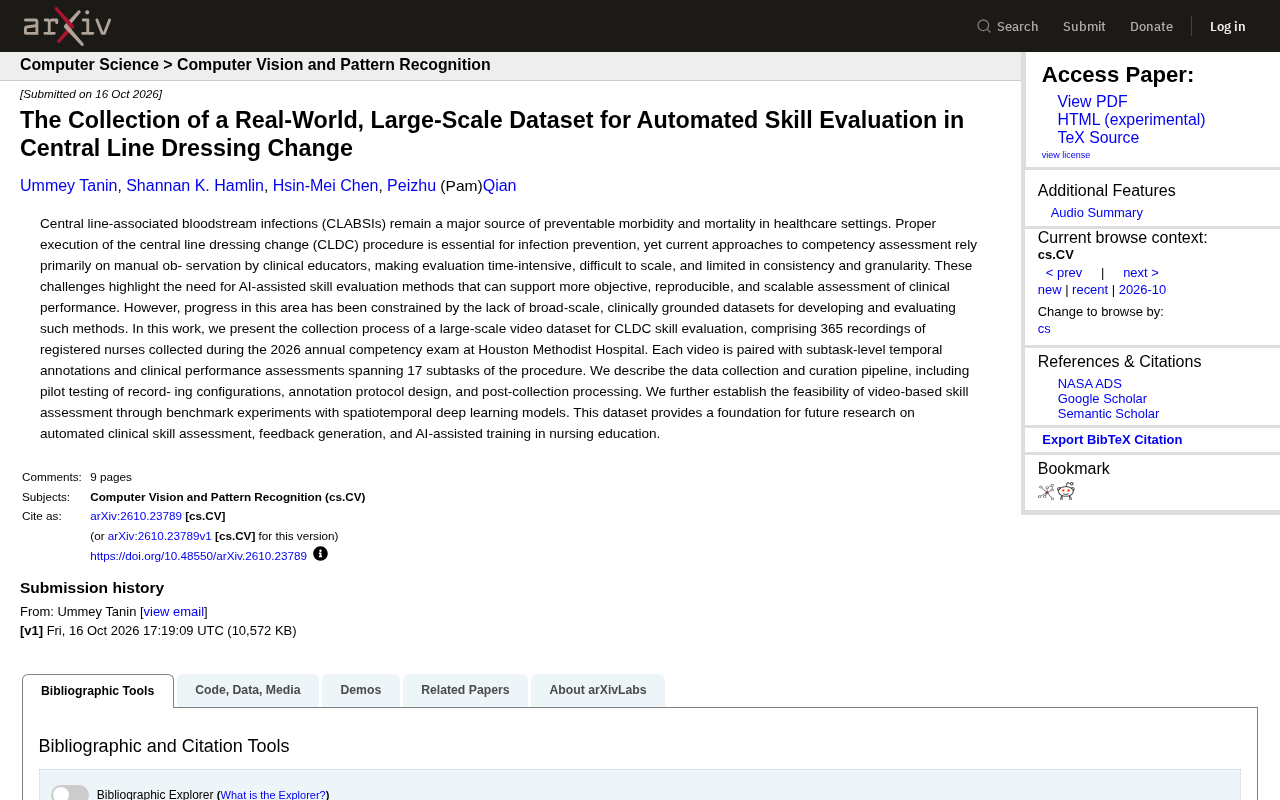
The dataset aims to address the lack of standardized, large-scale data for CLDC skill assessment. Manual assessment is not only time-consuming but also difficult to ensure consistency, especially in large-scale training settings. By providing video data with detailed annotations, the researchers hope to advance the development of AI-assisted assessment tools.
Central line-associated bloodstream infection (CLABSI): CLABSI refers to a primary bloodstream infection associated with a central venous catheter that occurs during catheter placement or shortly after removal, with no other clear source of infection. Because central venous catheters enter large veins directly, they provide pathogens a route that bypasses the skin barrier; once infection occurs, it can lead to sepsis, septic shock, and even death, while significantly prolonging hospital stays and increasing healthcare costs. Substantial evidence shows that strict adherence to aseptic technique (e.g., maximal sterile barriers, skin antisepsis, regular dressing changes) can greatly reduce CLABSI incidence, so assessing the quality of the dressing change procedure has direct clinical safety implications.
Data Collection and Curation Pipeline
The paper describes the data collection and curation pipeline in detail, including pilot testing of the recording setup, annotation protocol design, and post-collection processing. Pilot testing ensured the feasibility of the recording equipment and methods in the clinical environment, while the annotation protocol defined how to segment videos into subtasks and assess performance. These steps are critical to ensuring data quality and consistency.
Annotation Protocol and Quality Control
Each video underwent subtask-level temporal annotation, meaning annotators marked the start and end times of each subtask and provided clinical performance assessments. This fine-grained annotation enables models to learn the key steps and common errors in the procedure. Quality control measures may include annotator training, cross-validation, and consistency checks, though the original text does not elaborate.
Subtask-level temporal annotation: In skill assessment video datasets, subtask-level temporal annotation refers to decomposing the entire operational workflow into a number of well-defined atomic steps (such as "hand hygiene," "donning sterile gloves," "antiseptic application at the puncture site," etc.) and labeling precise start and end timestamps for each step. This annotation approach enables models to learn step order, per-step duration, and transition patterns between steps, thereby supporting fine-grained procedural assessment rather than only binary judgment of final outcomes. Compared with video-level labels alone, subtask-level annotations provide denser training signals, which help detect clinically common errors such as missed steps and out-of-order steps.
Spatiotemporal deep learning models: Spatiotemporal deep learning models refer to neural network architectures that simultaneously model spatial appearance information (e.g., hand movements, instrument shapes) and temporal dynamics (e.g., action order, rhythm). Typical examples include 3D convolutional networks (C3D, I3D), two-stream networks, and spatiotemporal Transformers. In video skill assessment tasks, the spatial branch extracts visual features from each frame, while the temporal branch captures inter-frame motion and long-range dependencies; after fusion, the two can output subtask categories, completion quality, or error types. Such models typically require large amounts of temporally annotated video for training, which is precisely the core value of this dataset.
Benchmark Experiments and Feasibility Validation
To validate the feasibility of video-based skill assessment, the researchers conducted benchmark experiments using spatiotemporal deep learning models. These experiments show that video-based automated assessment is feasible, laying the foundation for future research. Although the original text does not provide specific performance metrics, the existence of the experiments indicates that the dataset can be used to train and evaluate models.
Potential Applications and Future Directions
The dataset provides a foundation for future research on automated clinical skill assessment, feedback generation, and AI-assisted nursing education and training. Potential applications include real-time feedback systems, automated competency assessment tools, and personalized training plans. However, realizing these applications requires further research to address technical challenges and clinical integration issues.
Challenges and Limitations
Despite its large scale, the dataset has some limitations. For example, the data come from only one hospital and may not represent all clinical settings. In addition, the annotation process may be affected by subjectivity, although the protocol is designed to reduce this. The original text does not discuss these limitations, but they are factors to consider in future research.
Overall, this work makes an important contribution to the field of AI-assisted clinical skill assessment by providing a large-scale real-world dataset and demonstrating the feasibility of video-based assessment. With further research, such datasets are expected to help standardize skill assessment in nursing education and ultimately improve patient safety.
One-line Summary
Study releases a video dataset of central line dressing changes from 365 nurses, validating the feasibility of AI-based video skill assessment.
Paragraph Summary
To address the problem that assessment of dressing change competency for CLABSI prevention relies on manual observation and is time-consuming and difficult to scale, this study collected central line dressing change (CLDC) videos from 365 registered nurses during the 2026 annual competency exam at Houston Methodist Hospital, constructing a large-scale clinical skill assessment dataset. Each video is accompanied by subtask-level temporal annotations for 17 subtasks and clinical performance assessments, and the collection and curation pipeline covers pilot testing of the recording setup, annotation protocol design, and post-collection processing. The researchers conducted benchmark experiments using spatiotemporal deep learning models, validating the feasibility of video-based automated skill assessment and laying the foundation for real-time feedback, automated competency assessment, and AI-assisted nursing education, while noting limitations such as the single data source and annotation subjectivity.
Related articles

WorkBuddy Agent in Action: From AI Q&A to Automated Office Work
WorkBuddy is Tencent's AI agent desktop workbench that reads local files, operates office software, executes multi-step tasks, and runs on schedules. This article explains its core features, key differences from traditional AI tools, and use cases.

Anthropic Research: LLMs Make Formal Software Verification at Scale Possible
Anthropic Frontier Red Team research shows LLMs can generate formal proofs at the RISC-V assembly level for over 100 real open-source libraries, covering 123 OSS-Fuzz libraries and 239 entry points, totaling about 180 million lines of Rocq proofs and finding hundreds of bugs. The article analyzes specification generation, the proof pipeline, trust boundaries, and cost reduction paths.

Prompt Engineering for Beginners: From Writing Prompts to Building AI Collaboration Skills
From the four functions of prompts to the six-step prompt engineering process, this article systematically covers core concepts, business value, and three layers of limitations to help beginners build a complete cognitive framework for prompt engineering.