A New Approach to Unified Multimodal Models: Enabling VLMs to Generate Images via Shared Representations

Integral transforms a pretrained VLM into a unified multimodal model through shared visual representations, significantly improving generative capability.
The Integral method addresses the core obstacle of heterogeneous visual representations for understanding and generation in unified multimodal models by extending a pretrained VLM into a unified model through a shared representation space. Its core components are Abstraction Fusion (aggregating hierarchical features from a frozen visual encoder into shared visual tokens) and Block-wise MoT (a lightweight generation stream interacting with the VLM only at block boundaries). Controlled experiments show that shared representations significantly outperform independent representation spaces in generative learning while maintaining comparable reconstruction fidelity, indicating that pretrained VLM visual features can themselves provide an effective foundation for generation.
Title
A New Approach to Unified Multimodal Models: Enabling VLMs to Generate Images via Shared Representations
Meta Description
An analysis of the Integral method: constructing shared visual tokens via Abstraction Fusion and introducing a lightweight generation stream through Block-wise MoT to transform a pretrained vision-language model into a unified multimodal model. Controlled experiments show that shared representations significantly improve generative learning.
Article Content
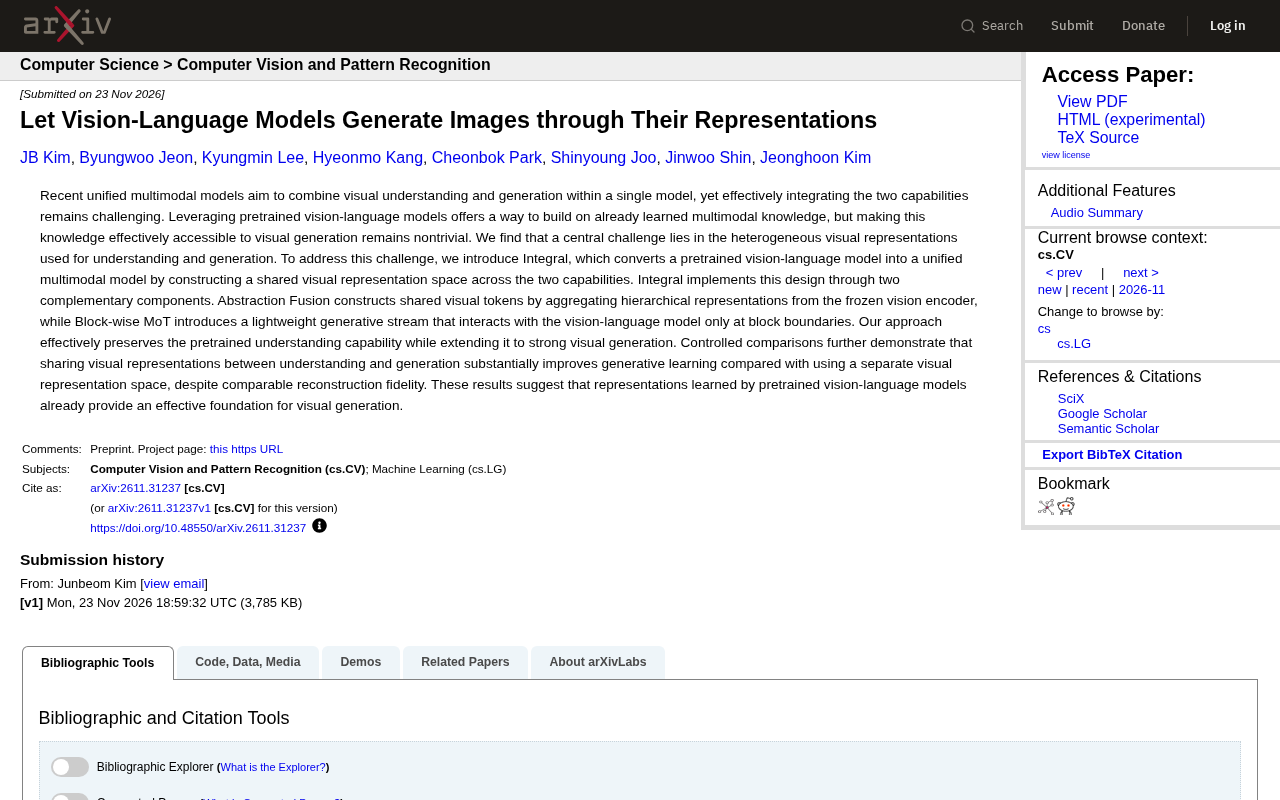
A core vision for multimodal large models is to possess both the ability to "understand" and the ability to "draw" within a single model. However, truly integrating visual understanding and visual generation is far more difficult than simply piecing two modules together. A recent study (source: rss) proposes a method called Integral, which transforms a pretrained vision-language model (VLM) into a unified multimodal model by constructing a shared visual representation space, offering a new solution to this challenge.
The Representation Gap Between Understanding and Generation
The study points out that the key obstacle to progress in unified multimodal models lies in the heterogeneity of the visual representations used for understanding and generation. Understanding tasks typically rely on hierarchical features extracted by a frozen visual encoder, while generation tasks often require a separate, independent representation space. The two representation systems operate in isolation, making it difficult for the multimodal knowledge already learned by pretrained VLMs to be directly leveraged for generation.
The starting point of Integral is precisely to bridge this gap: rather than building a separate system for generative capability, it lets generation reuse the representations already learned on the understanding side.
Heterogeneity of visual representations refers to the different requirements that understanding and generation tasks impose on how visual information is encoded. Understanding tasks (such as image question answering and captioning) typically use visual encoders pretrained on image-text pairs (e.g., CLIP's ViT), which output semantic-level patch features that have undergone multi-level abstraction, with a focus on distinguishing objects and semantic relationships. Generation tasks (such as image generation and editing), on the other hand, require pixel-level or fine-grained structural information and often employ encoders specialized for VAEs or diffusion models, whose latent spaces emphasize reconstruction fidelity. The feature distributions, dimensions, and information granularity of the two are inconsistent, making direct sharing within the same model difficult.
Hierarchical features refer to the feature maps output at different depths of a visual encoder: shallow layers retain details such as edges and textures, while deeper layers contain stronger semantic information. Understanding tasks commonly use multi-scale or final-layer features, whereas generation tasks require information at multiple granularities from fine to coarse, so directly reusing a single layer of features from the understanding side is usually insufficient.
The Two Core Components of Integral
Abstraction Fusion: Aggregating Hierarchical Representations
Abstraction Fusion is responsible for constructing shared visual tokens. It aggregates hierarchical representations from a frozen visual encoder, fusing visual features from different levels into a unified token sequence. In this way, understanding and generation start from the same representational foundation, allowing the visual knowledge accumulated during pretraining to be directly transferred to downstream generation tasks.
A frozen visual encoder means that during Integral's training, the parameters of the backbone network providing visual features (typically the vision tower in a pretrained VLM) are not updated; only the fusion module and the generation stream are trained. The benefit of this approach is that it avoids destroying the multimodal alignment knowledge learned during pretraining while significantly reducing training costs. The trade-off is that the fusion module must learn to extract information from fixed hierarchical features that is equally useful for generation.
Block-wise MoT: A Lightweight Generation Stream
Block-wise MoT introduces a lightweight generation stream that interacts with the VLM only at block boundaries. The advantage of this design is that the generation module does not need to intrude into the VLM's internals, thereby preserving the pretrained model's original understanding capabilities to the greatest extent possible while extending it to generation tasks at low cost.
MoT (Mixture of Transformers) is an architectural concept that combines multiple Transformer branches on demand, similar to a variant of Mixture of Experts (MoE) at the Transformer layer level. In Integral, Block-wise MoT allows the generation stream to exist as an independent branch that exchanges information with the main branch only at the boundaries of each Transformer block in the VLM (e.g., through gating or cross-attention), without modifying the parameters or forward paths inside the VLM blocks. This design allows the generation branch to be lightweightly inserted into an existing VLM while avoiding the forgetting of understanding capabilities that full-parameter fine-tuning can cause.
Shared Representations Yield Generation Gains
The study conducted controlled comparative experiments comparing two approaches: "sharing visual representations between understanding and generation" versus "using independent visual representation spaces." The results show that although the two are comparable in reconstruction fidelity, the shared-representation approach achieves significant improvements in generative learning. This comparison directly supports the paper's core argument: the representations learned by pretrained VLMs already provide an effective foundation for visual generation.
In other words, unified multimodal models do not need to build a generation-specific representation system from scratch; reusing the representations from the understanding side is actually more conducive to acquiring generative capabilities.
Implications for the Unified Multimodal Model Roadmap
The value of Integral lies not only in a specific method but also in the direction it points to: the key to unified multimodal models may not lie in "how many modules to add" but in "whether the representations are connected." Through the combination of Abstraction Fusion and Block-wise MoT, this method extends the model's capabilities to strong visual generation while preserving pretrained understanding abilities, providing a paradigm that subsequent research can draw on.
For practitioners concerned with the development of multimodal models, this study prompts us to re-examine the representational potential of pretrained VLMs—those visual features learned for understanding may well be the best starting point for generative capabilities.
One-line Summary
Integral transforms a pretrained VLM into a unified multimodal model through shared visual representations, significantly improving generative capability.
Paragraph Summary
The Integral method addresses the core obstacle of heterogeneous visual representations for understanding and generation in unified multimodal models by proposing to extend a pretrained vision-language model (VLM) into a unified model with both understanding and generation capabilities through a shared representation space. Its core components include Abstraction Fusion (aggregating hierarchical features from a frozen visual encoder to construct shared visual tokens) and Block-wise MoT (a lightweight generation stream that interacts with the VLM only at block boundaries to preserve pretrained understanding capabilities). Controlled experiments show that, with comparable reconstruction fidelity, the shared-representation approach significantly outperforms independent representation spaces in generative learning, indicating that the visual features learned by pretrained VLMs can themselves provide an effective foundation for generation. This research suggests that the key to unified multimodal models lies in connecting representations rather than stacking modules.
Related articles
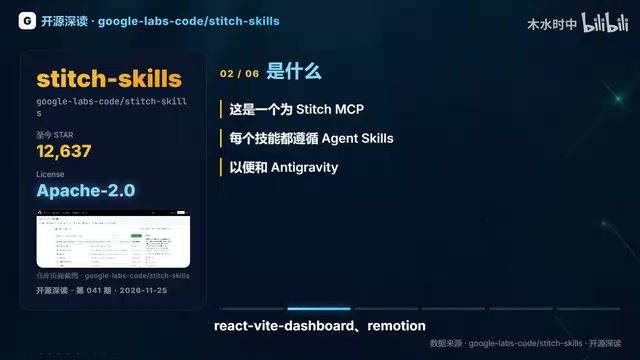
Google Stitch Skills: Connecting Coding Agents to the Design Workflow
Google Stitch Skills is an Agent Skills library following the open standard, adding a design-to-code workflow to the Stitch MCP Server. This article breaks down its three skill groups, SKILL.md directory structure, installation paths, and dependency pitfalls.
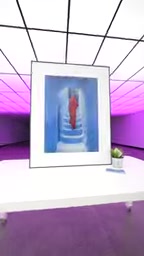
40.5-Inch Color E-Paper Art Frame: An Art Display You Charge Once a Year
The Ink Poster Tella 40.5-inch color e-paper art frame uses the E Ink Spectra 6 full-color solution: A1 format, no backlight, no noise, about one charge a year, 2,000+ licensed artworks built in, and automatic adaptation of phone photos.

Jingle Jam Memories: RT's Awkward First Encounter with Lewis
RT shares his awkward first Jingle Jam experience: unexpectedly pushed into the studio, meeting Lewis and Yogg's cast, and Toddy appearing in armor.