A New Billing Framework for Long-Context LLMs: Caching Cuts Costs by Two Orders of Magnitude, but Discounts Have Limits
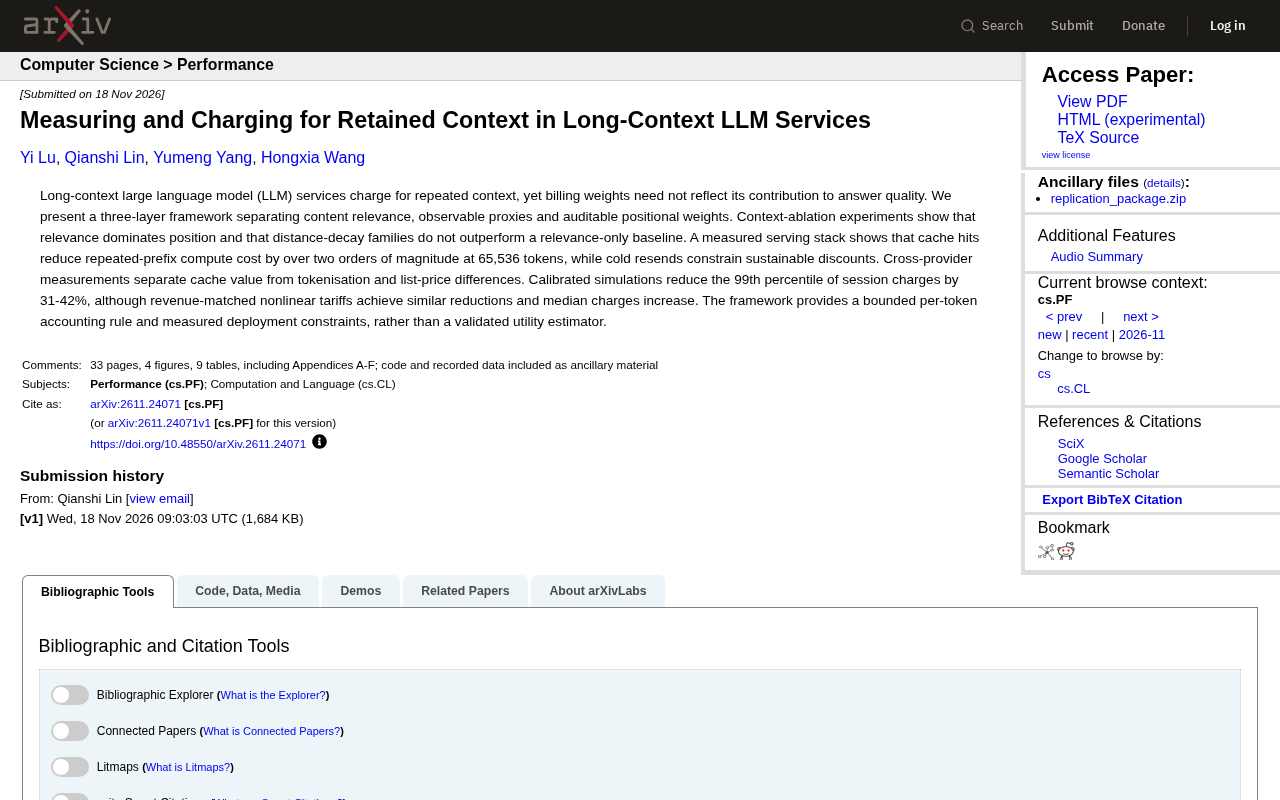
A study proposes a three-layer billing framework, testing retained-context billing for long-context services via measurement and simulation.
Addressing the crude billing practice of charging repeated context by token regardless of value, this study proposes a three-layer framework of content relevance, observable proxies, and auditable positional weights, decoupling billing weights from answer-quality contribution. Context-ablation shows content relevance dominates answer quality more than position, and distance-decay models fail to beat a relevance-only baseline. On a real service stack at 65,536 tokens, cache hits cut repeated-prefix compute costs by over two orders of magnitude, though cold resends limit sustainable discounts. In calibrated simulation, relevance weighting lowers 99th-percentile session bills by 31-42%, but revenue-neutral nonlinear tariffs achieve similar reductions with median bills rising. The authors position their work as bounded per-token accounting rules and deployment constraints, not a validated utility estimator.
Long-context large model services are becoming mainstream, but their billing methods have remained crude: context passed in repeatedly is charged by token regardless of whether it actually affects answer quality. A study titled "Measuring and Charging for Retained Context in Long-Context LLM Services" attempts to unpack this problem and presents an auditable three-layer billing framework.
Three-Layer Framework: Separating Content Relevance, Observable Proxies, and Positional Weights
The core claim of the research is that billing weights should not be equated with context's contribution to answer quality, but they also cannot be completely detached from it. To this end, the authors propose a three-layer structure:
- Content relevance layer: measures the degree of semantic association between a given context segment and the current question;
- Observable proxy layer: uses signals that the server can actually collect (such as cache hits and positional distance) as the basis for billing;
- Auditable positional weight layer: assigns explainable, reviewable weights to positional factors rather than making black-box adjustments.
The benefit of this layering is that it decouples "how much should be charged" from "what can be measured." Providers need not claim to have precisely estimated the value of each context segment; they only need to provide a bounded, verifiable per-token accounting rule.
Context-ablation is an experimental method that systematically removes or replaces parts of the input context to observe changes in model output quality. In this study, the authors use ablation to test different billing assumptions: for example, by removing a context segment from the input and observing how much answer quality drops, they can infer that segment's actual contribution to the answer. The advantage of this method is that it turns "whether context matters" into a measurable causal question rather than relying on prior assumptions. But it also has limitations—ablation can only approximately assess the value of a single context segment, struggles to capture interaction effects between multiple segments, and experimental costs rise with context length.
Auditable, in the billing context, means that every billing rule can be reviewed and explained by both the provider and the customer, rather than relying on an invisible black-box model. Auditable weight rules typically require: simple rule forms, publicly verifiable parameters, and reproducible billing results for the same input. This is different from "precisely estimating the value of each context segment"—auditability only guarantees that rules are transparent and verifiable, not that the rules themselves are optimal. The study emphasizes making the positional weight layer auditable precisely so that, given the inability to perfectly observe content relevance, the billing process can at least withstand scrutiny.
Relevance Overshadows Position: Distance-Decay Models Do Not Beat the Baseline
The study tested different billing assumptions through context-ablation experiments. The results yielded two key findings:
First, content relevance dominates answer quality more strongly than position. Context near the end is not necessarily more important.
Second, weight models such as distance-decay do not outperform a baseline that considers only relevance. In other words, discounting based on "the farther from the question, the less valuable" lacks sufficient support in empirical testing. This directly challenges some current approaches that price by position segments.
Real Service Stack: Cache Hits Reduce Repeated Prefix Costs by More Than Two Orders of Magnitude
On a real service stack, the study measured the impact of caching on the computational cost of repeated prefixes. At a context length of 65,536 tokens, cache hits reduced the computational cost of repeated prefixes by more than two orders of magnitude. This provides a physical basis for "retained context should enjoy discounts"—repeated content genuinely does not incur equivalent marginal computation.
But the authors also point out a constraint: cold resend limits the room for sustainable discounts. Once the cache misses and the context must be fully recomputed, the discount becomes difficult to sustain. Therefore, discounts cannot be an unconditional promise; they should be tied to cache status.
Cross-provider measurements further distinguish the value brought by caching from tokenization differences and list-price differences—when the three are mixed together, it is easy to misread price differences as cache efficiency differences.
Prefix caching is a key optimization in long-context services: when multiple requests share the same opening portion (for example, the same system prompt, the same document, or the same round of conversation history), the server can retain the key-value cache (KV cache) for that portion and reuse it directly in subsequent requests without redoing the forward computation. Since Transformer attention computation grows with context length, cache hits on repeated prefixes can significantly reduce compute consumption. The "more than two orders of magnitude" cost reduction in the study comes precisely from this saved repeated computation.
Cold resend refers to the situation where, on a cache miss, the client must resend the full context and trigger full computation. Caches typically have constraints such as time-to-live (TTL), capacity limits, and session isolation; once expired or evicted, the physical basis for the discount no longer exists. Therefore, tying discounts to cache status essentially means making billing reflect true marginal computational cost, rather than unconditionally conceding on "repeated content."
Calibrated Simulation: 99th Percentile Bills Drop 31-42%, but the Median Rises
The study used calibrated simulations to evaluate the effects of billing scheme adjustments. The relevance-weighted scheme reduced the 99th percentile of session bills by 31-42%. This significantly suppresses high tail-end bills.
However, the authors honestly present the other side: revenue-neutral nonlinear tariffs can achieve similar reductions while the median bill actually rises. In other words, tail-end cost reductions may not come from more precise metering, but may simply be a redistribution of the tariff structure. This is an important reminder for providers who market "fairer billing" as a selling point.
The distinction between percentile metrics and averages is crucial here. Session bills often exhibit a long-tail distribution: a small number of very long, highly repetitive sessions contribute a disproportionate share of costs. The 99th percentile measures the bill level of "the most expensive 1% of sessions"; reducing the 99th percentile means suppressing extreme tail-end bills, but it may well simultaneously raise the median bill for a large number of ordinary sessions. "Revenue-neutral" in the study means that the provider's total revenue remains roughly unchanged after the tariff adjustment, so the money for tail-end reductions must be recovered from other sessions in the middle or head of the distribution. This reminds us that when evaluating billing fairness, looking at any single percentile or average alone may lead to one-sided conclusions; one should consider the median, percentile spreads, and revenue-neutral constraints together.
Positioning: Bounded Accounting Rules, Not a Validated Utility Estimator
The paper is clear about the boundaries of its contribution: it provides a set of bounded per-token accounting rules and empirically measured deployment constraints, not a validated utility estimator. Content relevance is difficult to observe perfectly, and positional weights can only be made auditable rather than precise.
For designers of long-context services, the practical value of this framework lies in three points: tying discounts to cache hits, exercising restraint with positional weights, and evaluating billing fairness using percentile metrics rather than averages.
(This article is based on the arXiv paper abstract and does not introduce data beyond the original text.)
Related articles

HN Warning: Don't Use AI to Write Comments, or They'll Be Auto-Deleted
Hacker News warns that AI-written comments will be automatically deleted. This article analyzes HN's automated enforcement mechanism, the community's attitude toward AI-generated content, and what it means for creators using AI tools responsibly.

AI Product Manager Systematic Course for Beginners: Three Modules Explained with Pitfall Avoidance Guide
Breakdown of Bilibili's 100-episode AI product manager course: Foundation builds large model and Prompt cognition, Advanced tackles Agent workflows and RAG knowledge bases, Practice completes projects like personal knowledge bases and intelligent customer service. Includes learning roadmap and pitfall avoidance tips.

YOLO Object Detection for Absolute Beginners: Environment Setup and Core Concepts
Learn YOLO object detection from scratch: Python basics, VS Code, Miniconda environment setup. A Bilibili tutorial guides you step by step, with a desktop icon recognition project as your hands-on goal.