A New Framework for Generative AI Trust: Using Expert Models as Distributional References

Using expert model output distributions as references, turning generative AI trust into computable token statistics.
The article discusses the trust dilemma of generative models' "confident nonsense": outputs may seem credible yet be wrong, and many scenarios lack ground truth. A study proposes using expert model output distributions as a statistical "ruler" for token typicality, combined with token-level confidence, entropy, and perplexity, with an AI ontology calibrator producing 15 response-level metrics for correctness classification. The method avoids reliance on human labels. In BF program generation, math solving, and medical QA, calibrator metrics complement traditional ones to build hallucination detectors; detectors transfer across domains but asymmetrically, requiring per-domain calibration for deployment.
The Trust Dilemma of Generative AI
Modern generative models can produce convincing and confident responses even when their output is incomplete, unsupported, or outright wrong. This "confident nonsense" is precisely the core of the trust crisis—users find it very difficult to judge from the surface whether a model is reliable. More challenging still, in many scenarios there is no ground-truth answer or label to compare against, and the cost of verifying the truthfulness of outputs is extremely high.
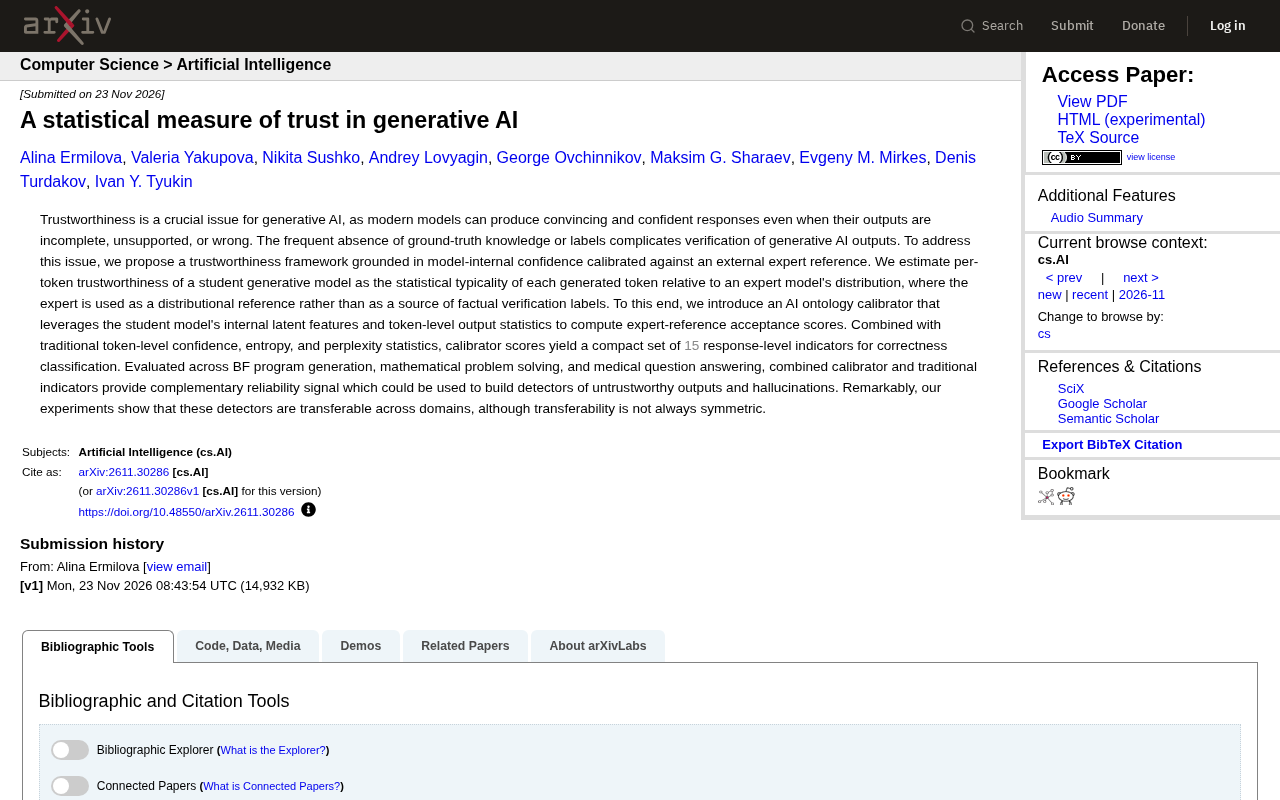
To address this problem, a study proposes a trust framework based on the model's internal confidence, using external expert models as distributional references. The core idea is not to have the expert model judge factual correctness, but rather to treat the expert model's output distribution as a "ruler" for measuring how statistically "typical" each token generated by the student model is.
How the Framework Works: The AI Ontology Calibrator
The research team introduces an AI ontology calibrator, which uses the student model's internal latent features and token-level output statistics to compute an "expert-reference acceptance score." This score is combined with the student model's own token-level confidence, entropy, perplexity, and other traditional statistics to ultimately form a compact set of 15 response-level metrics for classifying output correctness.
The key design lies in the role assigned to the expert model: it serves as a distributional reference, not as a source of fact-verification labels. This means the method does not rely on human-annotated ground truth, but instead extracts reliability signals from distributional differences between models. This approach sidesteps the deadlock of "no labels means no verification."
Perplexity and token-level confidence are foundational statistics for evaluating the reliability of language model outputs. Perplexity measures how "surprised" a model is by a sequence: lower values indicate greater model confidence in that sequence, typically lower on in-distribution text and higher on anomalous or out-of-distribution text. Token-level confidence refers to the probability the model assigns to the chosen token at each generation step, while entropy characterizes the dispersion of the entire probability distribution—high entropy means the model is hesitating among multiple candidates. These quantities only reflect the model's "self-perceived" certainty and do not directly equate to factual correctness, so relying on them alone can easily misclassify "confident errors" as reliable outputs. The study combines them with the expert-reference acceptance score precisely to use external distributional information to correct this self-reported confidence, making the reliability signal more discriminative.
Cross-Domain Experiments: Detectors Are Transferable
The study evaluated the framework in three markedly different scenarios: BF program generation, mathematical problem solving, and medical question answering. Results show that combining calibrator metrics with traditional metrics provides complementary reliability signals that can be used to build detectors for untrustworthy outputs and hallucinations.
More noteworthy is transferability: experiments show these detectors can transfer across domains, although transferability is not always symmetric. That is, a detector trained in domain A may work in domain B, but the reverse may not hold. This finding has direct implications for real-world deployment—when building detectors, the training domain must be chosen carefully, and one cannot assume transfer effects are bidirectionally equivalent.
Distribution shift and covariate shift are key background for understanding cross-domain detector performance. When a detector trained in domain A is applied to domain B, the statistical distribution of input data changes (covariate shift), and the originally learned "untrustworthy" features may conflict with the normal output patterns of the new domain, degrading detection performance. Transferability may be asymmetric because the output distributions and error patterns of different domains are not equivalent: for example, errors in mathematical solving often manifest as broken reasoning chains, while errors in medical QA may appear as terminology misuse or missing evidence—their token-level statistical signatures differ significantly. Therefore, transferring from a domain with "richer error patterns that are closer to the target distribution" to a simpler domain is usually easier than the reverse. This also explains why real-world deployment requires recalibrating thresholds and feature weights for the target scenario.
Implications for Practitioners
The value of this framework lies in transforming "trust" from a subjective feeling into computable statistics. For developers, the 15 response-level metrics offer a lightweight means of output screening that can flag high-risk responses without an additional fact-verification pipeline. For researchers, the idea of using expert models as distributional references rather than label sources opens a new direction for unsupervised reliability assessment.
Of course, the asymmetry of transferability also reminds us: there is no one-size-fits-all universal detector. Distributional differences across domains weaken cross-domain detection performance, and practical applications still require calibration for the target scenario.
One-line Summary
Using expert model output distributions as references, turning generative AI trust into computable token statistics.
Paragraph Summary
The article discusses the trust dilemma posed by generative models' "confident nonsense": outputs may seem credible yet be wrong, and many scenarios lack a ground-truth answer for comparison. To address this, a study proposes using an expert model's output distribution as a statistical "ruler" to measure the typicality of each token generated by the student model, combining this with token-level confidence, entropy, perplexity, and other traditional statistics, with an AI ontology calibrator producing 15 response-level metrics for correctness classification. The method does not rely on human-annotated ground truth, sidestepping the deadlock that unlabeled data is hard to verify. In three scenarios—BF program generation, mathematical solving, and medical QA—calibrator metrics complement traditional metrics and can build hallucination detectors; detectors can transfer across domains, but transferability is asymmetric, so deployment requires calibration for the target domain.
Related articles

GLM-5.4 vs. Opus and Neon: How Far From the Top?
No official benchmarks for GLM-5.4. Based on a YouTube deep test and developer trials, we analyze its gap vs. Claude Opus 5.5 and Gemini Neon, the speed bottleneck from marathon-style thinking, and its real position in enterprise agent scenarios.

From Gobbler to Sloppy Joe: The Hit-Making Playbook of a New Jersey Deli Institution
NYT Cooking visits Milburn Deli in New Jersey to break down the hit logic behind the Gobbler turkey sandwich and the local Sloppy Joe: bread sliced to order, house-made sauces, a group shout culture, and customer co-creation behind six locations.
In the Age of AI Programming, When Do You Still Need to Write Code by Hand?
Is handwritten code still valuable once AI programming agents are widespread? This article outlines three scenarios where handwriting is essential—learning, style development, and prototype validation—and provides a division-of-labor framework between AI and humans to help developers balance efficiency and skill growth.