A New Model-Free State Estimation Method: Set-Membership Filtering with Probabilistic Guarantees
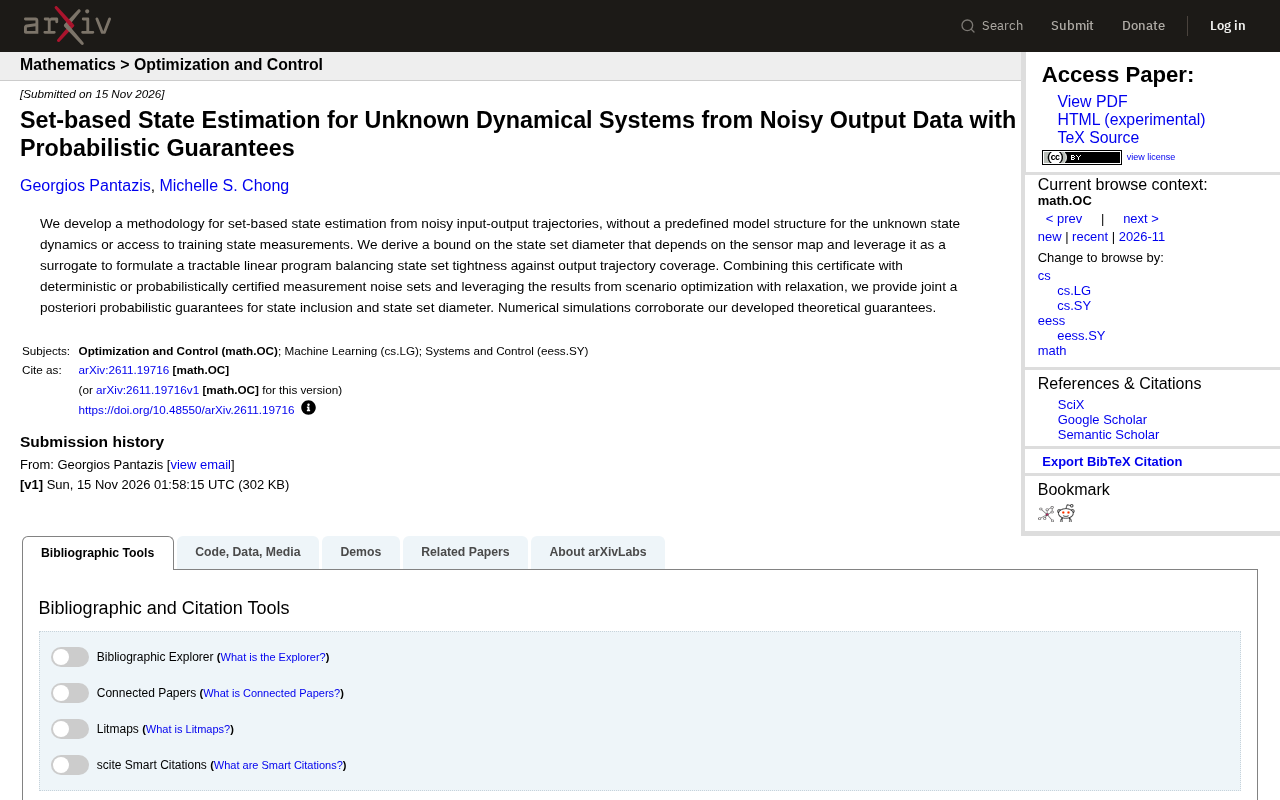
An arXiv paper proposes model-free set-membership state estimation with probabilistic guarantees via linear programming and scenario optimization.
This article introduces an arXiv paper proposing a model-free set-membership state estimation method. Unlike Kalman filtering, it estimates states using only noisy input-output trajectories without a predefined state dynamics model or training of state measurements. Its core is a state set diameter bound depending on the sensor map, used to construct a linear programming problem balancing state set tightness and output trajectory coverage. Combined with scenario optimization relaxation, it provides a joint posterior probability guarantee on state containment and state set diameter. Simulations validate the theory. The method suits robot control and process monitoring where accurate models are unavailable, but it has only been validated in simulation, and linear programming complexity may limit large-scale application.
Introduction
In control engineering and signal processing, state estimation is one of the core problems. Traditional methods such as Kalman filtering typically require a known system model, but in practice, an accurate model of a dynamic system is often difficult to obtain. A recent paper from arXiv proposes a model-free set-membership state estimation method that achieves state estimation using only noisy input-output trajectories, with probabilistic guarantees. The method does not rely on a predefined state dynamics model and requires no training of state measurements, offering a new approach for estimating unknown systems.
Set-Membership State Estimation is an important paradigm in state estimation. Unlike probabilistic methods such as Kalman filtering, it assumes that noise or uncertainty belongs to a known set (e.g., ellipsoid, polytope, or interval) and outputs a set guaranteed to contain the true state rather than a single point estimate. Its advantage lies in not relying on statistical distribution assumptions about noise and providing deterministic guarantees in the worst case. Traditional set-membership estimation still requires a known system dynamics model, propagating the state set iteratively through prediction and update steps; the method described in this paper further removes the dependence on the state dynamics model, constructing state sets using only input-output data—a new extension of the set-membership idea to the model-free setting.
Method Core: State Set Diameter Bound and Linear Programming
The core innovation of the paper is the derivation of a bound on the diameter of the state set, which depends on the sensor map. The authors use this bound as a surrogate metric to construct a solvable linear programming problem that balances the tightness of the state set against the coverage of the output trajectory.
Specifically, the method combines deterministic or probabilistically certified measurement noise sets and leverages relaxation techniques from scenario optimization to provide a joint posterior probability guarantee on state containment and state set diameter. This guarantee means that the estimation result not only gives the possible range of the state but also quantifies the confidence level of that range.
Sensor Map refers to the mapping from system state to measurement output, typically denoted as y = h(x) + v, where h is a known observation function and v is measurement noise. In model-free state estimation, the sensor map is often the only prior structural information available, because it is determined by the physical characteristics of the sensor and is usually easier to obtain than a state dynamics model. The state set diameter bound derived in this paper depends precisely on the properties of the sensor map: the better the sensitivity or condition number of the map, the narrower the distinguishable state range, and the tighter the bound on the state set diameter. This also explains why the method can still obtain meaningful estimates without a dynamics model—the observation structure itself provides the primary information constraining the state set.
Probabilistic Guarantees and Scenario Optimization
The paper provides rigorous probabilistic guarantees for state estimation through scenario optimization theory. Scenario optimization is a sample-based optimization method that can provide probabilistic performance guarantees with a finite number of samples. The authors combine it with set-membership estimation, making the estimation results reliable in a probabilistic sense.
Numerical simulations validate the effectiveness of the theoretical guarantees. Simulation results show that the method can achieve tight state set estimates under noisy data while maintaining coverage of the output trajectory.
Scenario Optimization is a class of robust optimization methods based on random samples: constraints with random uncertainty are approximated by a finite number of sampled scenarios, and a deterministic optimization problem is solved under these scenarios. Its core theoretical result shows that, under the assumption of independent and identically distributed samples, the resulting solution satisfies the constraints of unsampled scenarios with a certain confidence level, and this probabilistic guarantee depends only on the number of samples and the dimension of the decision variables, independent of the distribution form of the uncertainty. This property makes it particularly suitable for situations where the noise distribution is unknown. In this paper, scenario optimization is used to transform measurement noise set constraints into computable linear constraints, thereby providing a joint posterior probability guarantee on state containment and state set diameter with finite data.
Potential Applications and Limitations
The method is applicable to scenarios where an accurate model is unavailable but multiple sets of input-output data exist, such as robot control and process monitoring. However, the paper currently validates the method only through numerical simulation and has not yet tested it on real systems. In addition, the computational complexity of linear programming grows with problem size, which may limit its application to large-scale systems.
Conclusion
This research provides a new theoretical tool for model-free state estimation, achieving state estimation with probabilistic guarantees by combining set-membership estimation with scenario optimization. Future work may include extending to nonlinear systems, reducing computational burden, and validation on real platforms.
One-line Summary
An arXiv paper proposes model-free set-membership state estimation with probabilistic guarantees using linear programming and scenario optimization.
Paragraph Summary
This article introduces a paper from arXiv that proposes a model-free set-membership state estimation method. Traditional methods such as Kalman filtering require a known system model, whereas this method estimates states using only noisy input-output trajectories, without a predefined state dynamics model or training of state measurements. Its core is the derivation of a state set diameter bound that depends on the sensor map, which is used as a surrogate metric to construct a linear programming problem balancing state set tightness and output trajectory coverage. Combined with relaxation techniques from scenario optimization, the method provides a joint posterior probability guarantee on state containment and state set diameter. Numerical simulations validate the effectiveness of the theoretical guarantees. The method is suitable for scenarios lacking accurate models, such as robot control and process monitoring, but it has only been validated in simulation so far, and the computational complexity of linear programming may limit its large-scale application.
Related articles

AI Teams Up with Mathematicians to Attack the Riemann Hypothesis: 17 Million Lines of Code Tear Open a 167-Year Gap
In November 2026, Anthropic mathematicians and Claude claimed to have discovered a proof of the Riemann Hypothesis, publishing 17 million lines of Lean formalized code that passed machine verification. This article analyzes the event's impact on mathematics and cryptography, and the deeper questions raised by the separation of discovery and understanding.
AI Claims Formal Proof of the Riemann Hypothesis — But Machine Verification Isn't a Mathematical Proof
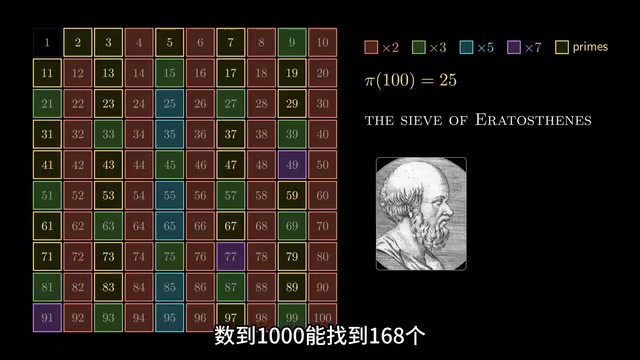
In Nov 2026, Anthropic's Levent Alpöğe released a Riemann Hypothesis proof of 175,000 code files that passed machine formal verification. But machine verification isn't a mathematical proof: the kernel can't confirm the proposition is the Riemann Hypothesis humans understand, and there's no human-readable paper. This article breaks down how ζ function zeros determine prime-count deviation, and the core of the controversy.

Anthropic Raises Over $80 Billion in IPO, DeepSeek Secures $100 Billion in Funding: AI Weekly Roundup
This week in AI: Anthropic's Nasdaq IPO raises $93.5B in the largest ever, DeepSeek closes ~100B yuan round, AI claims formal Riemann proof, MiniMax breaks crypto candidates in seconds.