AI Claims Formal Proof of the Riemann Hypothesis — But Machine Verification Isn't a Mathematical Proof

Anthropic claims a formally verified Riemann Hypothesis proof, but machine verification passing doesn't equal a proof accepted by the math community.
In 2026, Anthropic's Levent Alpöğe released a formalized Riemann Hypothesis proof of 175,000 code files, which passed a machine kernel. The article explains that the deviation between the prime count and the smooth logarithmic integral is governed by the ζ function's zero positions—all zeros on the critical line means minimal deviation. Humans have verified the first 10 trillion zeros, but infinitely many zeros and precedents of "holding over a vast range then failing" mean verification isn't proof. Formal verification checks each step's legality but can't judge whether the proposition is the Riemann Hypothesis as humans understand it; only partial verification is done, with no human-readable paper. The author admits announcing before fully digesting the background, and the Clay Institute's criteria are far from met. Even if true, it won't break encryption but would make many theorems depending on the conjecture unconditional.
A "machine says it passes" proof: why the math world is up in arms
In November 2026, a mathematician named Levent Alpöğe (from Anthropic) unveiled a proof of the Riemann Hypothesis. The proof consists of 175,000 code files, written in some language, allowing a machine to verify every step of the derivation. The machine's feedback: passed.
But the problem follows immediately: if a machine says the proof passes, does that really count as a proof? The controversy in the math world centers on exactly this point.
The Riemann Hypothesis has stood for 167 years, carries a $1 million prize, and is called the hardest problem in mathematics. This article doesn't take sides—it just breaks the matter down: what has actually been proven, and what hasn't yet.
What the Riemann Hypothesis is actually asking
You've certainly learned about primes: 2, 3, 5, 7, 11—numbers divisible only by 1 and themselves. Primes are the atoms of the integer world. The question is: how are primes distributed?
Among the first 100 numbers you can find 25 primes; counting up to 1000 you find 168. There seems to be no pattern—sometimes they appear consecutively, like 11 and 13; sometimes there are several gaps, like the seven non-primes in a row after 89. But over very long scales, a pattern does exist.
Gauss discovered that the probability a number near X is prime is roughly 1 divided by the natural logarithm of X. Summing these probabilities gives a smooth curve called the logarithmic integral. It differs from the true prime count by less than 0.2%.
The key point: the true prime count is like a staircase, jumping one level each time a prime appears; the smooth curve has no steps. How large can the gap between them get at most? This is the core question of the Riemann Hypothesis.
Zeta function zeros: the "tuning knobs" of prime deviation
In 1859, the mathematician Riemann devised a function called the zeta function (ζ function). Pick a number S, compute 1 plus 1 over 2 to the S, plus 1 over 3 to the S, and sum infinitely. This sum can be rewritten as a product over all primes—that is, the ζ function encodes information about all primes.
Riemann extended S to negative numbers, and negative numbers are points on the plane. He discovered that the staircase of the prime count can be expressed exactly as a smooth curve plus one oscillation for each zero, superposed together.
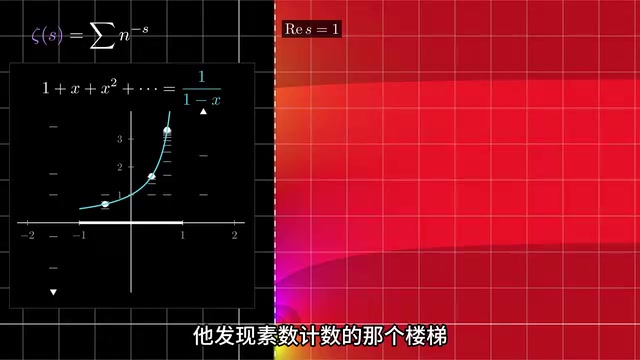
Where the zeros lie directly determines how the oscillations vibrate, and thus just how irregular the primes are. These zeros all line up on a numerical line called the critical line (originally written as the "zero boundary line"), with real part equal to 1/2. Riemann hand-computed the first few, all on the line. He wrote: it is very probable that all zeros lie on this line. Then he gave up on proving it. That is the Riemann Hypothesis.
If all zeros lie on the critical line, each oscillation grows at the slowest possible rate, and the primes won't stray far from the smooth curve. If a single zero deviates—say with real part 0.8—its corresponding oscillation grows like X to the 0.8 power, dragging the prime count badly off course.
Analytic continuation is the key technique for understanding the ζ function. The original definition Σ 1/n^s converges only when the real part exceeds 1; Riemann "continued" this definition to the entire complex plane (except for a simple pole at s=1), giving the ζ function meaning in the negative numbers and in the region with real part less than 1. This continuation is unique and satisfies a functional equation linking s with 1−s. It is precisely through continuation that the ζ function acquires nontrivial zeros—those zeros with real part between 0 and 1. The Riemann Hypothesis asserts that all these nontrivial zeros have real part equal to 1/2. Without analytic continuation, the ζ function is simply undefined within the critical strip, and the conjecture couldn't even be stated.
Verifying 10 trillion zeros—why it still isn't a proof
You might ask: so why not just verify it? Humans have already verified the first 10 trillion zeros, all on the line. But that isn't a proof, because there are infinitely many zeros.
There's a pattern in number theory: a conclusion can hold over an astronomically large range and then suddenly fail. For example, in 1914 someone proved that the size relationship between the prime count and the smooth curve flips infinitely many times. So verifying 10 trillion zeros is nowhere near enough.
The explicit formula is the bridge connecting the prime count to the zeros of the ζ function. It states precisely: the prime counting function ψ(x) equals x minus the sum over all nontrivial zeros ρ of x^ρ/ρ, minus some secondary terms. The magnitude of each term x^ρ is x to the power Re(ρ), and the oscillation frequency is determined by Im(ρ). Thus, the real part of each zero directly controls the amplitude of the corresponding oscillation term. If all zeros have real part 1/2, the error term is at most O(√x log x); if any zero has real part greater than 1/2, the error term grows with a larger exponent, and the prime distribution deviates significantly from the smooth curve. The explicit formula is the mathematical core of why the Riemann Hypothesis can "control" prime deviation.
What formal verification does—and doesn't do
So is this proof reliable? Anthropic performed formal verification in some language. The principle: write the definitions, propositions, and proof all as code, and a small program called the kernel verifies whether each step is a legal derivation. As long as the kernel accepts, the probability of error is extremely low.
But the problem is: the kernel cannot tell you whether the proposition you proved is the Riemann Hypothesis as humans understand it. It's like writing code that implements a feature—whether that feature actually solves the original requirement is absolutely critical, and a machine won't judge that for you.
Currently: partial verification is complete, all passing; some parts take too long and are still running. MIT experts ran it through multiple checkers, and everything that completed passed. But there is still no traditional paper that a human can easily read.
Levent Alpöğe himself admitted: he announced the result before fully digesting the mathematical background. That is where the controversy lies.
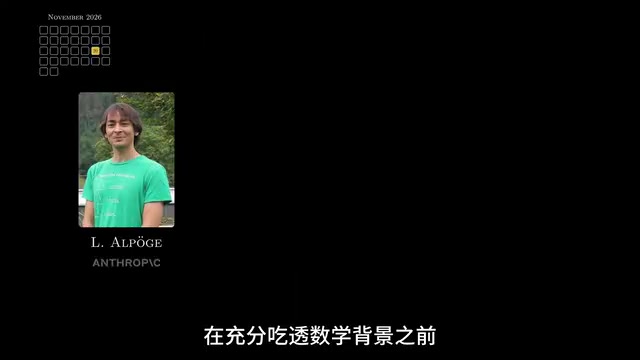
The Clay Mathematics Institute stipulates that a solution must be formally published, survive two years of public scrutiny, and be broadly accepted by the academic community before it counts as solving a Millennium Problem. Right now this proof is only a proposal.
Formal verification refers to translating mathematical propositions and proofs into a machine-checkable formal language (such as Lean, Coq, Isabelle), with each application of an inference rule verified step by step by a small trusted kernel. Its reliability rests on the "de Bruijn criterion": the kernel is minimal and rigorously reviewed, and all complex theorems are built up from simple rules. However, formal verification can only guarantee that "if proposition P is formalized and the proof passes, then P holds"; it cannot guarantee that the formalized P faithfully matches the original proposition in natural language. This "formalization gap" is precisely one focus of the current controversy.
Even if proven, what's the use?
Many people think proving the Riemann Hypothesis would break encryption. Wrong. Understanding how primes are distributed does not mean you can quickly factor large integers. Existing cryptographic systems won't collapse.
But it would turn a great many mathematical theorems from "assuming the Riemann Hypothesis holds" into unconditional truths. More importantly, it answers an ultimate question: just how regular is the distribution of the primes?
In 1859, Riemann set the proof aside. In 2026, a machine says it has found the answer. But mathematicians are only just beginning to read that answer. This 167-year quest may be over—or it may not be.
Is this a triumph of artificial intelligence, or a predicament for human mathematics? The answer may depend on how you define "proof."
One-line Summary
Anthropic claims a formally verified proof of the Riemann Hypothesis, but machine verification passing doesn't equal a proof accepted by the math community.
Paragraph Summary
In 2026, Anthropic's Levent Alpöğe released a formalized Riemann Hypothesis proof made of 175,000 code files, which passed verification by a machine kernel. The article explains the heart of the conjecture: the deviation between the prime count and the smooth logarithmic integral is determined by the positions of the ζ function's zeros—if all zeros lie on the critical line, the deviation is minimal. Humans have verified the first 10 trillion zeros, but infinitely many zeros and precedents in number theory of "holding over a vast range then failing" mean verification isn't proof. Formal verification can check the legality of each step, but cannot judge whether the proven proposition is the Riemann Hypothesis as humans understand it; only partial verification is complete, and there is no human-readable paper yet. The author admits announcing the result before fully digesting the mathematical background, and the Clay Institute's criteria are far from met. Even if it holds, it won't break existing encryption, but it would make many theorems that depend on the Riemann Hypothesis unconditionally true.
Related articles

AI Teams Up with Mathematicians to Attack the Riemann Hypothesis: 17 Million Lines of Code Tear Open a 167-Year Gap
In November 2026, Anthropic mathematicians and Claude claimed to have discovered a proof of the Riemann Hypothesis, publishing 17 million lines of Lean formalized code that passed machine verification. This article analyzes the event's impact on mathematics and cryptography, and the deeper questions raised by the separation of discovery and understanding.

Anthropic Raises Over $80 Billion in IPO, DeepSeek Secures $100 Billion in Funding: AI Weekly Roundup
This week in AI: Anthropic's Nasdaq IPO raises $93.5B in the largest ever, DeepSeek closes ~100B yuan round, AI claims formal Riemann proof, MiniMax breaks crypto candidates in seconds.

AI Proves the Riemann Hypothesis via Formal Verification? The Truth and the Controversy
AI and Claude are said to have completed a proof of the Riemann Hypothesis and passed Lean formal verification, sparking heated discussion. This article sorts through the event, explains what formal verification really means, and points out overinterpretations and unverified information to watch for in its spread.