A New Paradigm for AI Coding: Delegating UX Verification to Subagents

A nightly build commit delegates UX verification to subagents and patches permission, identity, and event projection consistency.
The article analyzes a nightly build commit, `feat(core): delegate UX verification to subagents`, whose core signal is splitting UX verification out of the main agent's duties and assigning it to a dedicated subagent to separate generation from verification. Three accompanying fixes ensure the approval policies of delegated tools, worker identity and agent execution mode, and child identity across Hub event projection all remain consistent — showing the real cost of delegation lies not in dispatch but in fully transferring context and policies. It distills three lessons: make verification a separate duty, treat delegation as a contract rather than a call, and use nightly builds as a window into architectural evolution.
The Architectural Signal Behind a Nightly Build Commit
On GitHub, a nightly build commit named desktop-nightly-20261104233655 carries the title feat(core): delegate UX verification to subagents (#15523). Judging from the commit message, this is not an ordinary feature patch — it explicitly carves out "UX verification" from the main agent's responsibilities and hands it to a dedicated subagent. In the same commit, the author abeatrix also included several fixes: preserving the approval policies of delegated tools, preserving worker identity and agent execution mode, and preserving child identity across Hub event projection.
Viewed together, these fixes reveal something more interesting than the title itself: delegation is not as simple as "telling a subagent to go run something." Identity, permissions, and execution mode must all survive the delegation chain without loss. This is precisely the key engineering detail that separates a multi-agent system that merely works from one that is genuinely usable.
Nightly build is a build that is automatically triggered on a fixed cycle (usually every night) in software development, with artifacts typically tagged with a date or timestamp — as in the commit desktop-nightly-20261104233655 in this article. Unlike official releases, nightly builds are used to verify that code merged that day can compile, package, and pass basic tests, so they often carry architecture changes and new features that are not yet stable. For large projects, nightly builds are an important part of the continuous integration pipeline, surfacing regressions early before problems spread. For observers, nightly build commits tend to be more granular with denser patches, so they reflect a team's technical direction earlier than official releases.
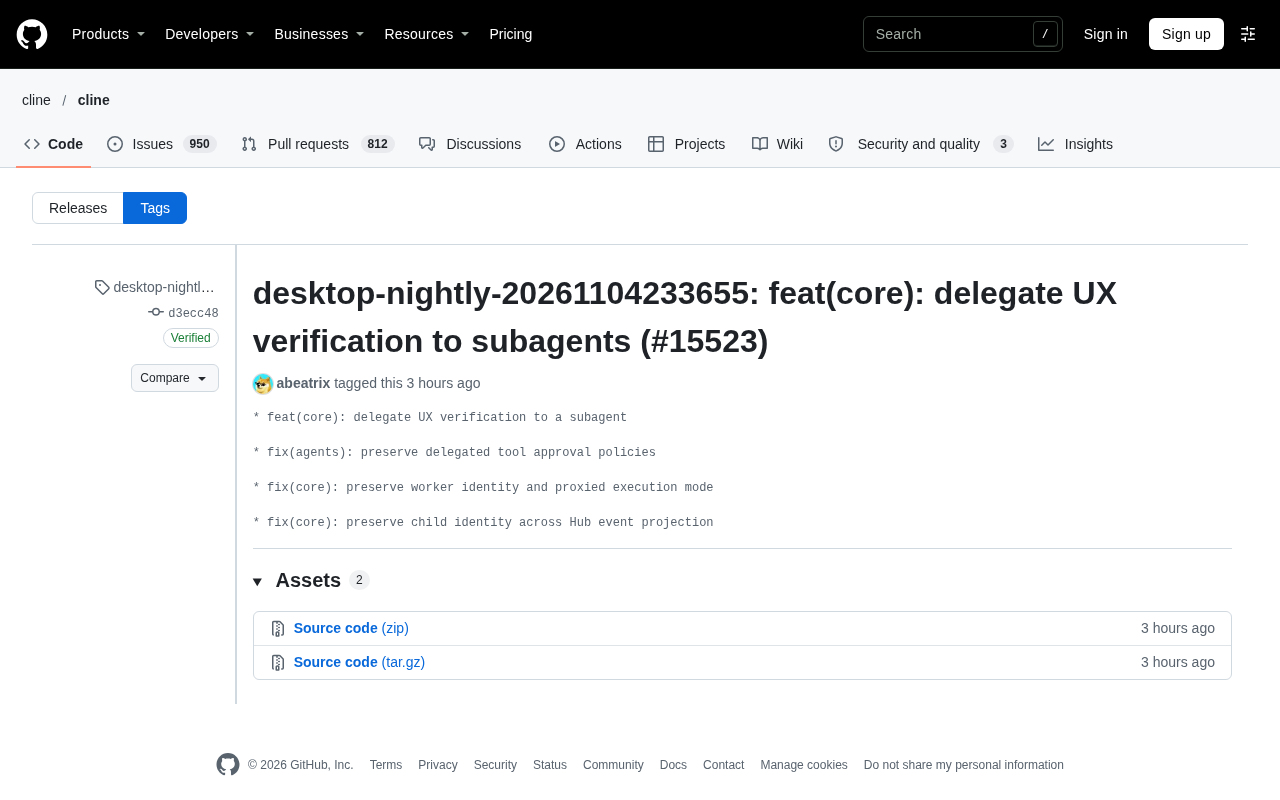
What Delegating UX Verification Means
From "the Main Agent Does It All" to "Separation of Duties"
In early AI coding agents, a single agent often handled writing code, running tests, and checking results simultaneously. UX verification was crammed into the main flow, and the problem is that its criteria differ from code correctness: code compiling and tests passing does not mean the interface interactions, state feedback, and flow transitions are right.
Delegating UX verification to a subagent essentially establishes a separate executor for "whether the experience meets the bar." The main agent drives the task forward, while the subagent reviews from an experience perspective, making the boundary of responsibilities clear. This split is especially valuable for complex tasks, because the main agent tends to accumulate contextual bias during long execution chains, whereas an independent subagent is more likely to spot overlooked experience gaps.
Subagent is a concept in multi-agent systems: the main agent is responsible for overall task planning and progress, and when a specific capability is needed, it delegates part of the work to a dedicated subagent, which returns its results upon completion. Subagents typically have independent context windows and tool sets, and can carry different identities and permission policies from the main agent. The advantage of this structure is isolation of duties — different agents can focus on different criteria, avoiding the contextual bias a single agent accumulates during long execution chains. The cost is that context, identity, and policies must be fully passed along the delegation chain, otherwise the subagent's behavior will deviate from expectations — which is exactly the problem the three fixes in this article address.
Permissions and Identity Must Not Evaporate with Delegation
Two of the fixes in the commit deserve separate mention. preserve delegated tool approval policies points to the issue of inheriting tool approval policies: the approval rules for tools invoked by a subagent must not fall back to defaults just because the executor changed, otherwise delegation becomes a loophole for bypassing approvals. preserve worker identity and proxied execution mode ensures the subagent knows under what identity and in what execution mode it is working.
The third fix, preserve child identity across Hub event projection, is more low-level: during the Hub's event projection process, the subagent's identity must be correctly restored. The event system is the nerve center of multi-agent collaboration; if child identity is lost during projection, subsequent tracing, auditing, and state reporting will all be distorted. Taken together, these three fixes show the team is seriously addressing the "consistency" of delegation, rather than merely building a dispatch entry point.
Tool approval policies refer to the authorization rules an agent must pass before invoking external tools (such as executing commands, reading or writing files, or making network requests), typically including whether human confirmation is required, the permitted scope of operations, and risk-level thresholds. In a multi-agent system, if tools invoked by a subagent fall back to default approval rules, operations that should have been restricted for the main agent may be bypassed by the subagent, creating a permission vulnerability. Therefore, when delegating, approval policies must be passed along with agent identity to ensure the subagent inherits the same constraints as the original executor. This is consistent with the principle of least privilege: permissions must not be relaxed just because the executor changes — a basic requirement for the security of any delegation mechanism.
Event projection is a pattern in event-driven architecture: the system records state changes as immutable events, then replays and aggregates these events through projection into a queryable view of current state. In multi-agent collaboration, the Hub serves as the event center collecting behavioral events from each agent, and the projection process must correctly restore the agent identity each event belongs to, including subagent child identities. If child identity is lost during projection, events cannot be accurately attributed to a specific executor, and tracing, auditing, and state reporting will all deviate. So "preserving child identity across Hub event projection" may look low-level, but it is in fact the foundational guarantee of multi-agent observability.
Three Lessons for AI Coding Tools
Making Verification a Separate Duty
When a system starts assigning a dedicated agent to "verification," it has recognized that generation and evaluation are two different capabilities. Generation pursues coverage and speed; verification pursues scrutiny and edge cases. Delegating UX verification to a subagent is equivalent to building a dedicated critic into the pipeline — much closer to real engineering practice than having the main agent check its own work.
Delegation Is a Contract, Not a Call
Permissions, identity, execution mode, event projection — if any one of these four is lost during delegation, the subagent's behavior will deviate from expectations. The three consecutive fixes in the commit illustrate exactly this: the real cost of a delegation mechanism lies not in dispatch, but in the complete transfer of context and policies. This is reusable experience for any team looking to build multi-agent workflows.
Nightly Builds as an Evolution Window
This commit appears under a nightly build tag, indicating the relevant capabilities are still iterating rapidly. Nightly builds often carry architecture changes that are not yet stable, and judging from commit granularity and patch density, delegated UX verification is in the stage of moving from getting the mechanism working to refining the details. For readers following the evolution of AI coding tools, nightly build commit messages are themselves a window for observation.
Conclusion
Delegating UX verification to a subagent looks like a feature split on the surface, but in essence it writes "who is responsible for the experience" into the agent architecture. Together with the three fixes for approval policies, worker identity, and event projection, this commit presents a checklist of issues any multi-agent system must address on the path to engineering reliability. Its value lies not in any single feature, but in demonstrating an approach to agent collaboration built on separation of duties and complete contracts.
(This article is based on publicly available commit information and does not involve undisclosed implementation details.)
Related articles

Non-Coding Dad Builds 3D Earth Toy with Claude Code, Unexpectedly Goes Viral in Classrooms
A non-coding father used Claude Code to build My Earth Toy, a 3D interactive Earth with 830+ landmarks, 470+ animals, and 180+ vehicles—now used in classrooms worldwide. Discover how AI coding lowers the barrier to creation.

Meta, Google, and TikTok Sue California Attorney General: The Battle Over Youth Social Media Law
Meta, Google, and TikTok jointly sue the California Attorney General to block a state law restricting social media use by minors under 16. This article analyzes the lawsuit's background, the law's core provisions, and its potential impact on tech industry regulation.

T-Mobile Parent Company CEO on Musk's Telecom Ambitions: Welcome, But You'll Need $200 Billion
Deutsche Telekom CEO Tim Höettges responds to Musk's SpaceX Starlink Mobile plan, saying "welcome to the party" but questioning feasibility—estimating at least $200 billion needed to become a major U.S. carrier.