A New Paradigm for Closed-Loop Learning: Efficiency Comparison of Data Assimilation and Embedded Methods in Dynamical Systems

Study compares embedded vs. staged closure modeling: embedded is most accurate but costly; staged trades moderate error for efficiency and robustness.
Using a synthetic epidemiological SIQR model with a nonlinear state-dependent quarantine closure as a testbed, this study systematically compares two data-driven closure modeling approaches. Embedded training embeds the closure directly into the simulator, achieving the highest accuracy but requiring frequent simulator calls, incurring high computational cost, and being prone to numerical instability. The staged approach first uses data assimilation to infer state and closure trajectories from observations, then trains a machine-learning closure model offline, decoupling training from the simulator, significantly reducing model evaluations, and improving optimization robustness with only a moderate error increase. The study thus provides guidance for method selection: choose embedded when accuracy is the priority and resources are sufficient; choose staged when rapid iteration is needed or budgets are limited.
In scientific computing, growing computational power continues to expand the boundaries of prediction, yet for complex dynamical systems many phenomena remain beyond current simulation capabilities or require rapid evaluation to support design iterations. Closure models are a key tool for meeting this challenge—they improve model accuracy and applicability by approximating unresolved effects in reduced or incomplete dynamical systems.
A recent study provides an in-depth comparison of two data-driven closure modeling approaches: embedded training and staged training. The study uses a synthetic epidemiological SIQR model as a testbed; this model contains a nonlinear, state-dependent quarantine closure. The results reveal a practical accuracy-efficiency trade-off: embedded training achieves the strongest average accuracy, while the staged approach, despite a modest increase in error, substantially reduces the number of model evaluations and offers better optimization robustness.
Comparing Two Closed-Loop Learning Paths
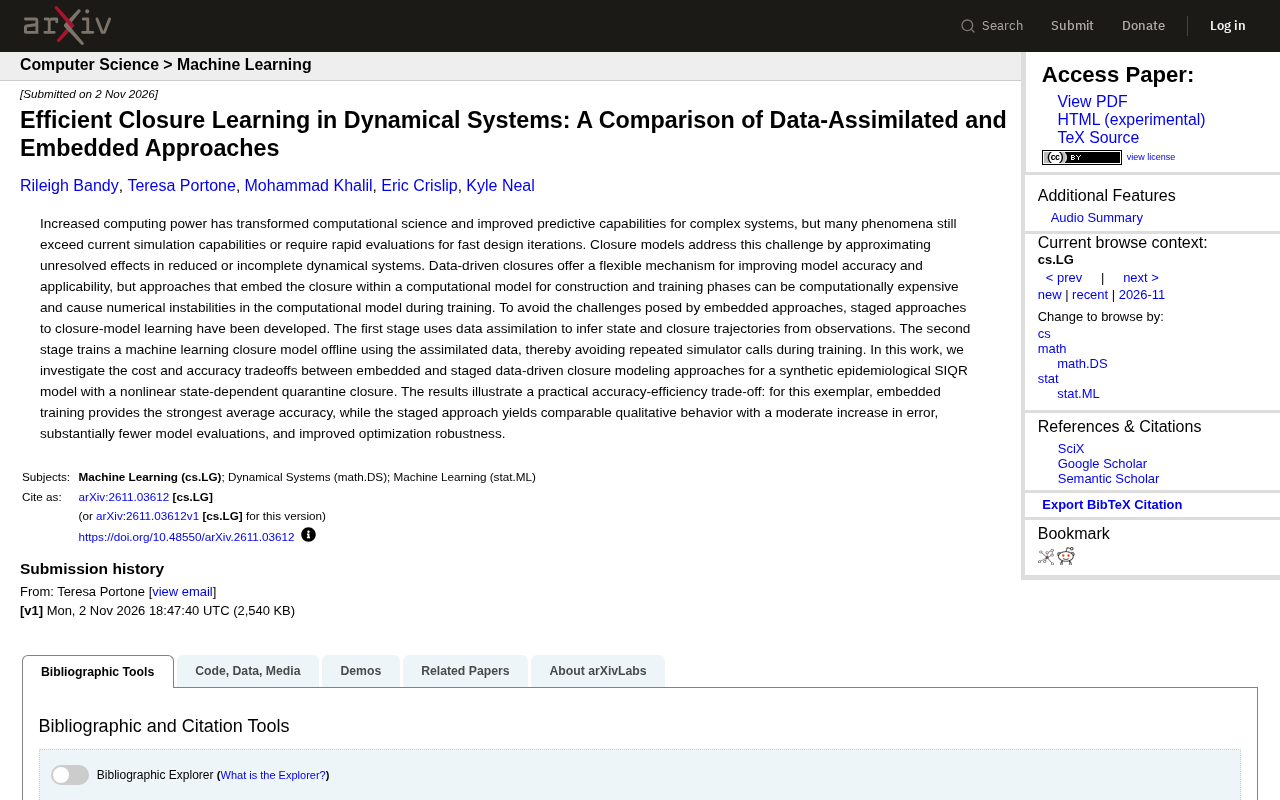
Data-driven closure models provide a flexible mechanism for addressing the above problems. However, constructing and training a closure embedded within a computational model (i.e., the embedded approach) can be computationally expensive and can induce numerical instabilities during training. To circumvent these challenges, researchers developed the staged approach.
The staged approach consists of two steps: the first stage uses data assimilation to infer state and closure trajectories from observations; the second stage uses the assimilated data to train a machine-learning closure model offline, thereby avoiding repeated calls to the simulator during training. The core difference between these two paths is whether training is tightly coupled with the simulator, which directly affects computational cost and optimization stability.
Data Assimilation is a family of state-estimation methods developed in fields such as Earth science and weather forecasting. Its core idea is to fuse the dynamical constraints of a physical model with sparse, noisy observations in order to infer the complete temporal trajectory of the system. Classical algorithms include the Ensemble Kalman Filter (EnKF), variational methods (3D/4D-Var), and particle filters. In staged closure modeling, data assimilation plays the role of "inverse inference": given observable variables (e.g., confirmed case counts) and the known dynamical system structure, it estimates the time evolution of unobserved state variables and the closure term. The key advantage of this step is that it requires no end-to-end differentiation through the closure model itself, thereby bypassing the memory and numerical-stability issues associated with backpropagating through the simulator. The assimilated trajectories then serve as supervision signals for offline training of the machine-learning closure model, making the second stage a standard regression task.
Empirical Findings in the SIQR Model
The research team conducted experiments using a synthetic epidemiological SIQR model, which contains a nonlinear, state-dependent quarantine closure. This setup can mimic real-world scenarios in which closure terms interact complexly with system state.
Experimental results show that embedded training provides the strongest average accuracy. This is intuitive: because the closure directly participates in system evolution during training, the model can more precisely capture the closure's influence on system dynamics. However, this accuracy advantage comes at a cost—the embedded approach requires frequent simulator calls, incurs higher computational cost, and may exhibit numerical instabilities.
By contrast, the staged approach performs comparably to the embedded method in qualitative behavior, with only a moderate increase in error, but it significantly reduces the number of model evaluations and makes the optimization process more robust. This means that in resource-constrained settings or scenarios requiring rapid iteration, the staged approach may be more practical.
The SIQR model is an extension of the classic compartmental epidemiological SIR model, dividing the population into four categories: Susceptible, Infectious, Quarantined, and Recovered. Compared with SIR, SIQR explicitly captures quarantine intervention as a public health measure, and thus is closer to real-world epidemic management scenarios. In this study, the "state-dependent quarantine closure" refers to a nonlinear feedback mechanism: the quarantine rate is not a fixed constant but varies dynamically with state variables such as the infection proportion or healthcare resource occupancy—for example, quarantine intensity increases as the number of infections rises. Such closure terms typically lack an analytical form and can only be approximated in a data-driven way. For this reason, SIQR serves as an ideal testbed—it retains the simple structure of an epidemiological model while introducing sufficiently complex nonlinear closure interactions to effectively distinguish different training strategies in terms of accuracy and stability.
Implications of the Efficiency-Accuracy Trade-off
By comparing two closed-loop learning strategies, this study reveals a key trade-off in practical applications. The embedded approach is suitable for scenarios that prioritize accuracy and have sufficient computational resources; the staged approach is better suited to tasks requiring rapid design iteration, limited computational budgets, or higher requirements for optimization stability.
Interestingly, the staged approach decouples closure learning from the simulator via data assimilation. This idea not only reduces computational burden but also avoids potential numerical instabilities during training. For researchers and engineers working on complex-system modeling, this finding provides a basis for method selection: when seeking a balance between accuracy and efficiency, the staged data-assimilation approach is an alternative worth considering.
The value of the study lies in the fact that it does not one-sidedly advocate a single method, but instead quantifies the pros and cons of the two paths through controlled experiments. This pragmatic comparison helps promote the appropriate application of closure modeling to real-world problems.
One-line Summary
This study compares embedded and staged closure modeling: the former achieves the highest accuracy but at high cost, while the latter trades a moderate error increase for efficiency and robustness.
Paragraph Summary
Using a synthetic epidemiological SIQR model with a nonlinear state-dependent quarantine closure as a testbed, this study systematically compares two data-driven closure modeling approaches. Embedded training embeds the closure directly into the simulator so that it participates in system evolution, achieving the highest accuracy, but it requires frequent simulator calls, incurs high computational cost, and is prone to numerical instability. The staged approach first uses data assimilation to infer state and closure trajectories from observations, then trains a machine-learning closure model offline, thereby decoupling training from the simulator, significantly reducing model evaluations, and improving optimization robustness, with only a moderate increase in error. On this basis, the study provides guidance for method selection: choose embedded when accuracy is the priority and resources are sufficient; choose staged when rapid iteration is needed or budgets are limited.
Related articles

Non-Coding Dad Builds 3D Earth Toy with Claude Code, Unexpectedly Goes Viral in Classrooms
A non-coding father used Claude Code to build My Earth Toy, a 3D interactive Earth with 830+ landmarks, 470+ animals, and 180+ vehicles—now used in classrooms worldwide. Discover how AI coding lowers the barrier to creation.

Meta, Google, and TikTok Sue California Attorney General: The Battle Over Youth Social Media Law
Meta, Google, and TikTok jointly sue the California Attorney General to block a state law restricting social media use by minors under 16. This article analyzes the lawsuit's background, the law's core provisions, and its potential impact on tech industry regulation.

T-Mobile Parent Company CEO on Musk's Telecom Ambitions: Welcome, But You'll Need $200 Billion
Deutsche Telekom CEO Tim Höettges responds to Musk's SpaceX Starlink Mobile plan, saying "welcome to the party" but questioning feasibility—estimating at least $200 billion needed to become a major U.S. carrier.