A New Paradigm for LLM Cultural Adaptation: From Q&A to Repeated Social Interactions

The study argues that LLM cultural competence evaluation should shift from static Q&A to dynamic adaptation in repeated social interactions.
The article reviews a study on LLM cultural adaptation, noting that current evaluations mostly stop at cultural knowledge Q&A, whereas most human culture is tacit and must be internalized through interaction. The study defines cultural adaptation as the process of continuously assimilating norms through social interaction and builds a sandbox to observe longitudinal learning across repeated interactions. The core finding is that memory mechanisms play a decisive role, enabling models to track normative cues across rounds and continuously improve fit, while also yielding cross-scenario transfer and multilingual norm assimilation across five languages. The article argues this paradigm is closer to real deployment than Q&A benchmarks and suggests developers prioritize interactive memory architecture design, while noting the gap between sandboxes and real community complexity.
From "Knowing" to "Adapting": The Shift in LLM Cultural Competence Evaluation
Most current methods for evaluating the cultural competence of large language models remain at the question-and-answer level—testing how much the model knows about a particular cultural custom, taboo, or holiday. But the vast majority of human culture is tacit; it is not learned from textbooks but gradually internalized through concrete social interactions. When LLMs are deployed as interactive agents in different communities, what really needs to be examined is whether they can adjust their own behavior during interaction, not merely recite knowledge.
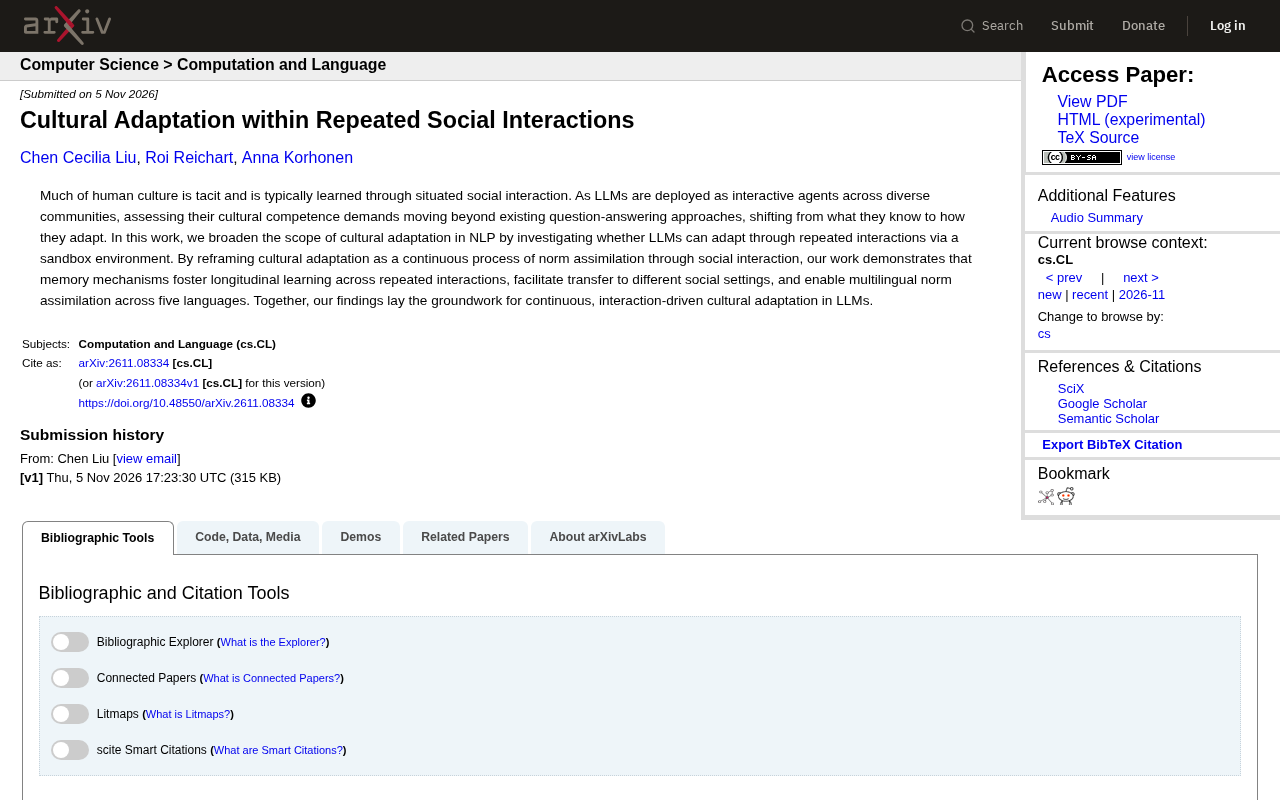
A study released by an RSS source (Cultural Adaptation within Repeated Social Interactions) addresses exactly this gap. The authors redefine cultural adaptation as "the process of continuously assimilating norms through social interaction" and build a sandbox environment to observe whether LLMs exhibit longitudinal learning capability across repeated interactions.
Tacit knowledge was introduced by philosopher Michael Polanyi in Personal Knowledge, referring to knowledge that is difficult to fully express through language, text, or symbolic systems, as opposed to "explicit knowledge" that can be stated in propositions. Typical examples include riding a bicycle, recognizing faces, and striking the right tone in conversation—people can perform these skillfully yet often cannot articulate the rules they rely on. A large portion of cultural norms falls into this category: when to interject, how to express refusal, the pragmatic intensity of an apology—all depend on tacit judgment in context. The significance of this concept for LLM evaluation is that tacit knowledge cannot be measured by static Q&A alone, because it does not exist in the form of statable propositions and can only be observed in behavior. This provides the epistemological basis for the article's argument in favor of interactive evaluation.
Experimental Design: Repeated Interactions in a Sandbox
Rather than using static benchmarks, the research team built a sandbox environment in which the model is exposed to specific cultural norms across multiple social interactions. The core question is straightforward: can the model, without explicit instructions, gradually adjust its response strategies through interaction history so that they better align with the implicit expectations of the target community?
Judging from the original text, the experiment focuses on the continuous process of "norm assimilation." The model receives feedback signals after each interaction, and whether its behavior shows a measurable shift in the next round is the key indicator of cultural adaptation. This design shifts the evaluation focus from parametric knowledge to dynamic adaptive capability.
Sandbox environment in AI research refers to a controlled, reproducible, isolated testing space in which researchers can set initial conditions, inject inputs, and observe agent behavior without affecting real systems or users. Unlike static benchmarks, sandboxes emphasize process: they record trajectories of multi-turn interactions, allowing researchers to examine how state evolves with feedback. In LLM agent research, sandboxes typically include simulated interlocutors, configurable social scenarios, and feedback signal channels. Their advantages are reproducible experiments and safe exploration; their limitation is the simplification of real social complexity in simulated environments—precisely the external validity issue mentioned at the end of the article.
Memory Mechanisms: The Key Support for Longitudinal Learning
A core finding of the study is that memory mechanisms play a decisive role in repeated interactions. Models with memory capability can maintain tracking of prior normative cues across multiple turns, thereby exhibiting longitudinal learning—that is, cultural fit continues to improve as the number of interactions increases, rather than each conversation starting from scratch.
This conclusion has intuitive explanatory power. Humans likewise rely on social memory to learn cultural norms: remembering the feedback from the last interaction is what enables avoiding repeated faux pas next time. If an LLM lacks a cross-session memory carrier, so-called cultural adaptation degenerates into single-turn prompt engineering and is unlikely to produce cumulative effects. The original text also notes that the benefits of memory mechanisms extend beyond longitudinal learning to transfer capability across different social scenarios, as well as multilingual norm assimilation across five languages.
Longitudinal learning in this context refers to the process by which a model continuously accumulates experience across multiple interactions in a time series, so that performance improves monotonically with the number of interactions—distinct from immediate adaptation in single- or few-turn dialogue. It is related to but distinct from "continual learning" in machine learning: the latter focuses on avoiding catastrophic forgetting and maintaining capability across task sequences, whereas longitudinal learning emphasizes gradually internalizing norms through repeated social interactions. Measuring longitudinal learning usually requires comparing fit curves between early and later rounds; only if the curve keeps rising rather than plateauing can a cumulative effect be considered present. Without cross-session memory, each conversation is independent and longitudinal learning cannot occur.
Transfer and Multilingualism: Two Extensions of Adaptive Capability
The experiment further examines the generalization boundary of adaptation. In terms of transfer, can norms learned in one social setting be carried into new interaction contexts? The original text gives an affirmative conclusion, indicating that the normative representations carried by memory are not shallow patterns bound to a single scenario.
The multilingual dimension covers five languages. This means norm assimilation is not limited to English-language cultural contexts; the model shows signs of adaptation in interactions across multiple languages. For interactive agents deployed in global communities, this result has direct engineering reference value: if cultural adaptation capability only works monolingually, its practical usability would be greatly reduced.
Cultural alignment refers to making AI systems' behavior, values, and modes of expression conform to the norms and expectations of a specific cultural community; it is a branch of AI alignment research. Unlike general alignment, which focuses on safety and ethical principles, cultural alignment emphasizes contextual sensitivity and pluralism: the same behavior may be appropriate or inappropriate in different cultures. Common technical approaches include fine-tuning on cultural preference data, setting cultural personas in system prompts, and the interactive norm assimilation examined in this article. The difficulty of cultural alignment lies in within-culture heterogeneity and dynamically changing norms; static knowledge injection struggles to cover the tacit dimension, which is why process-oriented, interactive alignment methods are receiving increasing attention.
Implications for Cultural Alignment Practice
The methodological significance of this work is that it pushes cultural adaptation from "knowledge assessment" toward "process modeling." Traditional Q&A-style benchmarks easily overestimate a model's cultural competence—knowing "when one should bow" and naturally making an appropriate gesture in actual conversation are capabilities at two different levels. The sandbox repeated-interaction paradigm is closer to real deployment conditions.
The original text positions itself as "laying the foundation for continuous, interaction-driven cultural adaptation of LLMs." From an engineering perspective, this suggests to developers that, in addition to expanding cultural knowledge in training data, improving a model's cultural sensitivity should also attach importance to the design of interactive memory architectures. Memory mechanisms have been shown to be the fulcrum of longitudinal learning and cross-scenario transfer, offering an actionable leverage point for subsequent agent system design.
Of course, there is still a gap between sandbox environments and the complexity of real community interaction, and five-language coverage is far from exhausting the global cultural landscape. But the direction is clear: the cultural competence of LLMs must ultimately be tested in interaction, not recited on an exam paper.
Related articles

Agent Clan: Command Multiple AI Coding Assistants Simultaneously with Mid-Air Gestures
Agent Clan turns Claude Code and Codex agents into a 3D team on screen, supporting fist summoning, pinch selection, drag-to-approve permissions, and local gesture and voice processing, free on Mac and Windows.

Inkling 2 Small: A 594B MoE Model That Can "See" and Revise
Thinking Machines Lab releases Inkling 2 Small, a 594B-parameter MoE model activating only 17B, focused on long-horizon coding and visual tasks where it can see and refine its own output, with inference and fine-tuning via the Tinker platform.

Deduplication: How Tech 'Steals' Everyday Words
Deduplication uses Wikipedia pageview data to quantify 719 words redefined by tech across 14 domains, revealing which meaning wins. Free and open by HackerNoon.