Agent Clan: Command Multiple AI Coding Assistants Simultaneously with Mid-Air Gestures

Agent Clan uses 3D characters, gestures, and voice to turn Claude Code and Codex into a visualized mini-team.
Agent Clan is an exploratory product unveiled on Product Hunt that turns AI coding agents like Claude Code and Codex into 3D characters on screen, letting developers command them directly with gestures and voice. Make a fist to summon the team, pinch to select an agent, drag left or right for permission approval, circle-select screen content to hand to an agent, and support a "captain" mode for task distribution. Gesture tracking and voice processing run locally for privacy and low latency, while mouse operation remains as a fallback. The article argues it addresses the new problem of rising multi-agent management costs, but community discussion is still limited and stability remains to be verified.
When Coding Assistants Become a 3D Squad
Imagine this: you make a fist at the screen, and several virtual characters appear in response; you pinch to grab one of them, and it becomes your "team member"; you say a word, and it starts working. When it needs your approval, dragging right means allow, and dragging left means reject. This isn't a sci-fi scene—it's exactly what Agent Clan, newly unveiled on Product Hunt, does: it turns AI coding agents like Claude Code and Codex into a 3D team on your screen, letting you command them directly with gestures and voice.
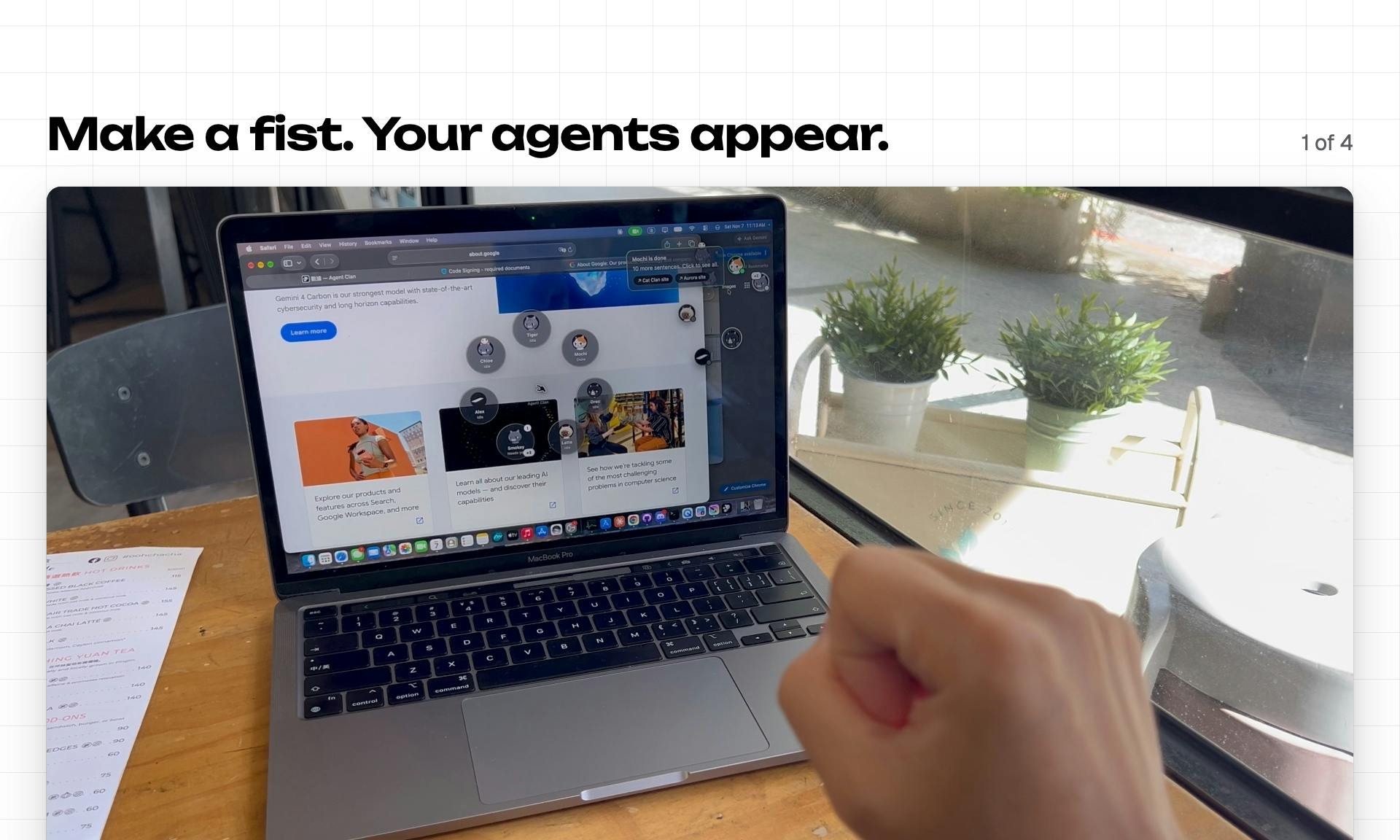
The core idea of this product is replacing command lines and chat windows with spatial interaction. Developers no longer need to memorize a bunch of commands or switch between multiple terminals; instead, they assign tasks to different AI agents through gestures and manage them in a unified visual interface.
Gesture Command: From "Talking to It" to "Grabbing It"
The interaction design of Agent Clan revolves around several basic gestures. Making a fist can summon your agent team onto the screen; pinching an agent and pulling it closer is equivalent to selecting it, and then you can simply speak your request. When an agent needs permission confirmation, dragging right means allow, and dragging left means reject.
This design compresses operations that originally required keyboard input or multiple clicks into one continuous motion. For developers who frequently switch between multiple AI agents, spatial interaction may be closer to the intuition of "managing a team" than a pure text interface. Even more interestingly, you can circle-select anything on the screen (such as an error message or a UI element) and hand it directly to an agent, saving the copy-paste steps.
The official description also mentions that you can first request a "captain" and then have its "team members" share the work—this means Agent Clan supports task distribution and collaboration, not just single-agent operation.
Hand tracking is the key underlying technology here. It usually relies on computer vision models to recognize hand keypoints (such as finger joint positions) in real time from camera frames, and then maps them into gesture commands such as pinching, fist-making, and dragging. Unlike VR controllers or touchpads, pure vision-based hand tracking does not require additional hardware, but it is more sensitive to lighting conditions, camera frame rate, and occlusion. Common implementations include lightweight models such as MediaPipe Hands, which can run with relatively low latency on ordinary laptops—this is also the premise that makes "local processing" possible. Understanding this helps judge: the smoothness of gesture interaction depends largely on the quality of the device camera, not merely on product design.
Local Operation: Dual Considerations of Privacy and Latency
Agent Clan clearly states that gesture tracking and voice processing both run locally on your computer. This is worth noting: if hand tracking and speech recognition relied on the cloud, they would bring noticeable input latency and privacy concerns, while local operation means this sensitive data does not need to leave your device.
For developers handling private codebases, this is a practical plus. However, it should also be viewed rationally: the product page does not elaborate on what hardware local operation specifically depends on (for example, whether a specific camera or GPU acceleration is required), and the actual experience may vary by device.
At the same time, Agent Clan retains full mouse support—gestures are not the only input method. This provides a necessary fallback for users without a suitable camera or when high-precision operation is needed.
On-device inference refers to models running directly on the user's device without uploading raw data to the cloud. For speech recognition, on-device solutions usually use smaller acoustic models, sacrificing some recognition accuracy in exchange for low latency and privacy; for hand tracking, lightweight vision models are mostly used. Compared with cloud inference, the advantages of on-device are fast response and data staying on the device, while the disadvantages are being limited by local compute, so model size and accuracy may be compromised. This explains why the article emphasizes that "local operation" is both a privacy selling point and may bring "device-dependent" experience differences—machines with weaker compute may need to reduce frame rate or lower recognition accuracy to maintain usability.
The Exploratory Significance of Multi-Agent Collaboration
The timing of Agent Clan's appearance is worth pondering. Claude Code and Codex are each powerful single-agent tools, but when developers use multiple agents at the same time, management costs rise rapidly: which agent is doing what? Which one is waiting for permission? How should tasks be distributed?
Agent Clan attempts to answer these questions with visualization + gestures. It concretizes "agents" into characters with positions and identities, making status clear at a glance. This anthropomorphic, spatial management approach may not suit everyone, but it offers an answer different from terminal tabs for "how to manage multiple AI agents at once."
On Product Hunt it received 82 votes and ranked 6th, indicating that this direction has sparked interest among some developers. However, there are currently only 2 comments, community discussion is still very limited, and the product's actual stability and long-term usability remain to be verified.
Multi-agent orchestration is an active direction in the current AI engineering field. When multiple agents work in parallel, the core challenges include task decomposition and allocation, state synchronization among agents, permission and security boundary control, and result aggregation. Common patterns include "supervisor-worker" (a coordinating agent dispatches tasks to sub-agents) and "peer collaboration" (agents communicate directly with each other). Agent Clan's "captain" model is a visual variant of the former. It is worth noting that the orchestration layer itself does not generate intelligence; it solves scheduling and observability problems—which is why "drawing" agent states on the screen has practical value: observability is the foundation for managing multi-agent systems.
Who Is It For?
Agent Clan is available for free on Mac and Windows, so the barrier to entry is low. It may be especially suitable for several types of people: developers who are used to working with multiple monitors or large screens and like trying new interaction methods; users who need to run multiple AI coding tasks simultaneously and want a more intuitive monitoring interface; and people interested in spatial computing interaction who want to see how far "gesture-commanded AI" can go.
If you are already very satisfied with command-line efficiency, gesture operation may not bring substantial improvement and may even seem unnecessary due to the learning cost. But as an exploratory product, it demonstrates an interesting idea: as AI agents become more numerous, how to manage them is itself becoming a new problem, and the answer may not exist only in better command lines.
One-line Summary
Agent Clan turns Claude Code and Codex into a visualized mini-team using 3D characters, gestures, and voice.
Paragraph Summary
Agent Clan is an exploratory product unveiled on Product Hunt that concretizes AI coding agents like Claude Code and Codex into 3D characters on the screen, allowing developers to command them directly with gestures and voice. Make a fist to summon the team, pinch to select an agent, drag left or right to complete permission approval, circle-select screen content to hand it to an agent, and support a "captain" mode for task distribution. Gesture tracking and voice processing both run locally, balancing privacy and low latency, while retaining mouse operation as a fallback. The article argues that it responds to the new problem of rising multi-agent management costs, but community discussion is still limited and stability remains to be verified.
Related articles
Whale Lords Returns: Sky Kia Showdown Game Show Debut
Whale Lords returns as the Sky Kia Showdown game show, with the first challenge being to build an airship. This article analyzes the mechanics, drama, and game show transformation of this high-competition Minecraft content show.
Claude Plans Fully Explained: Differences from Free to Ultra and the Truth About Account Bans
How to choose a Claude plan? This article compares pricing and quota differences across Free, Pro, Max, and Ultra, explains the 5-hour window and weekly quota mechanics, and covers common reasons for account bans and how to appeal.
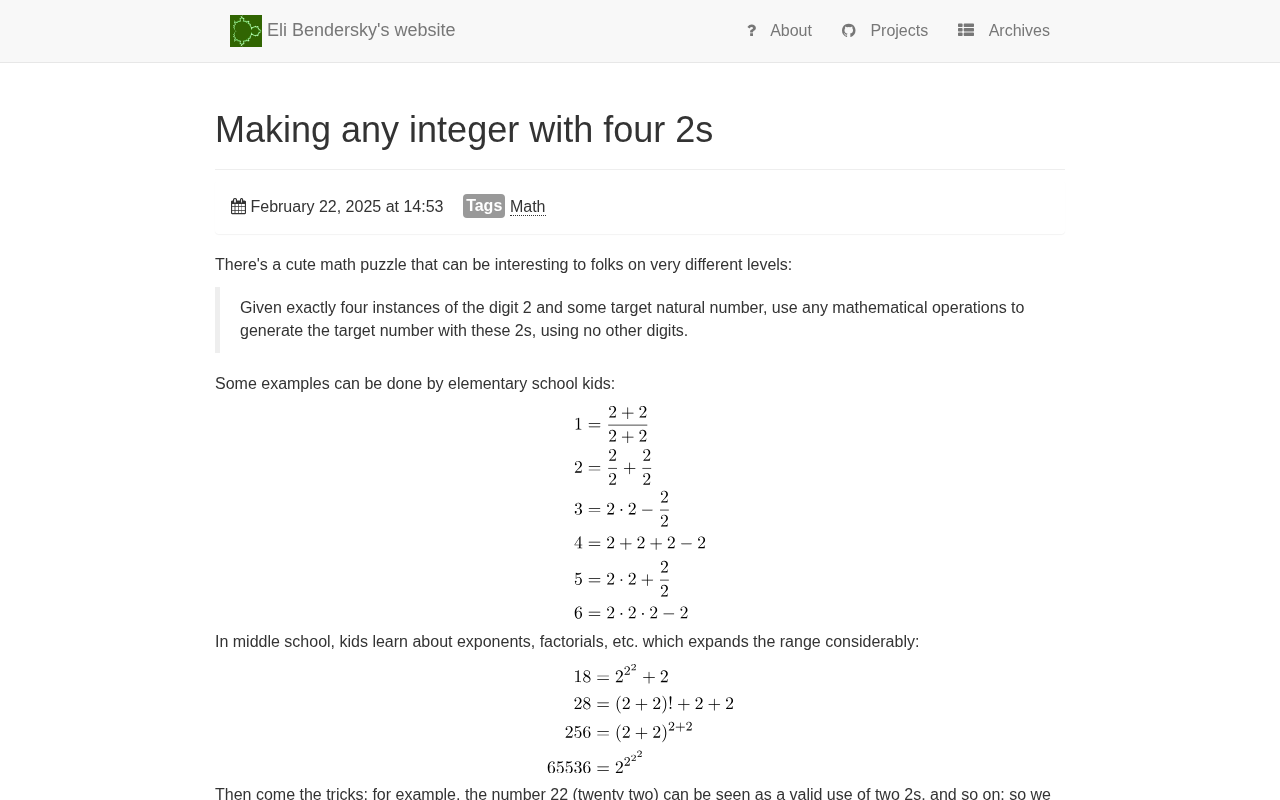
Four 2s to Make Any Integer: A Math Geek's Recursive Trick
Explore how to represent any integer with four 2s: Eli Bendersky's recursive construction using factorials and self-reference, hotly debated on Hacker News. Discover the constructive proof and community discussion behind this math puzzle.