Deduplication: How Tech 'Steals' Everyday Words

Deduplication quantifies how much tech vocabulary has 'colonized' everyday word meanings using Wikipedia pageview data.
Deduplication is a free, open project by HackerNoon on Product Hunt that measures tech's redefinition of everyday words. It collects 719 duplicate terms across 14 domains, pairing each word's original and technical Wikipedia entries and comparing real-time pageviews to classify words as original-dominated, contested, or tech-takeover. It offers word clouds, leaderboards, and detail pages to explore linguistic shifts and spot early tech trends.
Title
Deduplication: How Tech 'Steals' Everyday Words
Meta Description
Deduplication uses Wikipedia pageview data to quantify 719 words redefined by tech across 14 domains, revealing which meaning ultimately wins. Free and open, brought to you by HackerNoon.
Article Content
The tech industry doesn't just invent new words—it constantly 'borrows' everyday vocabulary and gives it entirely new meanings. Bug once meant an insect, Mouse was an animal, and Token was a coin. Today, these words carry vastly different meanings in technical contexts. So which meaning ultimately wins out? A project called Deduplication tries to answer this question with data.
When Tech Redefines Language
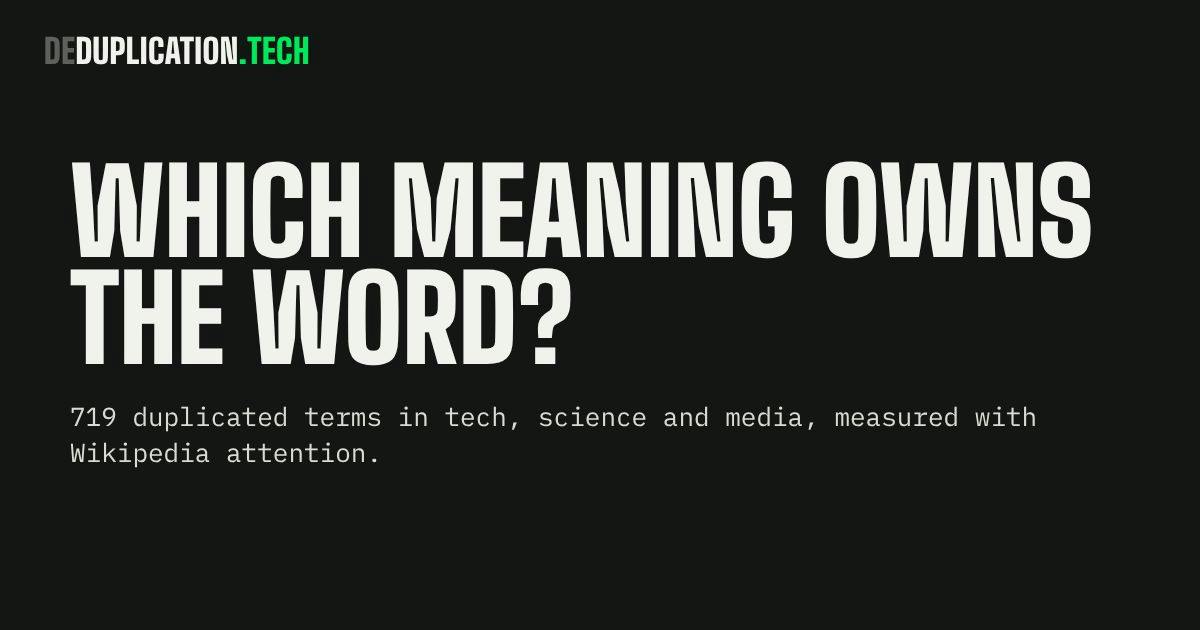
According to Deduplication, the #3 product on Product Hunt, the project is backed by HackerNoon and aims to measure 'which meaning owns the word.' It collects 719 duplicate terms across 14 domains (including AI, cryptocurrency, gaming, cloud computing, and more), each pairing an original meaning with a tech-domain 'duplicate' meaning.
These domains are hotspots for tech vocabulary collisions. In AI, for example, 'Token' went from a coin to the basic unit of text processing; in cryptocurrency, 'Mining' went from extracting minerals to computing hashes; in gaming, 'Bug' went from an insect to a program error. Behind every word is a battle over meaning.
Semantic Drift is a classic concept in linguistics referring to the shift in a word's meaning over time. The tech world is a hotbed of semantic drift because new technologies often need to borrow existing words to name new things, lowering the public's cognitive barrier. This borrowing typically goes through three stages: metaphorical use (e.g., 'Token' used as a metaphor for a text unit), professional consolidation (becoming a standard term within a technical community), and mass adoption (entering everyday language through media and products). What Deduplication measures as the 'battle over word meaning' is essentially quantifying the share of attention between old and new meanings during this drift process. Understanding semantic drift helps explain why the same word causes ambiguity in different contexts, and why the popularization of technical terms is often accompanied by the marginalization of original meanings.
Quantifying the 'Battle Over Word Meaning' with Wikipedia Pageviews
Deduplication's core method isn't complicated, but it's quite clever: it uses real-time Wikipedia pageview data to score each pair of 'original meaning vs. technical meaning.' Based on the pageview comparison, each word is classified into one of three states:
- Original meaning still dominates: When the public searches for the word, they still primarily mean the traditional sense.
- Meaning is contested: The pageviews for both meanings are close, with no clear winner.
- Technical meaning has taken over: The technical-context meaning has gained more attention.
This dynamic scoring mechanism means results are no longer static dictionary definitions but reflect the real-time migration of public attention. For example, when a technical concept suddenly goes viral, pageviews for related entries may surge rapidly, changing the word's 'ownership' status.
Wikipedia pageview data is the quantitative foundation of the project. The Wikimedia Foundation publicly provides daily visitor counts for Wikipedia pages across languages via the Pageviews API, aggregated by page title and precise to the hour level. Deduplication's approach is to find the corresponding 'original meaning' entry (e.g., 'Bug' pointing to the insect article) and 'technical meaning' entry (e.g., 'Software bug') for each term, then compare pageviews between them. The advantage of this method is that the data is public, updates in real time, and covers a wide range; the limitation is that pageviews only reflect search behavior and cannot distinguish user intent—someone searching 'Token' might just be looking it up in a dictionary rather than following AI or cryptocurrency. Therefore, the score is better suited as a trend signal than as a precise linguistic measurement.
Word Clouds, Leaderboards, and Free Access
To make results more intuitive, Deduplication offers word cloud and leaderboard views. The word cloud uses size and color to show which words have the most intense meaning battles, while the leaderboard lists the vocabulary 'completely rewritten by tech.' Users can also browse individual term detail pages to view specific pageview comparison data.
The project is supported by HackerNoon and is completely free and open. This means anyone can explore the traces of these linguistic shifts and perhaps even spot early signals of tech trends—when a word's technical meaning starts surging in pageviews, it may signal that a domain is entering mainstream view.
Product Hunt is a community platform for launching and discovering tech products, where users can upvote and comment on new products, and the platform generates daily, weekly, and monthly leaderboards. The ' #3 in Developer Tools for the day' mentioned in the article comes from the platform's daily category leaderboard. Product Hunt's ranking mechanism factors in vote counts, comment activity, and time decay, so a high ranking usually means the product received significant community attention on its launch day. 93 votes is a moderately above-average early performance on Product Hunt, indicating the project attracted a certain amount of developer interest but hasn't yet achieved large-scale spread.
Why It's Worth Noticing
Language is the carrier of thought, and tech's 'colonization' of vocabulary reflects the depth of technology's penetration into social life. Deduplication is not just an interesting toy but also a mirror reflecting the influence boundary of tech culture. For developers, writers, and tech observers, understanding these vocabulary shifts helps with more precise communication and also provides a side view of where the tech wave is heading.
According to Product Hunt data, the project received 93 votes and 2 comments, ranking #3 in the Developer Tools category for the day. Although there aren't many comments, the high ranking shows it struck a chord with many people's interests.
Next time you use 'Mouse' to refer to an input device, or 'Token' to talk about AI, take a moment to think: does the word's original meaning still exist?
One-line Summary
Deduplication uses Wikipedia pageview data to quantify how much tech vocabulary has 'colonized' everyday word meanings.
Paragraph Summary
Deduplication is a free, open project supported by HackerNoon and launched on Product Hunt, designed to measure tech's redefinition of everyday vocabulary. It collects 719 duplicate terms across 14 domains—including AI, cryptocurrency, gaming, and cloud computing—pairing each word's 'original meaning' and 'technical meaning' Wikipedia entries, and uses real-time pageview data to compare public attention between them. Based on the pageview comparison, each word is classified as original-dominated, contested, or tech-takeover. The project offers word clouds, leaderboards, and term detail pages, letting users intuitively explore traces of linguistic change and potentially spot early signals of tech trends. The project received 93 votes on Product Hunt, ranking #3 in the Developer Tools category for the day.
Related articles

Anthropic Files S-1: Behind the Trillion-Dollar Valuation and Massive Losses
Anthropic files its S-1: revenue surges in six months but net losses are huge, while compute cost ratio improves sharply. A breakdown of its financial reality, public benefit corporation governance, and the capital game behind a trillion-dollar valuation.

Anthropic's Massive Losses and Trillion-Dollar IPO: AI Safety Risk Takes Center Stage in Prospectus
Anthropic's IPO prospectus reveals over $80 billion in half-year net losses, growth exceeding 1000% in some months, and rare warnings of existential risk. We analyze the growth paradox and investor dilemma behind a trillion-dollar valuation.
US Stocks' Weak Rebound: Nvidia Data Center Results and Anthropic IPO in Focus
Bloomberg closing report: US stocks attempt rebound but end the week lower; Nvidia data center results are key to the AI trade, Anthropic IPO expected within weeks, OpenAI funding values it at about $1.25 trillion.