A Seven-Person Team Takes On Document AI Giants: Unsiloed Raises $7.5M from Felicis

Seven-person Unsiloed AI raises $7.5M led by Felicis to make enterprise documents usable by AI agents.
Unsiloed AI has raised $7.5 million led by Felicis. The seven-person team tackles unstructured enterprise documents, turning contracts, financial reports, manuals, and scans into structured semantic units AI agents can reliably retrieve, cite, and reason over—rather than human-readable layout reproduction. The market is crowded with platform giants and vertical document intelligence startups, so Unsiloed must differentiate by understanding what AI agents need. Customer, revenue, and technical metrics are undisclosed; the funding signals document structuring is becoming essential AI agent infrastructure, but $7.5M is just a head start.
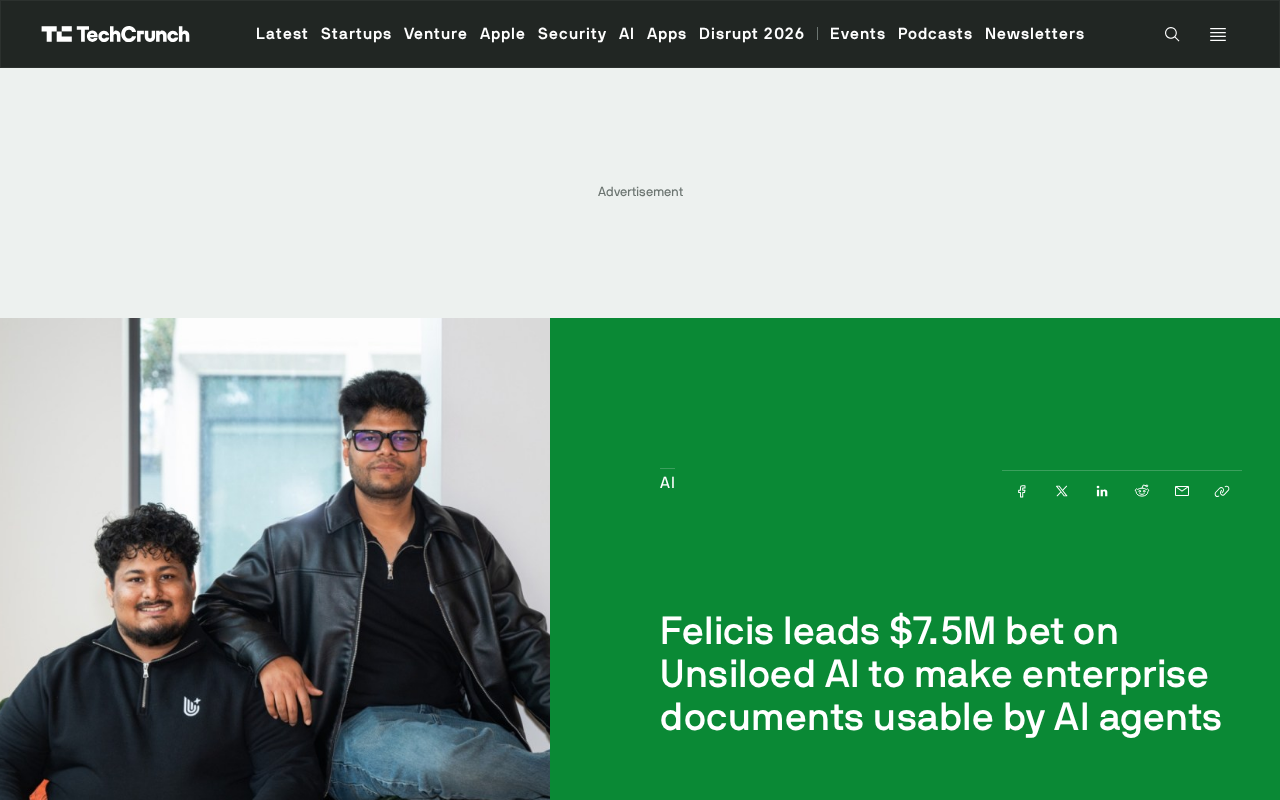
Unstructured enterprise documents have long been the "last mile" problem holding back AI agent deployments. Unsiloed AI aims to solve it with a document parsing and structuring engine, and has just raised $7.5 million in funding led by Felicis.
Funding Background: A Small Team Targeting a Big Market
Unsiloed AI was founded during a window when demand for enterprise document intelligence exploded. According to the original report, the company currently has only seven people, yet plans to compete head-on with tech giants and specialized startups in the crowded AI document processing market. The $7.5 million led by Felicis is a clear bet on its technical approach.
A seven-person team means extremely high demands on resource efficiency. In the document parsing space, players include cloud providers with massive compute and distribution channels, as well as vertical vendors that have spent years on OCR and layout analysis. Unsiloed's differentiation must be built on "understanding what AI agents need better" rather than "understanding what humans read better."
Product Logic: Making Documents "Readable" to AI Agents
Traditional document processing tools output for humans—beautiful PDFs, searchable text layers, high-fidelity layouts. But when the consumer becomes an AI agent, the requirements change fundamentally: agents need structured semantic units that can be reliably retrieved, cited, and reasoned over, not pixel-level fidelity.
Unsiloed AI's core proposition is to transform enterprise documents into a data form that AI agents can use directly. This involves layout understanding, table and chart parsing, cross-page logical linking, and more. The report explicitly positions it as "making enterprise documents usable by AI agents," rather than mere text extraction.
The value of this direction: a large amount of critical enterprise knowledge lies dormant in contracts, financial reports, technical manuals, and scanned files. If agents cannot read them reliably, any upstream AI workflow will fail at the retrieval stage.
Layout Analysis is a key step in the document parsing pipeline: it needs to identify text blocks, headings, paragraphs, tables, images, headers and footers on a page, and infer their reading order and hierarchy. For AI agents, the quality of layout analysis directly determines whether retrieval units are semantically complete—if cross-column text is concatenated in pixel order, the resulting snippets will be semantically garbled. Traditional OCR only solves "what the characters are"; layout analysis solves "where the characters belong." Only together can they produce structured chunks usable for RAG (retrieval-augmented generation). The "reliable retrieval, citation, and reasoning" that Unsiloed emphasizes presupposes accurate segmentation of layout structure and semantic units.
Table and chart parsing is one of the hardest parts of document structuring. Tables often contain merged cells, continued tables across pages, and borderless layouts, while charts carry data in pixel form and cannot be directly textualized. To let AI agents use this information, systems must restore it to row-column structures or key-value pairs while preserving context such as headers and units. Cross-page logical linking requires models to understand references like "continued" or "see next page," stitching the same table or clause scattered across pages into a complete semantic unit. These capabilities determine whether key fields such as contract amounts and financial line items can be correctly cited by agents—and they are the main battleground for technical differentiation among document intelligence vendors.
Competitive Landscape: A Seven-Person Squad in a Crowded Track
The report states plainly that the market is crowded. Unsiloed faces two fronts: tech giants with platform capabilities, and vertical startups focused on document intelligence. For a seven-person team to gain a foothold in such a landscape usually means two things—focusing on specific document types or workflows, and trading a lighter organizational structure for faster iteration.
However, the report does not disclose Unsiloed's specific customers, revenue, or technical metrics, so its actual advantages over competitors remain to be validated by product data.
What This Funding Says
Felicis's lead investment sends a signal: document structuring is seen as an indispensable layer of AI agent infrastructure. As agents move from demos to production environments, demand for reliable data access will keep growing—and documents are one of the toughest data sources to crack.
For a seven-person team, $7.5 million is a head start, not a moat. Whether it can build barriers at the data and workflow levels before giants catch up will be Unsiloed's most critical test ahead.
The AI agent infrastructure layer can be understood as the data and tooling support agents rely on beyond "thinking": including data access and parsing, retrieval indexing, tool-calling interfaces, and memory storage. Large models handle reasoning, but reasoning accuracy depends heavily on input data quality. Document parsing sits at the very front of the infrastructure, and its output quality amplifies or attenuates downstream retrieval and generation. This is why document structuring is seen as the "last mile" of agent deployment—no matter how capable the model, production-grade workflows cannot be built if it cannot reliably read enterprise contracts, financial reports, and scans. The significance of Felicis's lead investment lies in betting that this layer will become standard infrastructure in the agent era.
One-line Summary
Seven-person Unsiloed AI raises $7.5M led by Felicis to make enterprise documents usable by AI agents.
Paragraph Summary
Unsiloed AI has raised $7.5 million led by Felicis. The seven-person company targets the unstructured enterprise document problem, arguing that contracts, financial reports, technical manuals, and scans should be turned into structured semantic units that AI agents can retrieve, cite, and reason over—rather than human-readable layout reproduction. The report notes that the document processing space is crowded, with Unsiloed facing both platform tech giants and vertical document intelligence startups, and that its differentiation can only rest on "understanding what AI agents need better." Customer, revenue, and technical metrics are undisclosed, so its real advantages remain to be validated. The article argues the funding reflects document structuring being viewed as an indispensable layer of AI agent infrastructure, but $7.5 million is only a head start—whether it can build data and workflow barriers before giants catch up is the key test.
Related articles

The Gemini 4 Trio and 3.8 Flash: A Full Comparison of Positioning, Pricing, and Benchmarks
A comparison of Gemini 4 Neon, Carbon, Argon, and Gemini 3.8 Flash: positioning, context, API pricing, Artificial Analysis and Arena benchmark scores, and available entry points.

AI Coding Model Leaderboard: Opus 5.5 Crowned, Gemini Neon Stages a Comeback
Tech blogger Matthew Berman releases an AI coding model tier list: Claude Opus 5.5 holds S-tier, Gemini Neon surprises with A-tier, OpenAI Astra lands B-tier. How do open-source models like DeepSeek fare? We break down the scoring logic and practical takeaways.

New Jersey Joe Sandwich: Meat and Coleslaw on Triple-Decker Rye
New Jersey Sloppy Joe isn't a ground beef burger—it's triple-decker rye bread with meat, Swiss cheese, and coleslaw, plus Russian dressing. Learn the authentic Essex County method and family recipe.