A Software Engineer's Path to a Robotics Master's: Seeking a Mentor

How a software engineer transitioning into robotics can find an industry mentor who truly connects theory with industry.
Using a popular Reddit post as an example, the article tells the story of software engineer Vishnu applying to BITS Pilani's part-time robotics master's program and publicly seeking an industry mentor. He needs more than a consent letter — he needs guidance connecting control, perception, and planning theory with industry practice, plus advice on projects, tools, feedback, and career paths. The article analyzes the interdisciplinary cognitive gaps for software-background developers and summarizes four practical mentor-seeking paths: clarify needs, lower mentor participation cost, leverage formal institutional requirements, and use public platforms and weak ties. It concludes that part-time master's programs generally lack industry connections, and standardized mentor matching would improve transition efficiency.
In an era of rapidly evolving AI and automation technologies, more and more software engineers are hoping to transition into the robotics field. But the interdisciplinary barriers and the gap between academia and industry practice often make the self-study path feel shrouded in fog. Recently, a popular Reddit post sparked a discussion about "mentorship in robotics master's programs."
A Software Engineer's Transition Goals
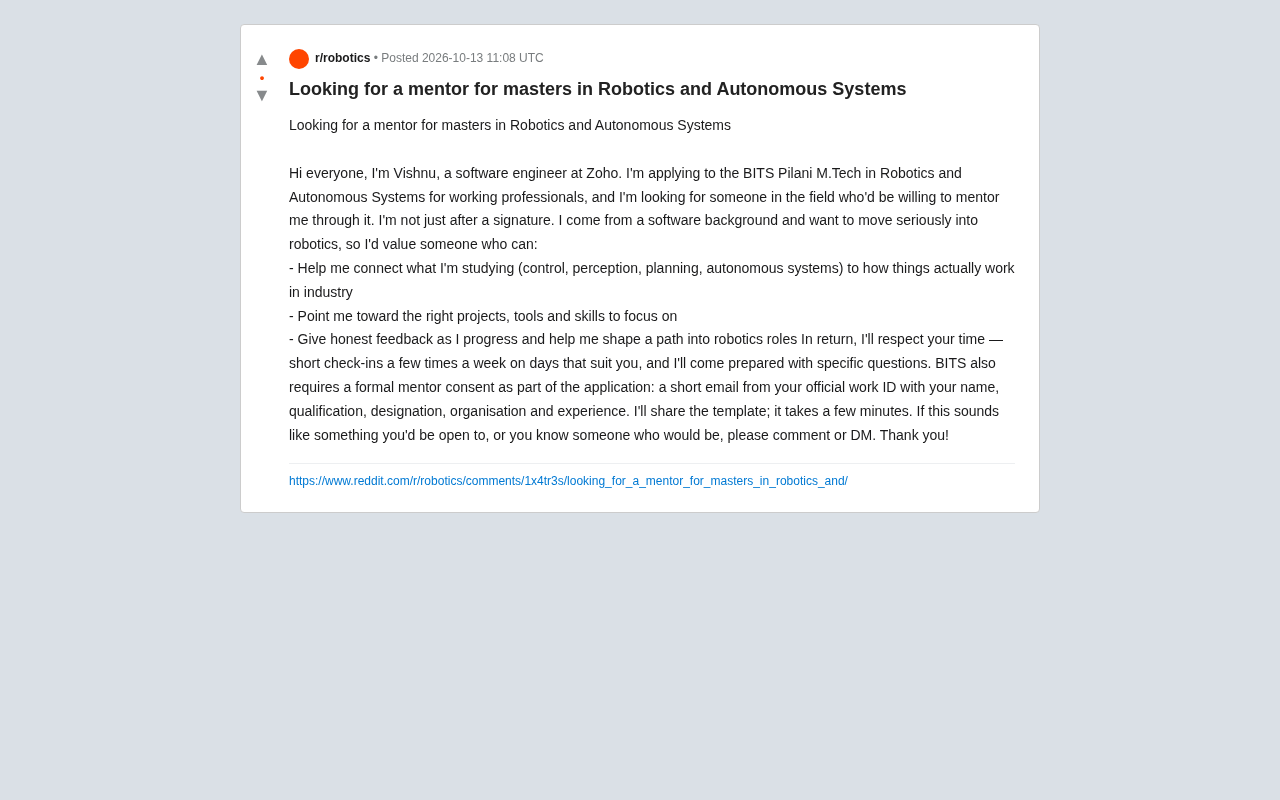
The poster, Vishnu, currently works at Zoho as a software engineer. He is applying to BITS Pilani's part-time master's program in Robotics and Autonomous Systems and is publicly seeking an industry mentor. Unlike the common "mentor in name only," Vishnu made it clear: "I'm not just looking for a signature."
He hopes his mentor can help him connect the control, perception, planning, and autonomous systems theory from his coursework with how things actually work in industry; guide him in choosing the right projects, tools, and skill directions; and provide honest feedback throughout his studies to help him chart a path into a robotics role.
The Practical Requirements of Mentorship and a Two-Way Commitment
In his post, Vishnu laid out the two-way commitment in detail. To his mentor, he promised to respect their time — brief communications a few times a week on a suitable day, always coming prepared with specific questions.
From an application standpoint, the BITS program requires a formal mentor consent letter: a short email from the mentor's official work email address, including name, degree, position, institution, and experience. Vishnu said he would provide a template, and the whole process would take only a few minutes. For the mentor, the bar isn't high, but for the applicant, it's a hard requirement.
Why the Robotics Field Needs "Industry Mentors"
Robotics and autonomous systems are a classic interdisciplinary field, spanning mechanical engineering, electronics, control, AI, and software engineering. Developers with a software background often have an edge in programming and system design, but lack intuitive understanding of hardware constraints, sensor fusion, real-time control, and the like.
Vishnu's appeal reflects a common dilemma for this group: classroom knowledge needs industry scenarios to "land." A mentor with industry experience can help students filter out outdated toolchains, point to frameworks that companies actually adopt (like ROS 2, simulation platforms, perception stacks), and explain the career prospects of different subfields (industrial robotics, autonomous driving, drones, etc.). This kind of guidance is far more valuable than simply earning credits.
ROS 2 is the second-generation version of the Robot Operating System, led by Open Robotics, and is the de facto standard middleware in both industry and academia today. It is not an operating system in the traditional sense, but a software framework for building robotics applications, providing inter-node communication, hardware abstraction, device drivers, simulation interfaces, and toolchains. Compared to ROS 1, released in 2010, ROS 2 is built on a DDS (Data Distribution Service) communication layer, supports real-time control, multi-robot coordination, and stronger security mechanisms, and has therefore rapidly replaced ROS 1 in scenarios with high reliability requirements such as autonomous driving, industrial robotic arms, and mobile robots. Companies often treat familiarity with ROS 2 as a basic threshold in hiring, making learning ROS 2 one of the most direct entry points for software engineers into robotics.
Sensor Fusion refers to spatially and temporally aligning and probabilistically merging data from multiple sensors (such as cameras, LiDAR, millimeter-wave radar, IMUs, and GPS) to produce more accurate and robust environmental perception than any single sensor could achieve. Common methods include Kalman filters, extended Kalman filters, particle filters, and more recently factor graph optimization approaches (such as GTSAM). For engineers with a software background, the difficulty often lies not in programming but in understanding the noise models of different sensors, coordinate frame transforms (TF trees), time synchronization, and failure modes. This field directly determines the reliability of autonomous driving and robot localization and mapping, and is also a key area where industry mentors can provide experience that "classroom teaching can't cover."
Real-Time Control is one of the core constraints that distinguishes robotics and autonomous systems from general software systems. It requires the system to complete computation and output control commands within a specified time window; missing a deadline can cause a robot to become unstable, collide, or even cause a safety incident. Typical implementations rely on real-time operating systems (such as FreeRTOS, Linux with the PREEMPT_RT patch), deterministic communication (such as EtherCAT, CAN bus), and periodic control loops (commonly 100Hz–1kHz). Software engineers are used to throughput-first web or backend systems and often overlook problems caused by latency jitter, priority inversion, and non-deterministic memory allocation. Understanding these constraints is an important dimension for judging whether a robotics role leans more toward "software" or toward "control."
Practical Paths to Finding a Mentor
For engineers also in transition, Vishnu's approach offers a template worth borrowing.
First, clarify your own needs. He listed specific expectations: connecting theory with practice, recommending projects and tools, and providing feedback and career path advice. The more specific the needs, the easier it is to find a matching mentor.
Second, lower the other party's cost of participation. Proactively providing a template, promising short meetings, and preparing questions in advance — these details can dispel a potential mentor's concerns about time commitment.
Third, leverage the institution's formal requirements. BITS's mentor consent letter mechanism actually becomes a legitimate reason to reach out to industry professionals — not "asking for a favor," but "a program requirement + mutual growth."
Fourth, ask publicly. Post on platforms like Reddit and LinkedIn, clearly explaining your background and goals, and mobilize your weak-tie network (friends of friends, alumni, open-source community acquaintances) to spread the word.
Weak Ties is a concept proposed by sociologist Mark Granovetter in 1973, referring to interpersonal relationships with low contact frequency and weak emotional intimacy, such as friends of friends, alumni, conference acquaintances, and open-source community contacts. His research showed that in job hunting and information acquisition, weak ties are often more valuable than strong ties (close friends, family) — because strong-tie circles have highly overlapping information, while weak ties can bridge to different circles and bring non-redundant opportunities. For engineers seeking industry mentors, actively maintaining weak ties on LinkedIn, participating in open-source project discussions, and asking friends of friends for introductions are all low-cost ways to break out of your circle.
An Observation on Robotics Education
Vishnu's post also reflects a pain point of online/part-time master's programs: institutions provide a course framework but struggle to offer one-on-one industry connections. Mentorship thus becomes a key supplement for part-time students to make up for practical gaps.
From an industry perspective, senior robotics engineers participating in this kind of mentorship work is both a way to give back to the community and an opportunity to broaden their own horizons through teaching and learning. If institutions could establish more standardized mentor-matching platforms rather than leaving students to "mass-apply" for help on their own, transition efficiency would improve significantly.
For software engineers considering a similar path, Vishnu's case shows: when entering the robotics field, technical learning is only the first step. Finding someone willing to share real experience often helps you avoid many detours along the way.
One-line Summary
How a software engineer transitioning into robotics can find an industry mentor who truly connects theory with industry.
Paragraph Summary
Using a popular Reddit post as an example, the article tells the story of software engineer Vishnu applying to BITS Pilani's part-time robotics master's program and publicly seeking an industry mentor. He made it clear that he needs more than a consent letter — he needs a mentor who can help him connect coursework in control, perception, and planning with industry practice, guide project and tool choices, and provide feedback and career path advice. The article analyzes the cognitive gaps that robotics' interdisciplinary nature creates for developers with a software background, and summarizes four practical paths to finding a mentor: clarify needs, lower the mentor's participation cost, leverage formal institutional requirements, and use public platforms and weak ties to spread the word. Finally, it points out that part-time master's programs generally lack industry connections, and that standardized mentor-matching mechanisms would improve transition efficiency.
Related articles

Huberman's Rational Supplement Guide: A Five-Layer Health Framework and Scientific Decision-Making
Stanford neurobiology professor Huberman proposes a rational supplement framework: behavior and nutrition are the foundation, basic combination supplements serve as insurance, and sleep/hormonal/cognitive directions should stick to single-ingredient experiments. Omega-3 is the top single-ingredient choice, and melatonin is not recommended.

The Unsung Painter Behind Gilded Age Manhattan Interior Design
HN discussion highlights the painter behind Gilded Age Manhattan interiors: he created murals and decorative paintings but was long overlooked as his work was seen as architectural appendage.

Can AI Agents Be Socially Engineered? Understanding Prompt Injection and Tool Permission Risks
Through Invariant Lab's GitHub Issue injection and Brave's AI browser attack, this article analyzes how Prompt Injection induces AI Agents to perform unauthorized actions, and offers protection advice across three layers: least privilege, tool validation, and operation auditing.