A Three-Month AI Agent Learning Roadmap: From Zero to Hands-On Agent Development

A three-month AI Agent roadmap from zero to hands-on development across four progressive phases.
This article breaks down a complete AI Agent learning roadmap into four progressive phases: foundational understanding, core paradigms (ReAct), memory and tools (RAG), and multi-agent collaboration. It covers prompt engineering, Function Calling, vector databases, and collaboration patterns, with practical project recommendations to become an in-demand AI Agent developer.
Why AI Agents Have Become the Most Worthwhile Skill to Learn
As large model capabilities continue to evolve, the focus of AI applications is shifting from "conversation" to "action." Models that can merely chat can no longer meet the real needs of enterprises. AI Agents—capable of autonomous planning, tool invocation, and completing complex tasks—represent the new frontier of value.
A learning roadmap that has attracted considerable attention has been circulating online: anyone with a sustained willingness to learn, given three months of systematic training, has the chance to grow from a beginner into an in-demand AI development talent. The core logic of this roadmap isn't complicated: first build a solid foundational understanding, then progress layer by layer to framework applications, memory mechanisms, and multi-agent collaboration. This article provides a structured breakdown of this roadmap and adds practical recommendations along the way.

It's worth emphasizing that the true value of a "fast-track roadmap" lies not in the time commitment itself, but in the clear capability map it provides. What determines learning outcomes is the continuity of execution and the depth of hands-on projects—not fleeting enthusiasm that fizzles out after three minutes.
Phase One: Fundamental Logic and Prompt Engineering
Understanding How Large Models Work
Many people rush to get hands-on with frameworks while skipping over an understanding of the underlying logic of large models. As a result, when debugging Agents, they often "know the what but not the why." The core task of the first phase is to understand how large models make predictions based on context, grasp the concept of tokens, the limitations of the context window, and how parameters like temperature affect output.
Large models are based on the Transformer architecture, learning the statistical patterns of language through self-supervised pre-training on massive amounts of text data. The Transformer was introduced by Google in the 2017 paper Attention Is All You Need. Its core mechanism—Self-Attention—computes the weighted dot product of three matrices (Query, Key, and Value), enabling the model to dynamically allocate attention weights across different positions in a sequence when processing each token. This captures long-range dependencies and breaks through the fundamental bottleneck that RNN/LSTM series models faced in processing long sequences. Compared to the previously dominant recurrent network architectures, the Transformer can be highly parallelized during training, which made pre-training at the scale of hundreds of billions or even trillions of parameters possible.
It's worth noting that the capabilities of modern large models don't come solely from the architecture itself, but rather from a multi-stage refinement process: in the pre-training stage, the model learns the deep statistical structure of language through the self-supervised task of "predicting the next word" on trillion-token corpora; then, through instruction tuning, the model learns to follow human instructions; finally, through Reinforcement Learning from Human Feedback (RLHF), it undergoes value alignment, ultimately forming the current general-purpose agent capable of smoothly understanding complex intent. The GPT series adopts a "Decoder-only" architecture, predicting the next token autoregressively, forming the foundational paradigm of today's mainstream large models.
Extended Background: The Engineering Significance of the Pre-training Paradigm The reason the Pre-train & Fine-tune paradigm has become mainstream in industry is its extremely high efficiency in knowledge reuse. The general language representations learned during pre-training on ultra-large-scale corpora (such as CommonCrawl, Books, GitHub code, etc.) can be transferred to hundreds or thousands of downstream tasks through relatively inexpensive fine-tuning, without needing to train a model from scratch for each task. This "scale conquers all" logic gave rise to milestone models such as GPT-3 (175 billion parameters), PaLM (540 billion parameters), and the LLaMA series, and directly propelled the commercial popularization of AI capabilities. Understanding this paradigm helps developers assess "when to fine-tune," "when prompt engineering is sufficient," and "when RAG is needed," enabling rational decisions between engineering cost and effectiveness.
Tokens are the smallest units by which a model processes text—a single Chinese character typically corresponds to 1-2 tokens, an English word is about 0.75 tokens. Understanding tokens helps estimate API call costs and context capacity. The Context Window determines the maximum amount of information the model can "see" at once. Early GPT-3 supported only 4K tokens, whereas current mainstream models have expanded to 128K or even longer. This parameter directly affects the upper limit of an Agent's ability to handle long documents and long conversations. The temperature parameter controls the randomness of the output: near 0, the model tends toward deterministic output, suitable for code generation and structured tasks; near 1, the output is more diverse, suitable for creative writing scenarios. Understanding these underlying parameters is an important foundation for tuning Agent behavior later on.
Mastering Prompt Engineering and API Calls
Prompt Engineering is the bedrock of the entire Agent development system. A crudely designed prompt can make even the most powerful model perform poorly. This phase requires focusing on mastering the following techniques:
- Role setting and task decomposition: Clearly tell the model "who you are" and "what to do" to reduce ambiguity.
- Few-shot examples: Guide the model to produce output in the expected format through demonstrations. Few-shot learning leverages the In-context Learning capability of large models—without modifying model weights, simply providing a few examples in the prompt can significantly improve output quality and format stability for specific tasks. This capability is considered one of the "superpowers" that emerged after models surpassed a certain critical scale threshold—the GPT-3 paper was the first to systematically document this phenomenon. The underlying emergence mechanism (i.e., model capabilities leaping non-linearly with parameter scale) remains a hot topic of academic research to this day. Some argue that In-context Learning is essentially a form of implicit gradient descent, but there is no definitive conclusion yet.
- Chain-of-Thought (CoT) prompting: Adding step-by-step reasoning processes to few-shot examples significantly improves model performance on complex tasks such as mathematical reasoning and logical inference. CoT was proposed by Google Research in 2022. Its core insight is that guiding a model to "think first, then answer" activates its internal multi-step reasoning capabilities, especially effective when the parameter count exceeds 100 billion, while smaller models benefit little. This technique is the direct predecessor of the subsequent ReAct paradigm and Agent reasoning mechanisms. Understanding CoT helps grasp the underlying logic of Agent "chain-of-thought" design.
- Structured output: Enabling the model to reliably return parseable formats such as JSON is a prerequisite for Agents to interface with external systems. Modern large models typically support "JSON mode" or use grammar constraints (Grammar Sampling) to force output conforming to a specified schema, significantly improving the reliability of Agent integration with downstream systems.
On the other hand, proficiently calling the APIs of mainstream large models is the watershed that separates "toy demos" from "engineered applications." Only when you can stably invoke models through code does the subsequent Agent logic have a foundation for implementation.
Phase Two: Mastering Core Agent Paradigms

Understanding ReAct's Think-Act-Observe Loop
The focus of the second phase is understanding the underlying mechanism that makes Agents "smart"—the ReAct (Reasoning + Acting) paradigm. ReAct was formally introduced by Yao et al. in the 2022 paper ReAct: Synergizing Reasoning and Acting in Language Models, and its effectiveness in surpassing pure reasoning (Chain-of-Thought) and pure action methods was validated on knowledge-intensive benchmarks such as HotpotQA and FEVER.
Understanding ReAct's historical context helps grasp its core value: before it, although the Chain-of-Thought (CoT) prompting method significantly improved a model's multi-step reasoning ability, the reasoning chain relied entirely on the model's internal parameterized knowledge, unable to access real-time external information, and was highly prone to hallucination on factual tasks. ReAct's core innovation lies in interweaving "chain-of-thought reasoning" with "tool invocation" within the same reasoning process—the model no longer merely deduces in its "mind" but corrects internal inferences by actually invoking tools to obtain real-world feedback, thereby drastically reducing the hallucination rate. This approach was later engineered into reality by OpenAI in the form of Function Calling, implemented by Anthropic as Tool Use, and evolved into the core execution engine of nearly all mainstream Agent frameworks today.
Extended Background: The Engineering Significance of Function Calling The Function Calling feature launched by OpenAI in June 2023 was a pivotal moment in ReAct's transition from academic paper to large-scale engineering implementation. Its essence is a structured tool invocation protocol built into the model's reasoning layer: developers declare the name, description, and parameter definitions of available tools in JSON Schema format, and the model autonomously determines during reasoning whether it needs to invoke a tool, which tool to invoke, and what parameters to pass, returning a structured invocation request rather than free-form text. This design decouples "Agent decision-making" from "tool execution"—the model handles decisions, while the host program handles actual execution and returns the results, forming a standardized human-machine collaboration interface. Compared to the fragile earlier approach of parsing tool invocation intent through prompts, Function Calling significantly improved both reliability and latency, becoming the de facto standard for industrial-grade Agent systems.
The core of ReAct is a continuously looping process:
- Reasoning: The model analyzes the current state and plans the next action.
- Acting: Invoking a tool or executing a specific operation.
- Observation: Reading the results returned by the action and feeding them back into the next round of reasoning.
This "think-act-observe" closed loop is key to an Agent's ability to handle multi-step complex tasks. Only by understanding it can you grasp why an Agent can "self-correct," and know how to intervene and tune when it gets "stuck."
Proficiency with Mainstream Agent Development Frameworks
After understanding the paradigm, you need to put it into practice with specific frameworks. The mainstream Agent development frameworks each have their own focus: LangChain is the most mature framework in terms of ecosystem, offering rich tool integrations and chained invocation modules, suitable for rapid prototyping; LlamaIndex (formerly GPT Index) focuses on data indexing and retrieval scenarios, with advantages in building RAG pipelines; AutoGen, developed by Microsoft Research, is designed specifically for multi-agent conversation scenarios, with built-in termination strategies and error handling mechanisms abstracted through "conversational programming"; CrewAI centers on the concept of "role-playing," reducing the design complexity of multi-Agent systems through declarative role definitions, suitable for building Agent teams with clear divisions of labor. Beginners are advised to first choose LangChain for in-depth practice, mastering fundamental operations like tool registration, chained invocation, and error handling, rather than dabbling in multiple frameworks simultaneously without depth.
Extended Background: The Architectural Evolution of LangChain Since LangChain was open-sourced in late 2022, it has undergone a significant architectural evolution from a "chained invocation toolkit" to a "full Agent orchestration platform." Early versions centered on Chain and Agent as core abstractions, emphasizing the flexibility of modular composition; the LangGraph extension launched in 2023 models the Agent execution flow as a Directed Acyclic Graph (DAG) or Cyclic Graph, supporting loop reasoning, conditional branching, and state persistence, making the design and debugging of complex Agent workflows more intuitive. At the same time, the LangSmith platform provides full-chain observability of Agent execution (every reasoning step, tool invocation parameter, and token consumption can be traced), addressing the core pain point of "black-box debugging difficulty" in Agent systems. Understanding this evolutionary trajectory of LangChain helps developers choose the appropriate level of abstraction based on project complexity, rather than blindly chasing the latest API.
Phase Three: Memory Mechanisms and Tool Invocation

Implementing Short-term and Long-term Memory
An Agent without memory is like an assistant that "loses its memory with every conversation." The core of the third phase is to endow Agents with memory capabilities:
- Short-term memory: Maintains the context of the current session, allowing the Agent to remember the content of the ongoing conversation. This is typically implemented by appending the history message list to the prompt with each request. Limited by the context window size, it requires designing reasonable truncation or summarization strategies. Common engineering practices include introducing a "sliding window" (keeping only the most recent N rounds of conversation) or "summary compression" (using the LLM to compress the conversation history into a summary before continuing to append it), to strike a balance between memory completeness and token cost.
- Long-term memory: Typically implemented with the help of a Vector Database, enabling the Agent to retrieve historical information and knowledge base content across sessions. Its underlying technical foundation is the Retrieval-Augmented Generation (RAG) architecture—a solution proposed by Meta AI in 2020, aimed at solving the two core pain points of large models: "knowledge cutoff" and "hallucination."
The RAG workflow is divided into two stages: in the offline indexing stage, documents are chunked and then converted into high-dimensional vectors (typically 768 or 1536 dimensions) through an Embedding Model (such as OpenAI's text-embedding-ada-002 or the open-source BGE series) and stored in a vector database; in the online retrieval stage, the user query is also vectorized, and semantic similarity matching is completed in milliseconds through approximate nearest neighbor algorithms (such as HNSW graph indexing or IVF-PQ quantization). The recalled relevant document chunks are then concatenated with the original question and fed into the LLM to generate an answer. Unlike traditional keyword retrieval, content with different wording but similar meaning can also be accurately recalled. Compared to fine-tuning, RAG does not require retraining the model, knowledge can be updated in real time, costs are significantly lower, and retrieval sources are traceable, giving it an irreplaceable advantage in enterprise-level compliance scenarios. Current mainstream vector databases include Pinecone, Weaviate, Chroma, and Milvus, each differing in hosting method, retrieval performance, and ecosystem integration.
Extended Background: Advanced RAG Variants and Engineering Trade-offs As RAG has been deployed at scale in production environments, researchers and engineers have developed various advanced variants to address the limitations of basic RAG. Hybrid Search merges the results of vector semantic retrieval and BM25 keyword retrieval through the RRF (Reciprocal Rank Fusion) algorithm, balancing semantic recall and exact matching capabilities, and performs particularly well in retrieving proper nouns and code snippets. Re-ranking introduces a cross-encoder after initial recall to finely score the relevance of candidate documents to the query, significantly improving the precision of the Top-K results, at the cost of adding about 50-200ms of latency. HyDE (Hypothetical Document Embeddings) first uses the LLM to generate a "hypothetical answer," then uses the vector of this hypothetical answer instead of the original query for retrieval, leveraging the LLM's completion capability to bridge the semantic gap between "short queries" and "long documents." In actual projects, the bottleneck of RAG effectiveness often lies not in the retrieval algorithm itself, but in the document chunking strategy (the setting of chunk size and overlap) and the domain adaptability of the embedding model—these two points deserve developers' focused tuning efforts.
Making Agents Truly "Take Action"
Tool invocation capability determines whether an Agent can interact with the real world—querying databases, calling external APIs, reading and writing files, searching the web, etc. This phase recommends using an intelligent customer service system with memory as a practice project: it needs to remember user identity, retrieve the knowledge base, and invoke tools to query order status. Although the project is small, it covers almost all the key elements of engineering-level Agent implementation.
Phase Four: Multi-Agent Collaboration
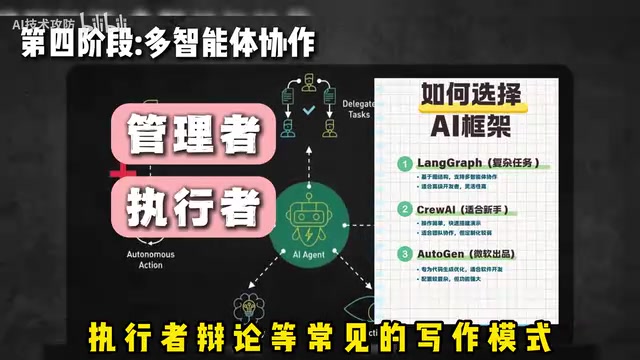
From Single-Agent to Multi-Agent System Architecture
When a single Agent struggles to handle complex tasks, multi-agent collaboration becomes an inevitable choice. The concept of a Multi-Agent System (MAS) originates from the field of distributed artificial intelligence, with academic research foundations dating back to the 1980s. In the era of large models, MAS has been given new engineering connotations: each Agent is essentially an autonomous decision-making unit driven by an LLM, with Agents collaborating through structured message passing. The core idea is "divide and conquer"—decomposing complex tasks that exceed the capability boundary of a single model and handing them off to specialized Agents for parallel or sequential processing.
In engineering practice, the core challenges faced by multi-Agent systems are far more complex than architecture diagrams suggest: regarding context explosion, when the intermediate outputs of multiple Agents need to be aggregated to the orchestration layer, token consumption may grow exponentially. The coping strategy is to design a streamlined structured output specification for each Agent and introduce a summary Agent at the aggregation node. Regarding state consistency maintenance, conflicts arising from parallel Agents modifying shared state require introducing a shared memory layer (such as Redis) and designing an optimistic locking mechanism. The error cascade problem requires configuring independent error handling logic and retry mechanisms for each Agent, rather than passing exceptions up to the upper layer. Termination condition design typically adopts a dual-safeguard mechanism of "maximum step limit + goal achievement detection" to prevent Agents from falling into infinite reasoning loops that consume resources. Mastering the approaches to these challenges is more important than merely being familiar with framework APIs.
The fourth phase requires mastering frameworks such as AutoGen or CrewAI and understanding the following common collaboration patterns:
- Manager-Executor pattern: One Agent is responsible for task decomposition and scheduling, while the other Agents focus on execution. This pattern is suitable for scenarios with fixed processes and clear divisions of labor, such as automated report generation or multi-step data processing pipelines. The orchestration-layer Agent typically needs to maintain a task dependency graph (DAG) to ensure that subtasks with dependencies are executed in the correct order, while independent subtasks can be distributed in parallel to improve throughput efficiency.
- Debate pattern: Multiple Agents argue from different angles, improving the quality of conclusions through "mutual criticism." Research (such as Du et al.'s 2023 paper Improving Factuality and Reasoning in Language Models through Multiagent Debate) shows that mutual questioning and rebuttal among multiple models can effectively reduce the hallucination problem of a single model, especially suitable for high-precision scenarios such as fact-checking, code review, and risk assessment. Its essence is to transform "a single reasoning pass within a model" into "an iterative game among multiple agents," driving output quality to converge through external social pressure.
- Reflection pattern (Reflexion): After a single or multiple Agents complete a task, a dedicated "evaluation Agent" critically reviews the output, generating improvement suggestions to drive the execution Agent toward iterative optimization. This pattern was proposed by Shinn et al. in 2023. Its core insight is that verbal reinforcement can replace parameter gradient updates, enabling the Agent to achieve reinforcement-learning-like behavioral improvement during inference without any training overhead. In scenarios with clear quality standards, such as code generation and article writing, the Reflexion pattern can significantly improve output quality to a level close to manual iteration.
Extended Background: Observability and Production Deployment of Agent Systems One of the biggest challenges when putting multi-Agent systems into production is the lack of observability. Unlike traditional software systems, an Agent's decision path dynamically emerges—the same input may trigger entirely different tool invocation chains in different runs, making traditional log monitoring approaches severely inadequate. The industry is forming an observability tool stack specifically for LLM applications: platforms such as LangSmith, Helicone, and Arize Phoenix provide trace-level reasoning chain tracking, token consumption statistics, latency distribution analysis, and hallucination detection capabilities. At the deployment architecture level, splitting the Agent system into a Stateless Inference Service and a Stateful Memory/Task Management Service is a key design pattern for achieving horizontal scaling and fault isolation. For developers aspiring to take on enterprise-level AI projects, having a basic awareness of observability design is often the core capability leap from "being able to make a demo" to "being able to go live."
Validating Comprehensive Capabilities with Complete Projects
It's recommended to complete two or three small projects in this phase, such as an intelligent customer service system based on multi-Agent collaboration. The significance of the projects lies in connecting the knowledge from the first three phases—only by truly running a complete system can you have something "presentable" in interviews and actual work. Completing the entire learning roadmap is sufficient to build the foundational capabilities needed to be qualified for mainstream AI positions.
Final Thoughts: The Roadmap Is a Map, but Execution Is the Road
The greatest value of this AI Agent learning roadmap lies in breaking down a complex body of knowledge into four progressive phases: Foundational Understanding → Core Paradigms → Memory and Tools → Multi-Agent Collaboration. Each phase has clear knowledge points and accompanying hands-on projects.
However, one should also view the expectation of "becoming skilled in three months" rationally. It holds true only under the premise of continuous, high-intensity investment and solid hands-on project implementation. Rather than agonizing over whether you can fast-track it within a specific timeframe, it's better to focus on "whether each phase has truly produced a runnable project." The technical roadmap can be a reference, but true competitiveness comes from those few hands-on projects that you personally debugged, stumbled through, and finally got running.
Key Takeaways
Related articles

Andrew Ng's New Company LearnVector: Achieving One-on-One Personalized Learning with AI
Andrew Ng launches LearnVector, using generative AI to deliver one-on-one personalized learning. Explore its core vision, potential capabilities, challenges, and how LLMs can solve education's scalability problem.

Truth Has No Direction: How the Tarski Paradox Challenges LLM Truth Probe Techniques
How a Tarski-style attack challenges LLM truth probes from the foundations of logic. Is the linear representation hypothesis valid, or is the "truth direction" in AI activations just a statistical illusion?

Andrew Ng's New Company LearnVector: Achieving One-on-One Personalized Learning with AI
Andrew Ng launches LearnVector, leveraging generative AI to create one-on-one personalized learning experiences. Explore its core vision, potential capabilities, challenges, and how LLMs could solve education's scalability problem.