A Universal Connection Layer for AI Agents: Essential Need or False Premise?
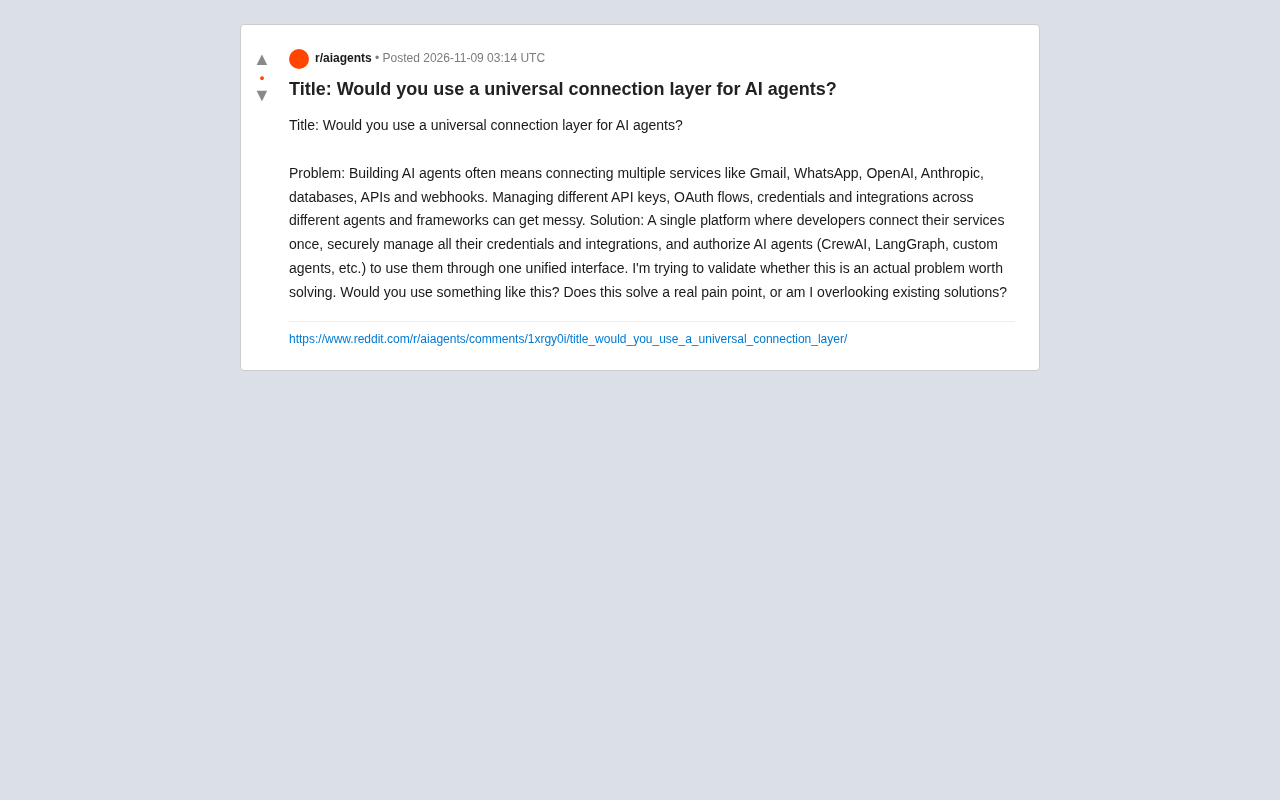
Can a universal connection layer solve the real problem of fragmented credentials and integrations in agent development?
The article analyzes the "universal connection layer for AI agents" concept proposed on Reddit. Building agents requires integrating Gmail, WhatsApp, multiple model providers, databases, and webhooks, each with its own API keys and OAuth flows, and integration logic quickly becomes chaotic when multiple frameworks run in parallel. Existing solutions—environment variables, secret managers, automation platforms like Zapier/n8n, and identity services like Auth0—address part of the problem, but they mainly serve human-driven workflows and offer inconsistent support for fine-grained authorization, call auditing, and per-agent credential isolation. A unified connection layer can reduce repetitive code and centralize risk management, but it introduces new failure points and trust boundaries, and the abstraction layer struggles to cover edge cases such as webhook callbacks and multi-tenant isolation. The article recommends validating demand by observing what developers actually do rather than asking about willingness, and starting with high-frequency, small-scope scenarios.
Why Agent Developers Need a "Connection Layer"
When building AI agents, developers often need to integrate with a variety of services: Gmail, WhatsApp, OpenAI, Anthropic, databases, APIs, and webhooks. Each service has its own API keys, OAuth flows, and credential management approach. When multiple agent frameworks (such as CrewAI, LangGraph, or custom-built agents) run in parallel, this integration logic quickly becomes chaotic. The "universal connection layer" concept proposed by a developer on Reddit targets exactly this pain point: let developers connect all services once, manage credentials and integrations securely in one place, and then grant access to different agents through a unified interface.
The core question is: have credentials and integration management already become a real bottleneck in agent development, or have developers simply worked around it with existing solutions?
OAuth flow is an authorization protocol that allows third-party applications to access a user's protected resources on their behalf without obtaining the user's password. In a typical flow, the application first redirects the user to the service provider's authorization page; after the user consents, the provider returns an authorization code, which the application exchanges for an access token and then uses to call the API. Tokens usually have an expiration and must be renewed via refresh tokens. In the agent context, the challenge with OAuth is that the authorization process requires human interaction, while autonomously running agents cannot easily complete browser redirects and click-through consent. In practice, developers therefore often complete authorization in advance, persist the tokens, and then make them available to agents through service accounts or token proxies. This is precisely the step that a centralized connection layer aims to simplify.
Can Existing Solutions Cover the Need?
Before making a judgment, it's worth looking at solutions that already exist in the community. For credential management, environment variables, secret management services (such as Vault-like tools), and cloud providers' Secret Managers have long been mature. At the integration level, automation platforms like Zapier, n8n, and Make offer a large number of prebuilt connectors. For OAuth aggregation, identity services such as Auth0 and Clerk handle authorization flows.
However, these solutions primarily serve "human-driven workflows" or "traditional backend services," not "autonomously running agents." Agents are characterized by dynamic tool invocation, multi-turn decision-making, and the possible use of multiple model providers simultaneously—which imposes new requirements for fine-grained permission control, call auditing, and per-agent credential isolation. Existing tools can achieve "connection," but the experience is not coherent when it comes to "authorizing a specific agent to temporarily use a specific service with least privilege."
The Value and Risks of a Universal Connection Layer
In terms of value, a unified connection layer can significantly reduce repetitive integration code, letting developers focus on agent logic itself. Centralized credential management also lowers the risk of leakage—especially when multiple agents share the same set of services, per-agent authorization is more controllable than scattered environment variables. For teams using frameworks like CrewAI and LangGraph, the appeal of "integrate once, reuse everywhere" is very real.
The risks are equally clear. Introducing a middle layer means an additional point of failure and trust boundary, with all sensitive credentials entrusted to a third-party platform; if that platform is attacked or experiences an outage, every agent depending on it is affected. In addition, authorization models vary greatly across services, and whether an abstraction layer can cover edge cases (such as webhook callbacks, read-only database credentials, and multi-tenant isolation) remains unknown. Whether developers are willing to pay for it also depends on how much maintenance cost it saves compared with building their own solution.
The Principle of Least Privilege states that each subject should be granted only the minimum access necessary to complete its task, for as short a duration as possible. In multi-agent systems, this principle is especially important: different agents may only need to read a specific label in a mailbox or call only a specific endpoint of a particular model. If all agents share a single full-permission API key, the damage is amplified once an agent falls victim to a prompt injection attack or makes a logic error. An ideal connection layer should support issuing short-lived, scope-limited credentials per agent and keep an audit log of every call, so that problems can be traced and credentials revoked. This is a capability that existing general-purpose secret management services do not yet fully cover.
Determining Whether This Is a Real Need
To validate this kind of idea, the key is not to ask "would you use it?" but to observe what developers are actually doing today. If teams are already cobbling together credential management with scripts, repeatedly rewriting OAuth flows, or manually syncing keys across multiple agents, then the pain point is real. Conversely, if most projects connect only a handful of services and environment variables are enough for credential management, then a universal connection layer may be an over-abstraction that "sounds beautiful."
A pragmatic starting point is to begin with a small but deep scenario: for example, solve only the single problem of "multiple agents sharing Gmail and OpenAI credentials" and see whether developers are willing to migrate. Rather than promising universal connectivity from the start, focusing on high-frequency, high-pain service combinations is more likely to yield real feedback. For the developer who proposed the idea, the next step should be in-depth interviews with a few teams already working in multi-framework, multi-service environments—not stopping at a proof of concept.
Prompt injection is a key risk in agent security: an attacker embeds malicious instructions in content that the agent reads (such as email bodies, web pages, or documents) to trick the agent into leaking credentials or performing unauthorized actions. When an agent holds a long-lived, full-permission API key, a single successful injection can lead to credential leakage. Therefore, if a connection layer only provides centralized storage without permission isolation and call auditing, it will instead concentrate risk into a single point. When evaluating such a product, the focus should be on whether it supports authorization by agent, by service, and by operation scope; whether it provides short-lived tokens and revocation mechanisms; and whether it keeps traceable call logs.
Conclusion
The universal connection layer points to a real friction point in agent engineering—the fragmentation of credentials and integrations. But whether it deserves to become a standalone product depends on how large a gap existing solutions leave and how much developers trust centralized hosting. Before giving an answer, first confirm whether the problem itself is painful enough.
Related articles

Seven Years of Evolution: How Far Has the Foldable Come From the First Generation?
From the first foldable to today's latest models, what has seven years changed? Shallower creases, higher brightness, thinner bodies, and smoother software migration—has the foldable crossed the chasm from enthusiasts to ordinary users? This article discusses the question based on a video comparison.

When Did Humans Start Eating Salt? A 10,000-Year History of Salt
When did humans start eating salt? From salt use at the dawn of agriculture 11,000 years ago to ancient seawater evaporation and rock salt mining, and on to the salt trade, salt taxes, and Gandhi's Salt March, this article traces salt's key role in human civilization.

Microsoft Paza Research: How African Language Speech Recognition Breaks Through Architecture and Data Bottlenecks
Microsoft's Paza research evaluates 53 speech models across 39 African languages, revealing architecture choice matters more than pre-training coverage, 200-300 hours is the practical data threshold, and language typology deeply influences recognition performance.