Seven Years of Evolution: How Far Has the Foldable Come From the First Generation?

After seven years of evolution, foldables have moved from enthusiast-only to maturity, but whether they can cross the mainstream chasm remains an open question.
Using the video creator's experience as a thread, the article reviews seven years of foldable phone evolution. The first generation, with uncertainties around crease durability, software adaptation, and bulk, suited only enthusiasts; today's latest iteration achieves "night and day" progress in hinge engineering, thin-and-light bodies, crease concealment, and screen brightness, while migration tools like Smart Switch lower the switching barrier, and the unfolded large-screen viewing experience has become a core value slab phones can't replace. The collective follow-up of multiple manufacturers confirms the first generation's path-paving significance. The video ends by invoking the concept of "crossing the chasm" to pose an open question: has the foldable gone from geek toy to rational choice for ordinary users? The creator leans toward yes, but notes that price, repair costs, and habit migration remain real obstacles—mainstreaming is still an ongoing story.
From Sci-Fi Concept to Everyday Tool: Seven Years of Foldable Evolution
When the first foldable phone debuted, the shock it delivered felt more like a preview from the future. As the video's creator put it when trying the first-generation product: "It really did feel like science fiction stepping into reality." That novelty also explains why early recommendations were aimed only at enthusiasts—there were simply too many unknowns that needed to be verified.
Seven years later, the latest iteration of the same product line shows a completely different level of maturity. The creator describes the leap as "like night and day": more precise hinge engineering, a thinner and lighter body, a more concealed crease, and a more reliable software migration experience. Foldables are no longer a proof of concept in the lab, but mature devices you can carry every day.
Hardware Evolution: Shallower Crease, Higher Brightness, Thinner Body
Comparing the first generation with current products, the most intuitive upgrades show up in physical form. The screen-to-body ratio when unfolded reaches a stunning level, and the crease is far less noticeable. The creator specifically notes that the new generation has a clear improvement in brightness, and the thickness control when folded is notably better.
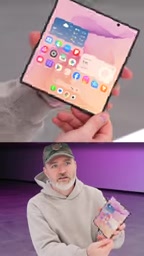
This hardware refinement isn't Samsung's achievement alone. The creator emphasizes that it was precisely because the first-generation foldable "paved the way" that other manufacturers dared to follow and invest, pushing the entire category forward together. From hinge structures to flexible screen materials, the maturation of the entire supply chain has made the foldable form no longer fragile.

The root cause of the foldable crease lies in the physical structure of flexible screens. Traditional slab phones use glass covers, while foldables must use bendable materials—early on mostly polyimide (PI) film, whose surface hardness and flatness fall far short of glass. Crease formation is directly related to the hinge's bending radius: the smaller the radius, the more concentrated the stress at the bend, and the more visible the crease. Recent improvements come mainly from two directions—hinge structures have evolved from U-shaped to waterdrop-shaped, letting the screen form a gentler arc rather than a sharp fold when closed; meanwhile, ultra-thin flexible glass (UTG) has gradually replaced PI film, improving surface flatness and feel. Brightness gains are tied to iterations in emitting materials and thinner display stacks; removing a polarizer layer or adopting depolarization technology can significantly boost light transmittance.
Software Experience: The Big-Screen Advantage Is Being Delivered
Beyond hardware, the maturation of the software ecosystem is equally critical. In the video, the creator mentions the continuous evolution of migration tools like Smart Switch—moving data and settings to a new phone has become smoother, lowering the psychological barrier for users to try something new.

More importantly, the large-screen viewing experience when unfolded is described by the creator as "an experience never before possible on a phone." This natural grip and expansive field of view is exactly the core value that distinguishes the foldable form from slab phones. Only when software can fully exploit the large-screen space does the foldable truly shed the criticism of "folding for folding's sake."
Smart Switch is a device-to-device data migration tool provided by Samsung, supporting transfer of contacts, photos, apps, and system settings from an old device to a new one via cable, wirelessly, or through the cloud. For foldables, the maturity of migration tools carries extra significance: foldable users often switch from slab phones, and during the switch, app layouts, split-screen preferences, and display habits for the outer and inner screens all need to be re-established. If migration tools can preserve existing settings and automatically adapt to the foldable form, they can significantly reduce migration costs and psychological barriers. This also explains why the creator views the software migration experience as an important part of foldables reaching the mainstream—the more radical the change in hardware form, the more crucial continuity at the software level becomes.
Has the Foldable Crossed the Chasm?
The video ends with an open question: has the foldable crossed the chasm between enthusiasts and ordinary users? The creator doesn't give a definitive answer, but leaves the judgment to the audience.
Judging from the comparisons presented, the answer leans toward yes. The uncertainties facing the first-generation product—whether the crease is durable, whether software is adapted, whether the body is too bulky—have been systematically resolved in the latest products. As the "sense of sci-fi" gradually turns into a "sense of everyday," the foldable's audience naturally expands outward from the geek crowd.
But crossing the chasm doesn't mean it's right for everyone. Price, repair costs, and the migration of usage habits remain practical factors ordinary consumers must consider. The creator admits in the video: "I don't know—let me hear your voices." That cautious attitude precisely shows that the mainstreaming of foldables is still an ongoing story, not a settled conclusion.
The phrase "crossing the chasm" comes from Geoffrey Moore's technology adoption life cycle theory. The theory divides consumers by how early they adopt new technology into innovators, early adopters, the early majority, the late majority, and laggards, with a "chasm" between early adopters and the early majority—the former are willing to pay for a new technology's imperfections, while the latter demand that a product be mature enough, reasonably priced, and well-supported by the ecosystem before entering. The early recommendation targets for foldables were typical early adopters (enthusiasts), while ordinary users belong to the early majority. The key to judging whether the chasm has been crossed isn't whether the product is better than the previous generation, but whether it has eliminated the core concerns of mainstream users: reliability, price, and seamless integration into daily use. By throwing the question to the audience, the creator is essentially asking whether foldables have completed the identity shift from "worth trying" to "worth choosing by default."
Final Thoughts
Over seven years, foldables have gone from "enthusiasts only" to a position where "ordinary people should seriously consider them." Improvements in hardware precision, the completion of the software experience, and the collective investment of multiple manufacturers together form this evolutionary curve. As for whether it's ready to enter everyone's pocket, perhaps the next seven years will give a clearer answer.
Related articles

When Did Humans Start Eating Salt? A 10,000-Year History of Salt
When did humans start eating salt? From salt use at the dawn of agriculture 11,000 years ago to ancient seawater evaporation and rock salt mining, and on to the salt trade, salt taxes, and Gandhi's Salt March, this article traces salt's key role in human civilization.

Microsoft Paza Research: How African Language Speech Recognition Breaks Through Architecture and Data Bottlenecks
Microsoft's Paza research evaluates 53 speech models across 39 African languages, revealing architecture choice matters more than pre-training coverage, 200-300 hours is the practical data threshold, and language typology deeply influences recognition performance.

Timeline of Nvidia CEO Jensen Huang's Alleged Affair with a Purported Chinese Spy
Reports claim Nvidia CEO Jensen Huang had an affair with an alleged Chinese spy; a timeline notes possible national security concerns amid the U.S.-China AI race, though details remain unverified.