A Universal Orchestration Layer for Deep Learning: Why MLOps Still Lacks a Standard Framework

Why deep learning still lacks a universal, framework-agnostic orchestration standard like Rails for web dev.
Training code represents only a fraction of deep learning workflows — environment setup, experiment tracking, hyperparameter tuning, and resource scheduling consume most engineering effort. This article examines why a unified, framework-agnostic orchestration layer remains elusive, analyzes existing tools like Ray, MLflow, Metaflow, and SkyPilot, and provides practical combination recommendations for ML engineers.
A Pain Point That Keeps Coming Up
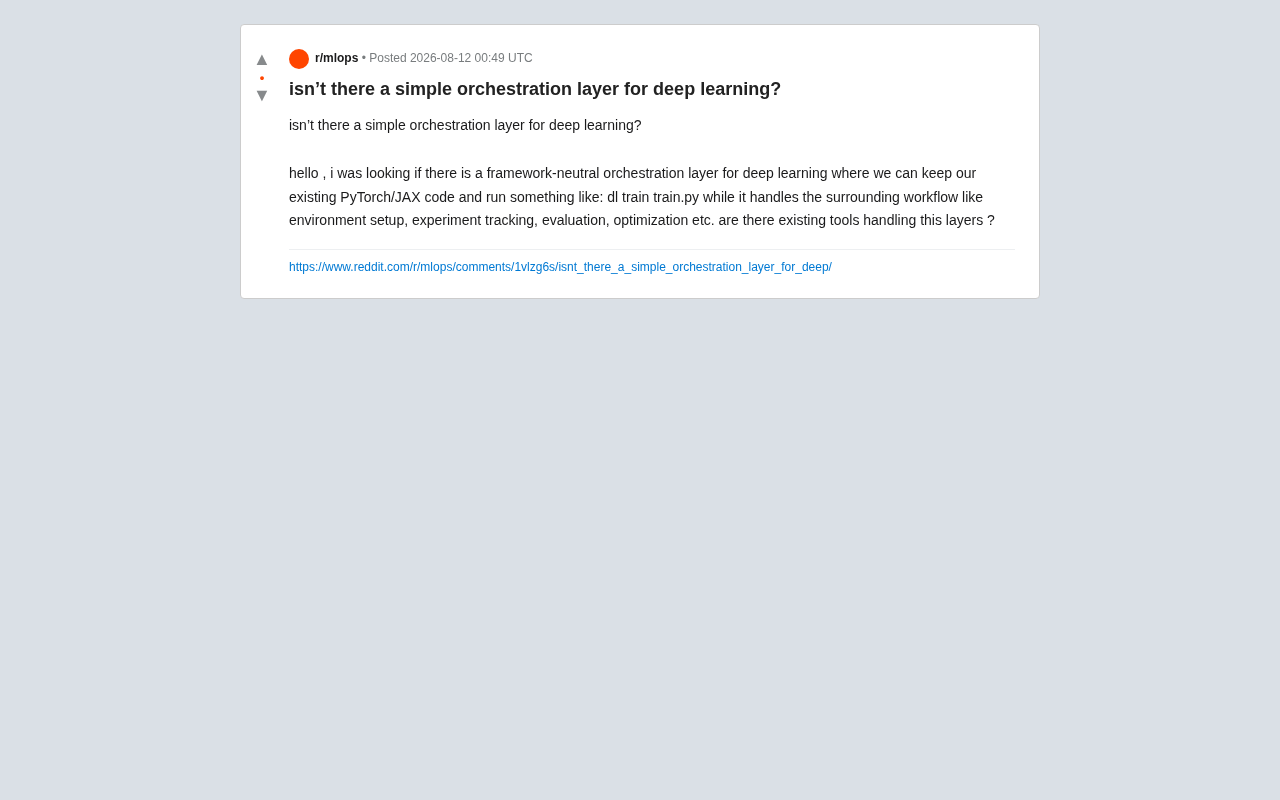
Recently, a developer on Reddit raised a question that strikes at the core of deep learning engineering practice:
"Is there a framework-neutral orchestration layer for deep learning? I want to keep my existing PyTorch/JAX code and just run something like
dl train train.py, and have it automatically handle environment setup, experiment tracking, evaluation, optimization, and other peripheral workflows."
This question seems simple, but it touches on a long-standing structural contradiction in the MLOps field: the training code itself is only a small fraction of the entire workflow, while the "glue work" surrounding it consumes a massive amount of engineering effort. Google's classic 2015 paper Hidden Technical Debt in Machine Learning Systems pointed out that model code in real ML systems typically accounts for only about 5% of the total codebase, with the rest being data management, configuration, monitoring, serving, and other "peripheral infrastructure."
Why the Demand for a Deep Learning Orchestration Layer Is So Universal
The "Hidden Costs" Beyond Training Code
Anyone who has worked on a deep learning project knows that model.fit() or the training loop is just the tip of the iceberg. What truly consumes time is often:
- Environment configuration: CUDA versions, drivers, dependency conflicts — especially painful when reproducing across machines. NVIDIA's CUDA toolkit has binary incompatibilities between major versions, and PyTorch/JAX precompiled packages are bound to specific CUDA versions. Add cuDNN, NCCL, and other auxiliary library version constraints, and you get a complex dependency matrix. Docker and conda environments can alleviate but not cure this problem.
- Experiment tracking: Recording hyperparameters, metrics, and model weights for each run to enable comparison and rollback.
- Evaluation pipelines: Automatically running validation sets and generating reports after training completes.
- Hyperparameter optimization: Grid search, Bayesian optimization, etc. all require external scheduling.
- Resource scheduling: Managing allocation across single-node multi-GPU, multi-node multi-GPU, and cloud GPU setups.
The poster's request essentially boils down to: Can these cross-cutting concerns be separated from business code and handed over to a unified orchestration layer, without invading the existing PyTorch/JAX logic?
Cross-cutting concerns are a classic concept in software engineering, originating from Aspect-Oriented Programming (AOP). They refer to functionality scattered across multiple modules that is orthogonal to core business logic but indispensable — such as logging, authorization, and transaction management. In the deep learning context, experiment tracking, environment configuration, and resource scheduling are typical cross-cutting concerns — they're unrelated to model architecture design and training logic, but every project must handle them. Traditional software development uses AOP frameworks (like Java's AspectJ) to elegantly separate these concerns, but the deep learning field has not yet formed a similarly mature paradigm.
Framework-Agnosticism Is the Key Constraint
You might not have noticed, but the poster specifically emphasized "framework-neutral." This means they don't want to be locked into a specific framework (like tools that only support PyTorch), but rather want an abstraction layer that can simultaneously support PyTorch, JAX, and even TensorFlow. This constraint significantly increases the difficulty of tool selection, because many existing MLOps solutions are more or less coupled to specific ecosystems.
To understand the difficulty of this constraint, you need to recognize the fundamental programming paradigm differences between PyTorch and JAX. PyTorch uses imperative programming (eager execution) — code executes line by line, tensor operations are evaluated immediately, debugging feels no different from regular Python code, and flexibility is extremely high. JAX takes a fundamentally different approach: centered on functional programming, it requires computational logic to be pure functions (no side effects), then compiles functions via jax.jit into XLA (Accelerated Linear Algebra) intermediate representations for hardware-level optimization. JAX's jax.vmap (automatic vectorization) and jax.pmap (automatic parallelization) transformations require code to adhere to strict functional constraints. This fundamental paradigm difference means that if an orchestration layer wants to deeply integrate both, it must find the greatest common denominator in interface design — usually settling for the coarse-grained level of "treating training scripts as black-box invocations."
Can Existing MLOps Tools Meet Orchestration Needs?
In fact, the community has accumulated quite a few tools, but they each solve different facets of the problem. It's hard to say any single one provides perfect "one-stop" coverage of all needs.
Experiment Tracking and Management Tools
- Weights & Biases (W&B) and MLflow are mainstream choices for experiment tracking. They are framework-agnostic and can record metrics, hyperparameters, and artifacts with just a few API calls. However, they don't handle environment configuration or resource scheduling themselves. MLflow, open-sourced by Databricks, uses a two-level "experiment-run" organizational structure and supports model registry and deployment pipelines; W&B is known for its beautiful visualization dashboards and team collaboration features, and has become one of the most frequently cited experiment tracking tools in academic papers.
- Neptune, Comet, and others provide similar capabilities.
Training Orchestration and Distributed Scheduling
- Metaflow (open-sourced by Netflix) provides workflow orchestration centered on Python decorators, handling data flows, step dependencies, and cloud scaling without being invasive to frameworks. Metaflow was open-sourced in 2019 by Netflix's machine learning infrastructure team. Its core innovation is versioned dataflow — each run automatically snapshots all intermediate data and code, making any historical experiment fully reproducible. In production, the same code can scale from a local notebook to AWS Batch or Kubernetes clusters without modification. Internally at Netflix, hundreds of machine learning projects run on Metaflow, spanning recommendation systems, content moderation, and financial forecasting.
- Kubeflow targets Kubernetes and is suitable for production-scale training orchestration, but has high configuration complexity.
- Ray and its ecosystem (Ray Train, Ray Tune) provide a unified interface for distributed training and hyperparameter optimization with good framework-agnosticism, approaching the ideal universal orchestration form. Ray was originally developed by UC Berkeley's RISELab (sharing origins with Apache Spark), with the core idea of providing a unified low-level abstraction for distributed computing. Ray's two primitives — tasks and actors — can express virtually all distributed computing patterns. Ray Train encapsulates distributed data parallelism and model parallelism training, Ray Tune implements scalable hyperparameter search (supporting advanced scheduling algorithms like Asynchronous Hyperband and Population Based Training), and Ray Serve handles online model inference. Users only need to wrap existing training code in Ray's Trainer class, and distributed scaling and fault tolerance are handled transparently by Ray.
Minimalist CLI Training Experience
The dl train train.py minimalist CLI experience aligns with the design philosophy of several emerging tools:
- Determined AI (now acquired by HPE and open-sourced) provides an integrated platform covering experiment tracking, hyperparameter search, and distributed training, while preserving users' existing training code.
- SkyPilot focuses on cross-cloud GPU scheduling — with a single command, you can run training jobs on the cheapest cloud resources available. Developed by UC Berkeley's Sky Computing Lab, SkyPilot uses a unified task description file (YAML) to automatically search across AWS, GCP, Azure, Lambda Cloud, and other providers for the optimal resource combination meeting constraints (GPU model, region, budget cap), while handling instance creation, environment configuration, data synchronization, and failure recovery. Its "sky spot" feature supports automatic fault tolerance for preemptible instances — when a spot instance is reclaimed, training automatically resumes from a checkpoint on another cloud. For small and medium teams, this mechanism can save 50-90% on GPU costs.
Why a "Unified" Orchestration Solution Is Hard to Achieve
The Tension Between Generality and Control
To be both framework-agnostic and cover the entire workflow, an orchestration layer must make trade-offs between "generality" and "control." The higher the level of abstraction, the less room users have for customization — and deep learning research demands extensive flexibility and low-level control. This is why many tools choose to focus on just one aspect (like tracking only or scheduling only), then combine to piece together a complete workflow.
This tension is known in software architecture as the "Leaky Abstraction" problem — Joel Spolsky's 2002 law states that all non-trivial abstractions are leaky to some degree. For deep learning orchestration, when researchers need custom gradient accumulation strategies, non-standard distributed communication patterns, or need to debug numerical precision issues, any high-level abstraction can become an obstacle.
Ecosystem Fragmentation Between PyTorch and JAX
PyTorch and JAX have vastly different programming paradigms — the former is imperative with dynamic graphs, the latter emphasizes functional programming and JIT compilation. Making the same orchestration layer seamlessly support both requires carefully designed interface boundaries. This technical difficulty means truly "framework-agnostic" full-workflow tools are few and far between.
The deeper issue is that each framework has formed its own independent tool ecosystem. PyTorch has Lightning, Hugging Face Accelerate, DeepSpeed, and other training helper libraries; JAX has Flax, Optax, Orbax, etc. These upper-layer libraries each define different training state representations, checkpoint formats, and distributed strategy interfaces, further exacerbating fragmentation.
Practical Tool Combination Recommendations for Deep Learning Engineers
If you share the same confusion, rather than searching for a non-existent "silver bullet," it's better to combine tools based on your needs:
- Tracking layer: MLflow or W&B — nearly zero-invasion.
- Scheduling and distribution: Ray or Metaflow — balancing framework-agnosticism with scalability.
- Hyperparameter optimization: Ray Tune or Optuna (the latter is known for its "define-by-run" clean API and support for various pruning algorithms).
- Integrated platform: If you want to reduce assembly costs, evaluate open-source solutions like Determined AI.
- Configuration management: Hydra (open-sourced by Meta) can help manage complex experiment configuration hierarchies and combines orthogonally with any of the above tools.
The value of this Reddit post lies not in whether a definitive answer was found, but in how it precisely reflects a pain point the entire industry has yet to fully resolve: deep learning engineering still lacks a "standard orchestration framework" comparable to Django/Rails in web development — one that is convention-over-configuration and works out of the box.
"Convention over Configuration" is a design principle popularized by Ruby on Rails in 2004. Its core idea is that the framework pre-establishes reasonable default behaviors and directory structure conventions, so users only need to configure what differs from the defaults. For example, in Rails, a model named User automatically maps to a users database table without explicit declaration. This paradigm dramatically reduces project startup costs and cognitive overhead. The deep learning field lacks such consensus-driven conventions — configuration management, data loading, model saving, and log formats differ from project to project. PyTorch Lightning attempted to establish such conventions at the training loop level, but it's limited to the PyTorch ecosystem and still requires considerable manual configuration.
This is perhaps the next open-source opportunity worth pursuing — a truly framework-agnostic, convention-over-configuration deep learning orchestration standard that covers the full workflow from environment setup to deployment.
Key Takeaways
Related articles

A Beginner's Guide to Vibe Coding: A Comprehensive Look at AI-Native Development
A comprehensive guide to Vibe Coding, the AI-native development paradigm covering core concepts, workflows, tech stack recommendations, pros and cons, and future trends.

RAGFlow Deep Dive: An Open-Source Knowledge Engine Combining RAG and Agent Capabilities
Deep dive into RAGFlow, an open-source RAG engine with 87K+ GitHub Stars. Explore its deep document understanding, Agent orchestration, traceable Q&A, and enterprise knowledge base applications.

Qwen 3.8 Weights Open-Sourced: Technical Analysis and Ecosystem Impact of Alibaba's Open-Source Model
Alibaba's Qwen 3.8 model weights are now open-source. This article analyzes Qwen's open-source strategy, the value of weight release for private deployment and fine-tuning, and its competitive position in the global open-source LLM landscape.