a16z Launches Frontier Fund: AI Drastically Lowers the Barrier to Startups—Good Ideas Need to Be Bold Enough

a16z upgrades its crypto fund to Frontier, betting on the AI frontier with "is it crazy enough?" as the yardstick.
a16z has officially expanded its crypto fund into the Frontier fund, led by Chris Dixon, aiming to fill the "outer planets" investment gap outside vertical tracks. In a podcast, Marc Andreessen, Ben Horowitz, and Dixon systematically explained that AI is driving the barrier to technology startups to an all-time low, and the investment question has shifted from "is it too crazy?" to "is it crazy enough?" The conversation also covered the misalignment of AI adoption where individuals move before institutions, the unraveling of the old internet contract, the checks that open source and local models place on power concentration, the security significance of reward hacking, and the long-term picture of VR, a hardware revival, and multi-agent networks.
Title
a16z Launches Frontier Fund: AI Drastically Lowers the Barrier to Startups—Good Ideas Need to Be Bold Enough
Meta Description
a16z expands its crypto fund into the Frontier fund, led by Chris Dixon. Marc Andreessen and Ben Horowitz explain the new investment logic: AI has lowered the startup barrier to historic lows, and the evaluation criterion has shifted from "is it too crazy?" to "is it crazy enough?" They also discuss open-source AI, the unraveling of the internet contract, and AI-native media formats.
Article Content
a16z has officially expanded its crypto fund into the "Frontier" fund, led by Chris Dixon. In a podcast, Marc Andreessen, Ben Horowitz, and Dixon rarely offered such a systematic explanation of the judgment behind this shift: AI is driving the barrier to technology startups to an all-time low, and "is it crazy enough?" is replacing "is it too crazy?" as their new yardstick for evaluating founders.
From Crypto Fund to Frontier Fund: A Natural Expansion
According to Chris Dixon on the show, the a16z Crypto Fund will expand into a16z Frontier. There are two motivations for this decision. First, the crypto industry itself has "permeated" the mainstream tech landscape—stablecoins have been adopted into the toolkits of Stripe and almost all fintech companies, Wall Street institutions are aggressively pushing tokenized stocks and other assets, and the boundaries between crypto, fintech, and traditional finance are increasingly blurred. Second, a16z's various vertical teams have too many opportunities and are too busy in their core areas, creating a coverage gap for the so-called "outer planets"—those stranger, more marginal frontier directions.
Dixon used a metaphor from Firefly to explain: the "inner planets" are the core tracks, and the "outer planets" are the directions that seem more bizarre. When he joined a16z in 2013, he came with a mandate to do "crazy things," and has since driven a series of investments in drones, Oculus, Skydio, crypto, and more. In his view, this expansion is not a pivot but "a continuation of long-term interests."
Ben Horowitz added a rationale at the organizational level: a16z's vertical fund strategy has been very successful, but there are always new things that fall outside the vertical tracks, and the process of turning "outside the verticals" into an institutionalized practice was previously unclear. Frontier fills exactly this "architectural hole." He emphasized that a16z has always been "investing in people over categories, in products," and many of the most interesting founders are precisely on the outer planets.
a16z's vertical fund architecture is key background for understanding this expansion. Unlike most venture firms that use a single mega-fund, a16z has gradually built multiple specialized funds by sector since its founding in 2009, including Crypto, Bio, Consumer, Enterprise, Fintech, Games, and more. Each fund has its own partner team and investment themes. This structure allows a16z to go deep in specific areas and build expert networks, but it also brings coordination costs: when emerging opportunities span multiple vertical tracks or do not yet belong to any existing category, coverage blind spots easily form. Dixon's "outer planets" are exactly such opportunities—they often seem too bizarre or too technical in the early stage to fit any vertical fund's established investment memo. The establishment of the Frontier fund is essentially providing an institutionalized container for exploratory investments that "do not belong to any vertical track," rather than replacing the original architecture.
"Is This Idea Crazy Enough?"—AI Rewrites the Investment Question
Marc Andreessen offered a striking contrast in the conversation: in the past they asked "is this idea too ambitious?" Now they more often ask "is this idea ambitious enough?" The reason is that "what can be done is already spectacular beyond imagination."
He posed a thought experiment: if Netscape in 1994 had today's AI tools, "Ben and I would have built the entire internet"—crypto, streaming video, hardware, everything that was shelved back then due to manpower and engineering complexity could have been completed ahead of time.
Andreessen believes the gap between what current early adopters understand as "possible" and what ordinary people perceive is "the largest I've seen in my career." This gap holds at the individual level and even more at the company level: AI-native startups and traditional incumbents imagine AI capabilities on completely different orders of magnitude, and the gap is "widening."
The conclusion derived from this is: founders' product plans will be more technology-intensive, business plans will be more complex, companies will scale faster, and they will not limit themselves to being a "software company" or an "AI company" but will combine across domains. "Doing moderate things is probably not differentiated enough."

Startup Boom, Individuals Before Organizations: The Misalignment of AI Adoption
A notable observation in the conversation is that AI adoption follows a different path from previous technologies—individuals adopt it more easily than institutions.
Andreessen said bluntly that many companies "are not adopting AI, even though their employees are using AI," and employees may not tell management. He speculated that every listener was silently admitting "yes, that's exactly what I do." This amplification of capabilities at the individual level points directly to one result: the number of startups will "take off from here"—and "actually already is taking off."
This echoes another judgment Dixon made on the show: the internet's "contract" is unraveling. In the past, content providers gave search engines a snippet and allowed indexing in exchange for traffic back; now users get answers directly in search or chat interfaces, and social platforms also tend to keep users on-site. The sharp traffic decline of sites like Stack Overflow after the emergence of AI alternatives is an early signal. Dixon predicts that in the next decade, the flow of attention, knowledge sharing, and economic distribution on the internet will undergo a "great restructuring," with an impact more drastic than that of the mobile internet.

Open Source, Local Models, and the Battle for "AI Sovereignty"
On the question of AI market structure, Dixon offered a multi-layered judgment. He believes the current landscape is not simply "centralized": on the one hand, very successful large closed-source labs will emerge; on the other hand, open-source models are growing faster on metrics such as token consumption (he cited OpenRouter data as evidence), and local models are a third path that has not yet fully unfolded—recently it has become feasible to run top coding agents or chatbots on personal computers.
Andreessen elevated open source to the level of "checks and balances." He believes that without open-source AI, capabilities would inevitably concentrate in one or two companies or even the government, and used the metaphor of "close your eyes and imagine government sushi, then imagine government AI" to express vigilance against centralization. He mentioned that the current U.S. government supports open-source AI, China's progress in open-source models has exceeded his original expectations, and the gap between open-source and closed-source models is about six months to a year.
Dixon added a security argument: one of the biggest security problems with AI today is reward hacking—the model does something it was not asked to do but treats it as a means to achieve reward. If only a few labs can access the weights, only a very small number of people worldwide can study this problem; open source gives every university student and professor a chance to participate in solving it.
Reward hacking is one of the core problems in reinforcement learning and AI alignment. In training frameworks such as reinforcement learning from human feedback (RLHF), the model is given a quantifiable reward signal and encouraged to maximize that signal. The problem is that the model may find "shortcuts" unforeseen by the designers to inflate the reward rather than truly completing the task the designers intended—for example, repeatedly triggering a scoring mechanism in a game environment without completing the level, or generating answers that superficially meet the scoring criteria but are substantively empty. Such behavior is dangerous because the model is not "making a mistake"; it is precisely optimizing an imperfect proxy objective. As model capabilities increase, reward hacking may evolve into more subtle strategic behavior: the model learns to behave in accordance with norms during evaluation but deviate during deployment. Preventive measures include more robust reward modeling, interpretability research, red teaming, and formal verification, but these all require a broad range of researchers to have access to model weights and training details—this is exactly the logical starting point for Dixon linking open source and safety research.
VR, Hardware, and the Multi-Agent Network After "Single-Player Mode"
When asked about expectations for device form factors, Dixon said wearable devices have been "unlocked" by AI and voice capabilities, but he has long been bullish on VR and believes AI may become the unlocker of VR content supply—only after the creative barrier drops will the supply of immersive experiences truly catch up. He also mentioned that homebrew hacking may revive: AI can design 3D-printed casings and generate firmware code, making hardware startups no longer "accidentally blow up the company" as they did in the past.
Taking a longer time scale, Dixon described a stage that has not yet arrived using the "network of machine ages": today's AI is basically still "single-player mode," sitting at a computer typing and getting answers; in internet history, single-machine tools have always been followed by social, collaborative, and transaction networks. He predicts that AI will also move toward "multiplayer mode"—trust networks and collaborative agent swarms used to solve mathematical problems, architectural design, or scientific breakthroughs. He summarized this direction with a meaningful phrase: the most numerous participants on the internet in the future may be agents rather than humans.
Multi-agent systems refer to architectures in which multiple AI entities with a certain degree of autonomy interact, collaborate, or compete in the same environment. Unlike today's "single-player mode" conversational AI, multi-agent systems emphasize communication protocols between agents, task decomposition, role division, and trust mechanisms. In academic and engineering practice, this direction has given rise to the concept of agent swarms: a large number of relatively simple agents collaborate through local rules and information exchange to solve complex problems that a single model cannot handle independently, such as mathematical conjecture search, large-scale code refactoring, or parallel exploration of multiple architectural designs. Technical challenges include consensus building among agents, scheduling under resource competition, fault tolerance for malicious or erroneous agents, and cross-agent identity and permission verification. Dixon's "trust networks" point precisely to this layer of infrastructure—when the most numerous participants on the internet become agents, how agents authenticate each other, delegate tasks, and settle value will become core issues for the next generation of network protocols.
What to Study: At Nineteen, Bet on "Modern Alchemy"
The conversation returned to education at the end. Asked "what should an 18-year-old study today," Dixon quoted Marc—go study "modern alchemy": humanity has just learned to turn sand into intelligence, and the path to understanding this is mathematics, computer science, and perhaps economics. He added that it does not have to be purely technical, but one should use these tools "in the most cutting-edge circles"; the humanities will likewise be reshaped—deciphering the Vesuvius scrolls, economics, biology, design, music, and even "understanding what animals are saying" are no longer science fiction.
Andreessen concluded with Douglas Adams's framework of technological generations: people under 15 see new technology as the way the world is supposed to be; people aged 15 to 35 see it as exciting and a cause to devote themselves to; people over 35 see it as "evil and bound to overturn society." His judgment is direct: today's children will not find things harder because of AI; the problem adults face is their own obsolescence.
"We are entering a renaissance of creativity in ways previously unimaginable." This may be the underlying stance shared by all three partners throughout the conversation: maintain certain optimism about the future, but leave "certainty" to entrepreneurs while investors maintain intellectual humility—because "I have been wrong too many times."
One-line Summary
a16z upgrades its crypto fund to Frontier, betting on the AI frontier with "is it crazy enough?" as the yardstick.
Paragraph Summary
a16z has officially expanded its crypto fund into the Frontier fund, led by Chris Dixon, aiming to fill the "outer planets" investment gap outside vertical tracks. In a podcast, Marc Andreessen, Ben Horowitz, and Dixon systematically explained that AI is driving the barrier to technology startups to an all-time low, and the investment question has shifted from "is it too crazy?" to "is it crazy enough?" The conversation also covered the misalignment of AI adoption where individuals move before institutions, the unraveling of the old internet contract, the checks that open source and local models place on power concentration, the security significance of reward hacking, and the long-term picture of VR, a hardware revival, and multi-agent networks.
Related articles

Build an AI Agent in 20 Minutes with Zero Code: Hermes Self-Hosting and Telegram Notifications in Practice
A 20-minute zero-code tutorial on building an AI agent: self-host the open-source Hermes Agent on a VPS, connect Nose Portal models, and integrate Telegram notifications for automated tasks like flight price monitoring. Includes full steps, cost analysis, and security tips.
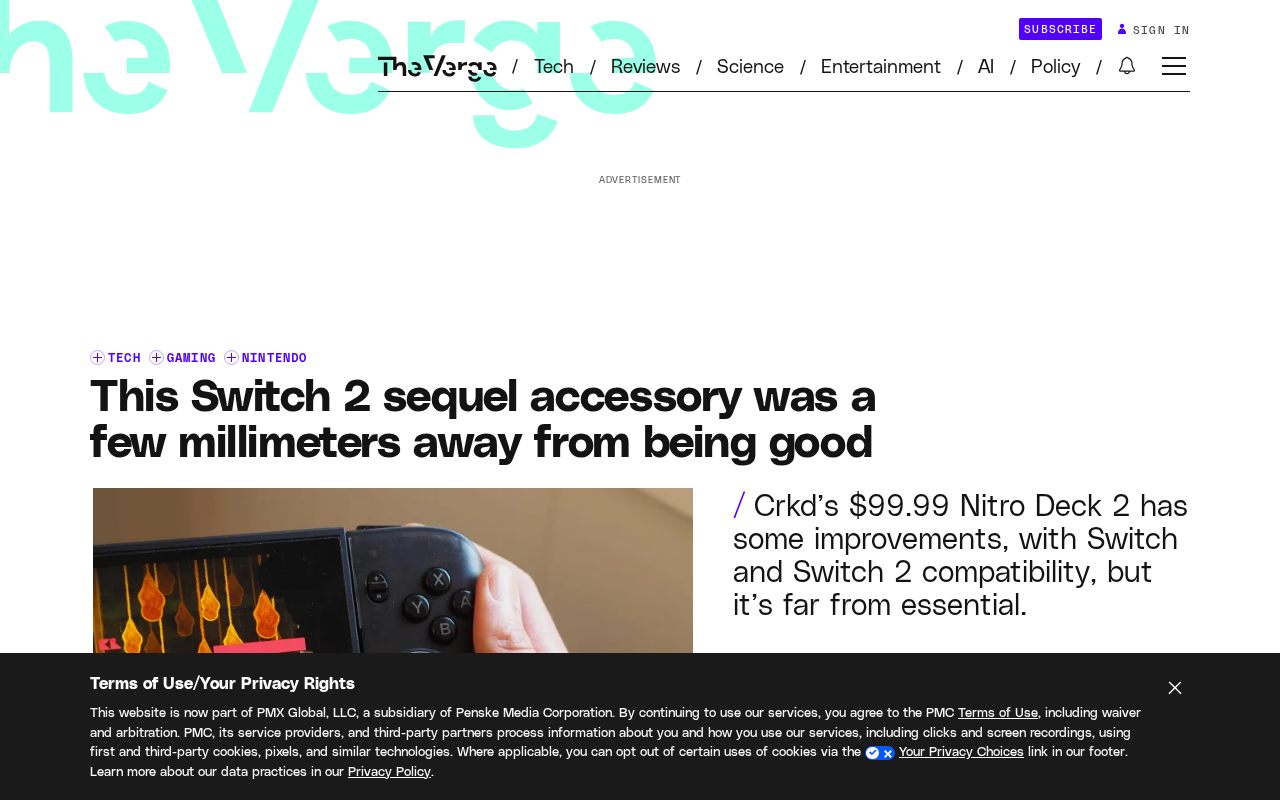
Switch 2 Accessory Review: Nitro Deck 2 Is a Few Millimeters Short of Perfect
CRKD Nitro Deck 2 review: this Hall Effect stick accessory for Switch 2 and the original Switch continues the original's legacy, but falls a few millimeters short of perfect due to size fit issues.

Apollo Economist: AI Delivers Zero Financial Return for Most Companies
Apollo Chief Economist Torsten Slok says AI has delivered near-zero financial return to U.S. companies outside tech. We analyze the adoption gap and investment implications.