A²ODA: Adaptive Accelerated Optimistic Dual Averaging

A²ODA unifies and accelerates unconstrained convex optimization with low-cost p-norm preconditioning and line-search-free optimistic dual averaging.
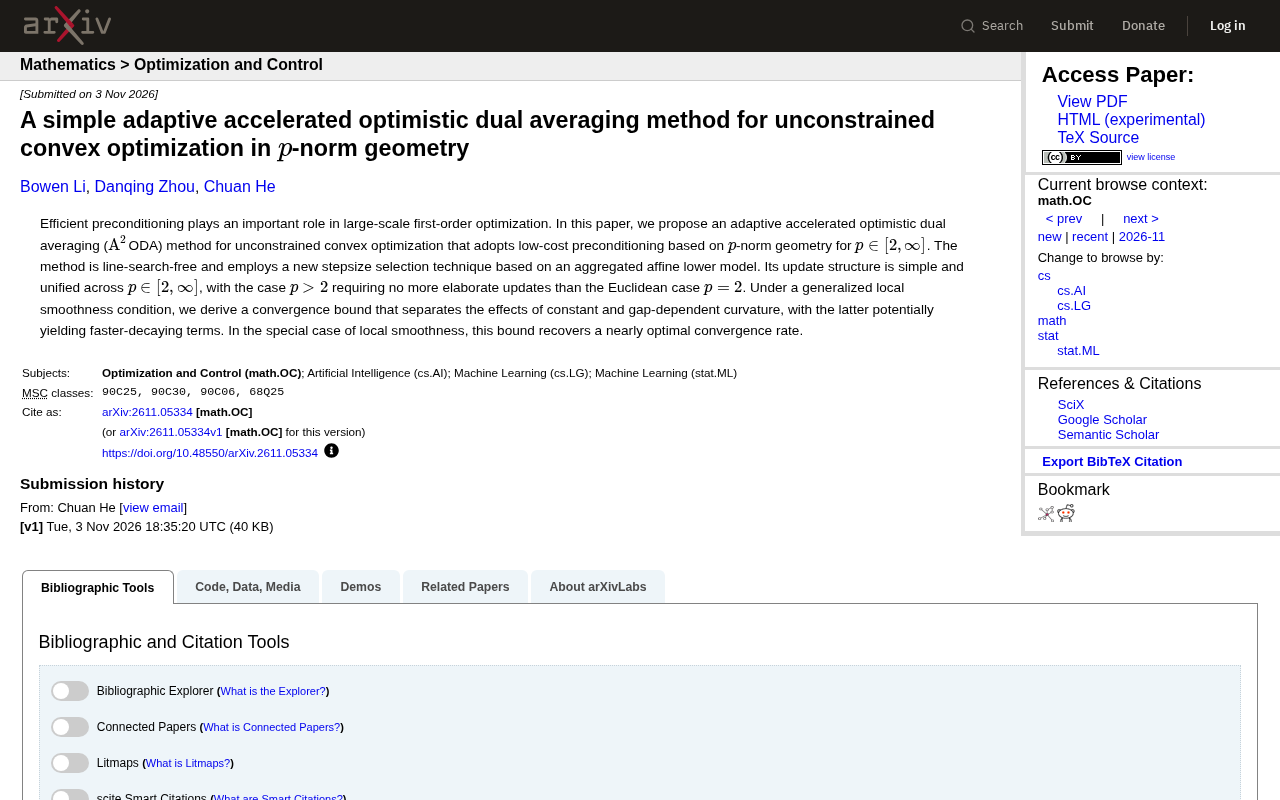
The article introduces an Adaptive Accelerated Optimistic Dual Averaging method (A²ODA) for unconstrained convex optimization. Its core is a low-cost preconditioner based on p-norm geometry (p∈[2,∞)), and it proves that updates when p>2 are no more complex than the Euclidean case (p=2), keeping the algorithm structure simple and unified. The method is entirely line-search-free and introduces a new step-size selection technique based on an aggregated affine lower model. Theoretically, the authors derive a convergence bound under generalized local smoothness conditions that separates constant curvature from gap-dependent curvature, the latter enabling faster decay; in the locally smooth special case, it recovers a nearly optimal rate. The article argues the method lowers the implementation barrier for p-norm optimization and outlines extensions to constrained optimization, stochastic optimization, and deep learning training.
Introduction
In large-scale first-order optimization, preconditioning techniques are critical to convergence speed. Traditional methods often rely on expensive line searches or complex update rules, which are particularly difficult to implement under non-Euclidean geometry. A recent study proposes an Adaptive Accelerated Optimistic Dual Averaging method (A²ODA), offering a simple and unified solution for unconstrained convex optimization.
Preconditioning refers to introducing an invertible linear transformation in optimization iterations to "straighten out" the geometric structure of the original problem, balancing the scale of gradient directions and thereby improving the condition number and accelerating convergence. Under Euclidean geometry, the most naive preconditioner is multiplying by the identity matrix (i.e., no preconditioning), while more refined approaches include diagonal scaling, quasi-Newton matrices (such as the inverse Hessian approximation in BFGS), or adaptive diagonal matrices (such as the second-moment estimates in Adam). The core value of preconditioning lies in the fact that when the curvature of the objective function varies dramatically across different directions, unpreconditioned gradient descent oscillates back and forth in the "valley" direction, whereas a suitable preconditioner can significantly alleviate this problem. The cost is that each iteration requires additional matrix operations or solving linear systems, making "low-cost preconditioning" a key trade-off in large-scale optimization—A²ODA attempts to achieve this effect under p-norm geometry with almost zero additional overhead.
Method Core: Simple and Unified Update Structure
The core of A²ODA lies in adopting a low-cost preconditioner based on p-norm geometry, where p ∈ [2, ∞]. Compared with the Euclidean case (p=2), updates when p>2 do not require more complex operations, maintaining the simplicity of the algorithm structure. The method requires no line search and introduces a new step-size selection technique based on an aggregated affine lower model. This design enables the algorithm to run efficiently across different p values, avoiding the cumbersome parameter tuning of traditional methods.
Dual Averaging is a class of methods originating from online learning and convex optimization. Its core idea is not to rely only on the current gradient like gradient descent, but to accumulate historical gradient information, construct dual variables and take their average, then map back to the primal space via conjugate transformation. Classical dual averaging (such as Nesterov's primal-dual method) can achieve O(1/t) convergence rate under Euclidean geometry, but the step size typically requires knowledge of the problem's Lipschitz constant or a line search. The optimistic variant additionally uses a "predicted" gradient at each step, giving the algorithm stronger adaptivity and enabling automatic adjustment without knowing the curvature, and is often combined with acceleration techniques to obtain better rates. A²ODA combines "optimistic" with "dual averaging" and replaces Euclidean geometry with p-norm geometry, thereby maintaining the low-cost accumulation property of dual averaging in non-Euclidean settings.
P-norm geometry refers to the geometric structure induced by using (|\cdot|_p) as the metric norm, with dual norm (|\cdot|_q), where (1/p + 1/q = 1). When p=2, it degenerates to the familiar Euclidean geometry; when p>2, the unit ball takes on a "pointed" shape, and the scaling of gradients across coordinate directions is no longer isotropic. Under this geometry, gradient mapping is closely related to the distance-generating function in mirror descent, commonly using (\frac{1}{2}|x|_p^2) or its smooth approximation as the potential function. The advantage of p-norm geometry is that for problems with sparse gradients or large differences in coordinate scales, it can provide tighter convergence bounds than Euclidean geometry (e.g., dimension-dependence improvement on the order of (O(\sqrt{\log d}))). However, when p>2, computing the dual mapping and update direction typically involves solving nonlinear equations, which is precisely the implementation difficulty that A²ODA claims to overcome with "no more complex operations."
Convergence Analysis: Separating Curvature Effects
Under generalized local smoothness conditions, the authors derive a convergence bound that separates the effects of constant curvature and gap-dependent curvature. The gap-dependent curvature term may yield faster-decaying terms, thereby accelerating convergence. In particular, in the special case of local smoothness, the bound recovers a nearly optimal convergence rate. This theoretical result not only demonstrates the effectiveness of the algorithm but also provides a framework for further analysis of non-Euclidean optimization.
Generalized local smoothness is a relaxation of the traditional global Lipschitz smoothness condition. Classical analysis requires the gradient to satisfy (|\nabla f(x) - \nabla f(y)| \le L|x-y|) over the entire domain, i.e., the curvature has a global upper bound L; however, in practical optimization problems (such as deep network losses), curvature often varies with position, and the global constant is either too large (leading to too small a step size) or nonexistent. Generalized local smoothness allows the smoothness constant to depend on the current point or the function value gap, for example in the form (|\nabla f(x) - \nabla f(y)| \le L(f(x)-f^)^{\alpha}|x-y|), where (f^-f(x)) is the optimality gap. This condition can more finely capture the phenomenon that "curvature automatically decreases near the optimal solution," thereby producing a gap-dependent curvature term in the convergence bound—this term decays as the gap shrinks, which is precisely the theoretical source of the acceleration effect. Separating the constant curvature term from the gap-dependent term allows the analysis to cover both extremes of global smoothness and local smoothness simultaneously.
Practical Significance and Outlook
The proposal of A²ODA simplifies the optimization pipeline under p-norm geometry and lowers the implementation barrier. Its line-search-free and unified-update characteristics make it easy to integrate into existing machine learning pipelines. Although the current analysis is limited to unconstrained convex optimization, the method is expected to extend to broader scenarios such as constrained optimization and stochastic optimization. Future work could explore its potential application in deep learning training.
One-line Summary
A²ODA unifies and accelerates unconstrained convex optimization with low-cost p-norm preconditioning and line-search-free optimistic dual averaging.
Paragraph Summary
This article introduces an Adaptive Accelerated Optimistic Dual Averaging method (A²ODA) for unconstrained convex optimization. Its core is a low-cost preconditioner based on p-norm geometry (p∈[2,∞)), and it proves that updates when p>2 are no more complex than the Euclidean case (p=2), thereby maintaining a simple and unified algorithm structure. The method is entirely line-search-free and introduces a new step-size selection technique based on an aggregated affine lower model. Theoretically, the authors derive a convergence bound under generalized local smoothness conditions that separates the effects of constant curvature and gap-dependent curvature, the latter yielding faster decay; in the special case of local smoothness, it recovers a nearly optimal rate. The article argues that the method lowers the implementation barrier for p-norm optimization and outlines extensions to constrained optimization, stochastic optimization, and deep learning training.
Related articles

Agent Clan: Command Multiple AI Coding Assistants Simultaneously with Mid-Air Gestures
Agent Clan turns Claude Code and Codex agents into a 3D team on screen, supporting fist summoning, pinch selection, drag-to-approve permissions, and local gesture and voice processing, free on Mac and Windows.

Inkling 2 Small: A 594B MoE Model That Can "See" and Revise
Thinking Machines Lab releases Inkling 2 Small, a 594B-parameter MoE model activating only 17B, focused on long-horizon coding and visual tasks where it can see and refine its own output, with inference and fine-tuning via the Tinker platform.

Deduplication: How Tech 'Steals' Everyday Words
Deduplication uses Wikipedia pageview data to quantify 719 words redefined by tech across 14 domains, revealing which meaning wins. Free and open by HackerNoon.