AAAI-27 Phase 1 Review Results Approaching: What Submitters Need to Know
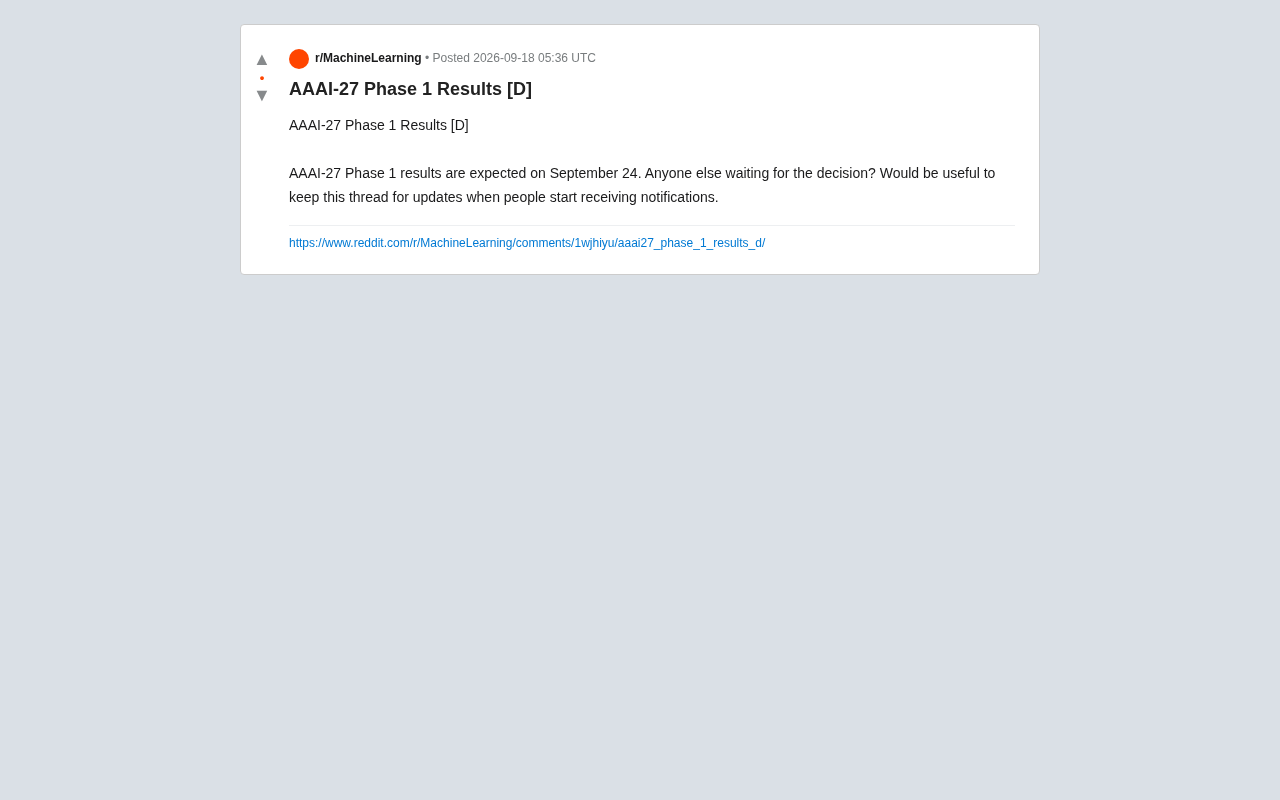
AAAI-27 Phase 1 results expected September 24 — here's what the phased review process means for submitters.
This article examines a Reddit discussion thread about the upcoming release of AAAI-27 Phase 1 results, with a focus on explaining AAAI's phased review mechanism. Phase 1 is an initial screening round where less competitive papers are rejected early, while those that pass move on to full review — though passing doesn't guarantee final acceptance. The article traces this system back to the surge in AI conference submissions and offers practical advice for researchers awaiting results: keep results in perspective, rely on official channels, and plan contingencies. It also reflects on the broader phenomenon of academic communities self-organizing on Reddit during high-stakes waiting periods, while cautioning that such community signals carry inherent selection bias.
AAAI-27 Phase 1 Results Coming Soon
AAAI (Association for the Advancement of Artificial Intelligence) is one of the oldest and most influential academic conferences in the AI field, and its paper acceptance results have always been a source of anticipation for researchers worldwide. According to a discussion thread on Reddit, Phase 1 review results for AAAI-27 are expected to be released on September 24, leaving many submitting authors anxiously awaiting notifications.
The post itself carries limited information — it primarily serves as a coordination point where submitters can share updates and check in with each other. The original poster suggested keeping the thread active so that people can post updates as notifications arrive. This kind of community support thread during the results waiting period is quite common across top-tier conference cycles like NeurIPS, ICML, and CVPR.
Understanding AAAI's Two-Phase Review Process
AAAI has adopted a Phased Review process in recent years, which is where the term "Phase 1" in the post comes from. The first phase is essentially an initial screening round: the program committee conducts an early assessment of submissions, and papers that are clearly below the bar or insufficiently competitive may be rejected at this stage (as a desk reject or early reject), while papers that pass the screening move on to a more thorough Phase 2 review.
This design was introduced to address the mounting review burden caused by the explosion in submission volume at top AI conferences. By filtering out a portion of papers early on, the conference can concentrate limited reviewer resources on more promising work, while also giving some authors earlier feedback and reducing overall reviewer load.
For submitters, the Phase 1 result is the first checkpoint — but passing it doesn't mean you're in the clear. Papers that advance still go through a full review process, including a rebuttal stage where authors can respond to reviewers.
From a broader perspective, AAAI submission volumes have grown exponentially in recent years: in 2023, roughly 8,000 papers were submitted with an acceptance rate of around 19%, compared to just a few hundred submissions a decade ago. Traditional single-round review processes struggle to maintain both efficiency and quality at this scale. Phased review has therefore become an approach explored by multiple top conferences — NeurIPS has experimented with "conditional accept" mechanisms, while ICLR has embraced transparency through OpenReview's public review system. AAAI's Phase 1 early reject decisions are typically made directly by Area Chairs or Senior Program Committee members based on initial scores, without requiring a full peer review cycle. This is meaningfully different from a standard desk reject (which is triggered by formatting or scope issues): the former is a competitive filter, while the latter is an eligibility filter.
Advice for Researchers Awaiting Review Results
For researchers waiting on AAAI-27 results, this period often comes with considerable psychological pressure. A few practical suggestions may help:
- Keep Phase 1 results in perspective: A Phase 1 rejection doesn't necessarily reflect the research's merit — early-stage filtering is partly resource-driven. Conversely, passing Phase 1 doesn't guarantee final acceptance; you still need to prepare for the full review process.
- Follow official channels: Community discussion threads can serve as useful reference points, but final results should be confirmed through AAAI's official systems (such as CMT or OpenReview). Avoid being misled by unofficial rumors.
- Plan ahead for contingencies: Regardless of the outcome, it's wise to think in advance about potential improvements to your paper or alternative conferences to target — this leads to a more composed and strategic approach.
The Value of Community Collaboration in Academic Submissions
While the Reddit post is brief, it reflects a broader pattern in academic communities: at sensitive junctures when results are about to drop, researchers tend to gather on platforms like Reddit to exchange information and offer mutual encouragement. This spontaneous information coordination helps submitters across different time zones and institutions stay up to date on result release timelines.
It's worth noting that information of this kind is community hearsay in nature, and specific release dates and review schedules may still shift based on the conference's actual progress. Researchers should stay informed, but there's no need for excessive anxiety.
As September 24 approaches, AAAI-27 Phase 1 results will begin rolling out — and this will offer a window into the submission landscape and review trends for this year's conference.
Subreddits like r/MachineLearning and r/artificial, along with dedicated academic submission discussion communities, have become important channels for AI researchers to track unofficial conference updates. Researchers aggregate reports of "received notification" or "nothing yet" through these platforms, allowing them to roughly gauge the progress of result releases before any official announcement — a phenomenon sometimes jokingly called "crowdsourced decision trees." However, this kind of information aggregation comes with obvious selection bias: those who receive rejections tend to post more actively than those with good news, which means the negative feedback ratio in discussion threads may skew higher than the actual acceptance rate. This is worth keeping in mind when interpreting community signals.
Related articles

A DeepSeek Researcher's Confession: The AI He Trained Is About to Replace Him
DeepSeek V4.1 kernel engineer Liu Shengyu admits the AI he trained will surpass his own skills within a year—yet he keeps pushing forward. Here's why.
n8n Automation in Practice: How AI Workflows Help SMBs Cut Costs and Boost Efficiency
Learn how SMBs use n8n and AI tools to automate multi-platform messaging, AI customer service replies, and bulk exam data entry — real-world workflows for cutting costs.

DeepSeek Harness Hands-On: Build Your Own Coding Agent for Free
DeepSeek Harness hits 190K GitHub stars as a free Claude Code alternative. This hands-on review covers installation, plugin models, full traceability, and driving Claude Code as a subprocess.