Access 15+ Top AI Models with One API Key — Say Goodbye to Multi-Platform Management

A unified API platform aggregates 15+ models, simplifying multi-model Agent development while requiring trade-offs on stability and feature completeness.
The article addresses the API management pain points in multi-model AI Agent development and introduces a unified API platform that aggregates 15+ models including Claude, GPT, Gemini, and DeepSeek under a single key. By sharing token balance, offering a daily 3 million free quota, and supporting coding tools like Cursor and Claude Code, the platform lowers the infrastructure setup cost for multi-model applications. The article also notes trade-offs introduced by the aggregation layer, such as latency, stability, and passthrough of native features, and offers scenario guidance: multi-model Agent teams, individual developers experimenting at low cost, and engineers needing quick model switching should prioritize it, while projects with strong dependencies on specific model features or latency sensitivity should evaluate carefully.
The Development Pain Points of the Multi-Model Era
Imagine you're building an AI Agent. You want to use Claude for coding tasks, GPT for reasoning, Gemini for research, and DeepSeekAd for everyday low-cost tasks. According to a developer scenario shared on a YouTube channel, this is almost the typical configuration for current AI application development — each model excels at different things, and combining them achieves the best results. But this brings a slew of tedious work: API key management, pricing systems, account setup, and more. Multiple platforms mean multiple sets of bills, multiple consoles, and multiple rate limits — a large amount of developers' energy is consumed by operations rather than innovation.
This problem is especially prominent in AI Agent development. Agents often need to call multiple models within a single task. If each model corresponds to an independent API endpoint and key, code complexity multiplies. Developers are forced to write extra routing logic, error handling, and platform-specific adapter layers — work that generates no business value in itself.
The Core Idea of a Unified API Platform
According to the video, a tool attempts to change this situation: aggregating multiple AI models under a single API key. Developers only need to manage one key and one token balance to freely switch between models like Claude, GPT, Gemini, and DeepSeek. The platform is said to provide access to over 15 top AI models and includes free-tier models.

The core value of this aggregation model lies in establishing an abstraction layer. Developers no longer need to worry about interface differences between model providers — a unified gateway handles request routing and format conversion. The shared token balance design also makes cost management simpler — you only need to track the consumption of one account instead of bills scattered across multiple platforms.

Unified API Gateway is a middleware layer between clients and multiple backend services, responsible for cross-cutting concerns such as request routing, protocol conversion, authentication and authorization, and rate limiting. In the AI model aggregation scenario, the gateway unifies the differing RESTful interfaces and request/response formats of various vendors (such as OpenAI's Chat Completions format and Anthropic's Messages format) into a single specification, enabling developers to call any model with the same code. This abstraction layer shields the differences between underlying providers, but it also introduces extra network hops that may add tens to hundreds of milliseconds of latency, and the gateway's own availability becomes a single point of dependency for the entire call chain.
Feature Details and Integration Capabilities
The platform's features go beyond model switching. According to the video, it also provides web research tools and a substantial daily free token quota — the video mentions a daily usage of 3 million tokens. For individual developers and small teams, this is enough to support experiments and prototyping at a considerable scale.

In terms of integration, the platform can connect to mainstream coding tools such as Claude Code, Cursor, and Codex. This means developers can use the unified API directly within familiar IDEs and workflows without modifying their existing toolchains. For developers already accustomed to Cursor or Claude Code, the onboarding cost is nearly zero.
Claude Code, Cursor, and Codex are currently mainstream AI-assisted coding tools, but with different positioning: Claude Code is an agentic coding tool in the terminal launched by Anthropic, capable of directly reading/writing files and executing commands; Cursor is an AI-native IDE based on a VS Code fork, emphasizing intelligent completion and conversation within the editor; Codex is the name of OpenAI's early code generation model, now also referring to its coding agent product. These tools typically allow users to customize the API Base URL and key to connect to third-party unified gateways. This compatibility design lets developers switch backend models without changing their existing workflows, but each tool depends on model capabilities (such as function calling and long context) to varying degrees — whether the aggregation platform can fully pass through these features directly affects the user experience.
The Practical Significance for Developers
From an engineering perspective, a unified API platform lowers the barrier to starting AI application development. In the past, a multi-model Agent project might require several days to set up infrastructure; now, configuring a single key is enough to get a prototype running. This efficiency gain is especially valuable in the early stages of rapid iteration.
However, aggregation platforms also bring new considerations. All requests pass through the same gateway, so latency and availability depend on the platform's own stability. The sustainability of the free quota also needs to be observed — whether the daily token quota mentioned in the video will be maintained long-term is something there is currently no further information to confirm. In addition, a unified interface may not expose certain native advanced features of some models; for scenarios requiring fine-grained control, developers still need to return to the native APIs.
Tokens are the basic units of measurement for text processed by large language models, roughly equivalent to 0.75 English words or half to one Chinese character. Model APIs typically charge based on the number of input and output tokens, with significant price differences between models — for example, flagship models can cost several to dozens of dollars per million tokens, while lightweight models can be as low as a fraction of a dollar. If the "3 million free tokens per day" mentioned in the video is priced at mid-tier model rates, it amounts to roughly a few dollars of call quota per day, enough to support hundreds to thousands of medium-length conversations or code generation requests. But the sustainability of the free quota depends on the platform's business model, and developers should pay attention to whether it has clear rate-limiting policies, quota reset rules, and future pricing plans, to avoid being forced to migrate after forming a dependency in critical projects.
Applicable Scenarios and Selection Advice
This type of platform is best suited for three types of developers: teams building multi-model AI Agents, individual developers who want to experiment with different models at low cost, and engineers who need to quickly switch models within coding tools. If your project has a strong dependency on a specific feature of a certain model, or is extremely sensitive to latency, you need to evaluate the extra overhead introduced by the aggregation layer.
The video author's stance is clear: rather than paying separately for each AI model and managing keys, it's better to use one platform for unified access. This idea itself is worth noting, but whether it suits your project depends on the actual trade-offs regarding stability, feature completeness, and cost structure.
Related articles
Nominations Open for MIT Technology Review's 2027 Innovators Under 35
MIT Technology Review opens nominations for the 2027 Innovators Under 35, honoring young scientists and entrepreneurs worldwide. The same issue of The Download newsletter also introduces a brain-computer interface technology called a bionic window, offering new ways to observe brain activity.
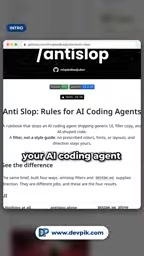
Anti-Slop: Putting a "No-Cliché" Leash on AI Coding Agents
Anti-Slop is an open-source rulebook with 38 mandatory rules that stop AI coding agents from producing cookie-cutter UIs, filler copy, and AI-flavored code. Compatible with Claude Code, Cursor, and Codex; free under MIT.

From ER Doctor to Clinical AI Engineer: The New Role After Prompt Engineering's Demise
Boston Children's first clinical AI engineer Dinesh Rai, a former ER doctor, explains why prompt engineering faded, how dual clinical-engineering views prevent model misuse, and what domain knowledge healthcare AI roles truly need.