From ER Doctor to Clinical AI Engineer: The New Role After Prompt Engineering's Demise

Prompt engineering roles faded fast; clinical AI engineers with dual medical and engineering perspectives are the new core.
The article traces Dinesh Rai's career to show how the hot prompt engineer role was quickly marginalized as models improved. Rai combines medical training with programming, and now sees himself as a "clinical AI engineer": half his time coding and advancing system integration, half with clinicians understanding real needs. Through the clinical doppelgangers project and a clinical note platform, it shows healthcare AI's real difficulty isn't phrasing prompts but understanding data meaning, judging output trustworthiness, and catching plausible-but-wrong assumptions on both teams. Letting end users review outputs early and preserving healthy skepticism beats pitching the tool; domain knowledge outlasts any specific tool.

When Boston Children's Hospital posted a job opening for a "prompt engineer" in 2023, Dinesh Rai, who came from an emergency medicine background, submitted his résumé—though he didn't expect to land the job. Three years later he's still at the hospital, and the job title that once got him in the door no longer adequately describes what he actually does.
A Short-Lived Job Label
Prompt engineering was once seen as a hot new profession spawned by generative AI—companies needed people who knew how to phrase things, provide examples, and set personas and context to squeeze better answers out of large language models. John Brownstein, Chief Innovation Officer at Boston Children's Hospital, recalls that the hospital's judgment at the time was that "knowing how to prompt AI correctly would become a job function of the future," and that the hospital needed someone internally to figure out how to start using AI.
Things changed quickly. According to IEEE Spectrum, improvements in model capabilities made carefully crafted prompts less critical, and the truly difficult part shifted to embedding AI into real healthcare systems and judging whether its answers could be trusted. Brownstein says the questions his team now cares about have become "how do we embed these tools into daily operations" and "how do we build agents to manage nearly every piece of work." Rai's description of his own role has shifted accordingly: "I'm more of a clinical AI engineer now."
This career trajectory is itself a signal: the definition cycle for AI-related jobs is shrinking. Planning a career path around a hot job title carries higher risk than one might imagine.
Prompt engineering refers to the practice of designing input text (prompts) to guide large language models toward desired outputs, with common techniques including few-shot prompting, persona assignment, and chain-of-thought. Between 2022 and 2023, as models like ChatGPT exploded in popularity, some companies treated this skill as a standalone role, with job postings even offering six-figure salaries. Yet it was marginalized because model vendors kept improving robustness to ambiguous instructions through instruction tuning and RLHF (reinforcement learning from human feedback), reducing the marginal returns of "careful phrasing"; meanwhile, the parts that truly determine whether an AI system succeeds—data pipelines, system integration, evaluation, and monitoring—cannot be solved with prompts. The rise and fall of this role is often cited as a classic case of "the shrinking half-life of AI skills."
The Unique Value of a Dual Identity
Rai's résumé is unusual. He studied supply chain management and marketing science at Rutgers Business School, and began teaching himself to program in 2014, the same year he entered medical school—back when neural networks and image recognition were just beginning to attract widespread attention. Throughout medical school he kept writing software, such as Academius, a platform he built for medical students to track residency interviews and organize rank lists.
He explains what drew him to programming: emergency medicine can directly affect the one patient in front of you, while software has the potential to be used by thousands of clinicians and reach far more patients. A clinical informatics fellowship from 2021 to 2022 made working full-time in tech realistic, and in 2022 he joined the healthcare AI company Pieces, where he led the effort to bring LLM-based clinical note summarization into clinical use—at one point leaving clinical practice entirely. He calls "leaving clinical work a difficult decision," and he has since reactivated his physician's license, hoping to return to the exam room in some form within the next year.
Now he spends roughly half his time working like an engineer—collaborating with developers, writing code, and advancing projects from the technical side—and the other half with clinicians, figuring out what they actually need. This combination is itself the core of the role.
Clinical informatics is a physician subspecialty certified by the American Medical Association, focused on the intersection of healthcare data, information systems, and clinical workflows; practitioners must understand electronic health records (EHR), clinical decision support, and data governance. Its fellowship typically lasts one to two years, covering healthcare data standards (such as HL7 and FHIR), quality measurement, and system implementation. This background explains why Rai could move into tech full-time: he not only writes code but has systematically learned how hospital data is generated, where it becomes distorted, and how clinicians interact with systems in real workflows—precisely the areas where people with purely engineering backgrounds are weakest.
Clinical "Doppelgangers": Finding Similar Cases in Historical Data
One project he worked on is called clinical doppelgangers, which aims to help doctors find similar patients from the hospital's historical data when facing complex cases.
The root of this need is a structural gap in medical evidence. Clinical guidelines are usually based on large populations, but at a hospital that treats rare and complex diseases, a particular child's situation may not fall within the population represented by published research. The system lets clinicians identify previous patients with relevant similarities, review their disease trajectories, and see what different interventions ultimately led to. It is not intended to replace randomized controlled trials, but to provide another kind of evidence when the literature offers almost no guidance.
Projects like this require far more than knowing how to ask a large model a good question. They require understanding what hospital data means, how clinicians will use the answers, and where an AI system might go wrong.
Randomized controlled trials (RCTs) are the gold standard of clinical evidence, but their strict inclusion criteria often exclude patients with many comorbidities and complex conditions, limiting the generalizability of their conclusions. Real-world evidence (RWE) uses routine care data such as electronic health records and registries to fill evidence gaps, and the FDA has issued guidance recognizing its regulatory use in specific scenarios. Systems like "clinical doppelgangers" are methodologically close to case retrieval and similarity matching: by representing patients as structured feature vectors and searching historical cohorts for individuals with similar disease trajectories and intervention responses, they provide reference points for individualized decisions. Their inherent limitations are confounding bias and selection bias—historical patients were not randomly assigned to treatments, so observed differences in outcomes cannot be directly attributed to the interventions themselves.
When Both Developers and Doctors Assume Wrongly
A scenario Rai encountered on another project illustrates well where things go wrong. The team was discussing how much medical record information to give an AI model when asking it to identify findings associated with a certain clinical outcome.
Both the development team and the clinical team initially leaned toward giving the model more information, but for different reasons. Developers assumed any data point might be useful; clinicians assumed the model would recognize irrelevant findings and ignore them. Rai thought both assumptions were untenable: from a clinical perspective, an abnormal lab value or vital sign is not necessarily relevant to the question being asked; from a technical perspective, you cannot count on a large model to recognize that irrelevance—if the system asks the model whether some abnormality is important, it may invent a plausible explanation for "important" even when the record does not support such an association.
"That's where the value of the dual perspective comes in," he says. "It's not just translating between teams, but recognizing that an approach that seems reasonable from either angle is actually built on assumptions that shouldn't be made."
This is a risk that pure prompting techniques cannot cover: a model's output looks coherent, professional, and explanatory—precisely when it is most likely to be mistakenly trusted.
After Prompting, Evaluation Is the Main Battleground
In healthcare settings, the challenges surrounding prompts have become more important than polishing the prompts themselves: Is the model's output consistent with the underlying data? How should results be evaluated? Can the clinicians using it recognize errors?
Rai's team's answer is to involve end users early. Before their clinical note drafting platform went live, the clinicians who would eventually use the tool reviewed a batch of generated notes. Rai says a doctor who has cared for a complex patient in the cardiac intensive care unit for weeks is far more likely to spot errors than someone skimming the record afterward.
As for healthcare practitioners' doubts about AI, his attitude is not to persuade: "I think a certain amount of skepticism is healthy, and we don't try to make people give up their skepticism." The team told clinicians from the start that this is a generative AI tool that supports their judgment and does not replace their own review of the record. "Once people have seen its mistakes, they trust it more than if we just told them it's good."
In the context of healthcare AI, evaluation goes far beyond a single accuracy metric and typically requires examining faithfulness (whether outputs are supported by underlying data), relevance, completeness, and whether errors can be recognized by users. Common methods include human review scoring, comparison with gold-standard summaries, and "red team"-style error injection testing. More critical is evaluation at the human-computer interaction level—whether clinicians can detect model errors within a reasonable time. Research shows that automation bias makes people prone to over-trusting outputs that appear professional, so evaluation design must simulate real usage situations rather than relying solely on offline scoring by developers.
What to Learn If You Want to Follow This Path
Rai is wary of how his own role is evolving, so he is reluctant to advise others to master any specific tool. For those who want to do hands-on engineering work, basic programming skills remain important, and some knowledge of machine learning and experience building and testing systems is useful; but not every clinician who wants to work with AI needs to become a database architect or dig deep into algorithms.
What he considers irreplaceable is domain knowledge. In healthcare, that means understanding how clinical workflows operate, how electronic health record data is generated, what that data actually represents, and where care breaks down.
"The value isn't just knowing how to get an answer from a model," Rai says, "but knowing what context it needs, and whether that context supports the answer we're asking it to give."
That sentence may be the more enduring lesson from a career that was briefly defined by the hottest AI job title of its time.
One-line Summary
Prompt engineering roles were quickly marginalized, and clinical AI engineers with dual medical and engineering perspectives have become the new core.
Paragraph Summary
Using Dinesh Rai's career trajectory as a thread, the article describes how the hot role of prompt engineer was rapidly marginalized as model capabilities improved. Rai combines medical training with programming ability, and now considers himself more of a "clinical AI engineer": half his time writing code and advancing system integration, half his time with clinicians understanding real needs. Through the "clinical doppelgangers" project and discussions of a clinical note platform, the article shows that the real difficulty of healthcare AI lies not in phrasing prompts but in understanding what data means, judging whether outputs are trustworthy, and recognizing the plausible-but-wrong assumptions of both development and clinical teams. The author emphasizes that letting end users review outputs early and preserving healthy skepticism is more effective than pitching the tool; and domain knowledge outlasts mastery of any specific tool.
Related articles
Nominations Open for MIT Technology Review's 2027 Innovators Under 35
MIT Technology Review opens nominations for the 2027 Innovators Under 35, honoring young scientists and entrepreneurs worldwide. The same issue of The Download newsletter also introduces a brain-computer interface technology called a bionic window, offering new ways to observe brain activity.
Access 15+ Top AI Models with One API Key — Say Goodbye to Multi-Platform Management
One API key for 15+ top AI models — freely switch between Claude, GPT, Gemini, and DeepSeek, share token balance, get daily free quota, and connect to coding tools like Cursor and Claude Code to solve multi-platform API management pain points.
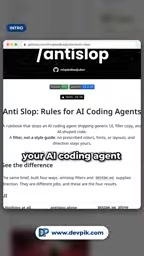
Anti-Slop: Putting a "No-Cliché" Leash on AI Coding Agents
Anti-Slop is an open-source rulebook with 38 mandatory rules that stop AI coding agents from producing cookie-cutter UIs, filler copy, and AI-flavored code. Compatible with Claude Code, Cursor, and Codex; free under MIT.