Accuracy ≠ Evidence Dependence: The Evaluation Blind Spot and a New Training Solution for Video Temporal Grounding

The study proposes an evidence dependence measure, revealing that video temporal grounding accuracy can conceal blind guessing and style fitting.
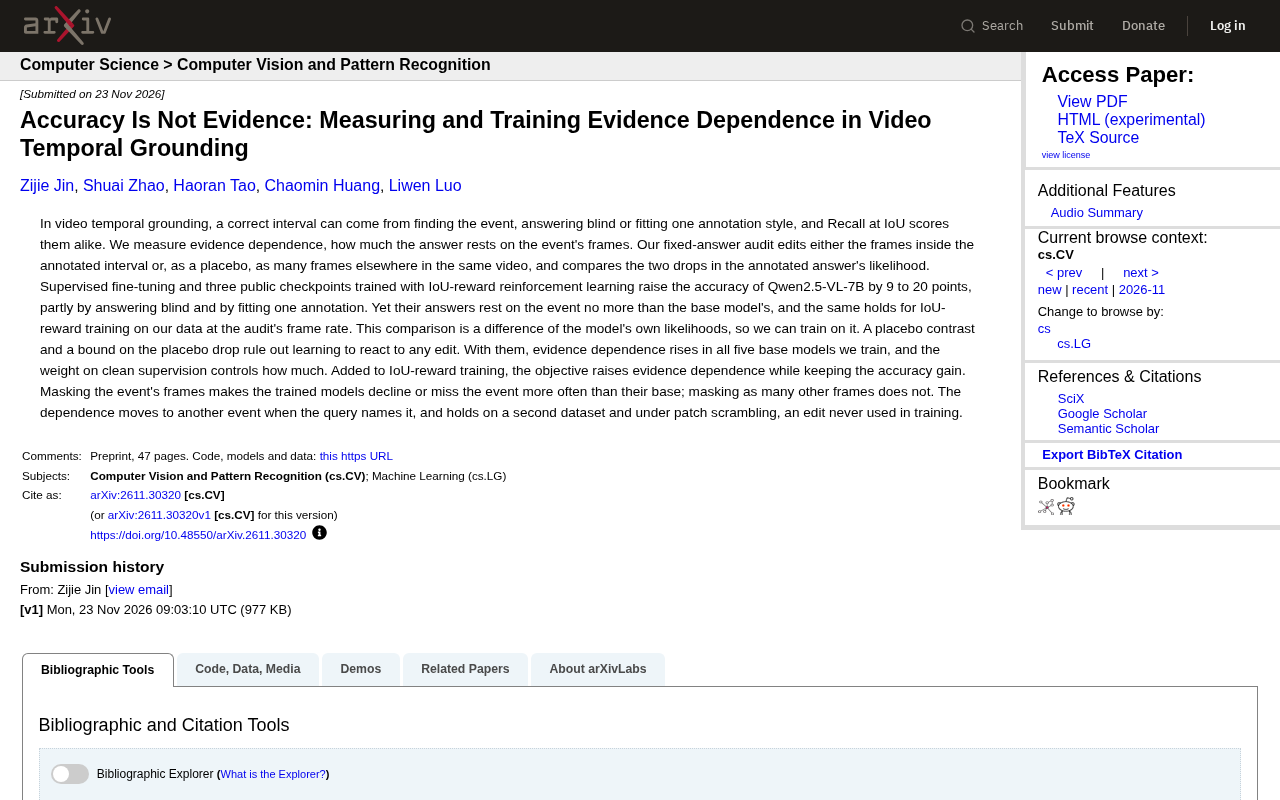
The study points out that Recall at IoU accuracy in video temporal grounding cannot distinguish whether a model truly finds the event, blindly guesses, or fits annotation styles. The authors design a fixed-answer audit that quantifies evidence dependence by comparing the difference in likelihood drop of the annotated answer when editing event frames versus irrelevant frames, and introduce placebo contrast and upper-bound constraints to rule out shortcuts. Experiments find that although SFT and IoU-reward RL improve Qwen2.5-VL-7B accuracy by 9 to 20 points, evidence dependence does not exceed that of the base model. Adding evidence dependence as a differentiable training objective to IoU-reward training improves evidence dependence while maintaining accuracy gains, and this effect holds on a second dataset and under patch scrambling, indicating a certain degree of generalization. The study calls for incorporating evidence dependence measures into evaluation, pushing models from "answering correctly" toward "answering correctly based on the right evidence."
In the Video Temporal Grounding task, does a model producing the correct interval mean it actually "saw" the event? A study titled Accuracy Is Not Evidence: Measuring and Training Evidence Dependence in Video Temporal Grounding points out that a correct answer can arise from blind guessing, fitting annotation styles, and various other pathways—and the conventional Recall at IoU metric treats them all the same. The study proposes a measure of "evidence dependence" and designs a training objective to increase the model's reliance on event frames.
What Accuracy Conceals: Blind Guessing and Style Fitting
In video temporal grounding, a model is asked to localize the event interval in a video based on a text query. Recall at IoU is typically used to evaluate the overlap between the predicted interval and the annotated interval—the higher the overlap, the higher the score. But the paper points out that a correct interval can come from three fundamentally different mechanisms: genuinely finding the event, blind guessing (relying only on language priors or positional preferences rather than video content), or fitting a particular annotation style (e.g., always predicting intervals of a fixed length or at a fixed position). These three cases may receive identical scores on Recall at IoU, yet the reliability of the models differs vastly.
This phenomenon of "accuracy not equaling evidence" is especially worth guarding against in supervised fine-tuning (SFT) and IoU-reward reinforcement learning (RL). The paper notes that SFT and three public checkpoints (trained with IoU-reward RL) improved the accuracy of Qwen2.5-VL-7B by 9 to 20 percentage points, but part of the improvement came from blind guessing and fitting a single annotation style. In other words, the metric went up, but the model's dependence on the event itself did not increase in tandem.
Supervised fine-tuning (SFT) and IoU-reward reinforcement learning (RL) are two mainstream training paradigms in video temporal grounding. SFT fine-tunes the model by maximizing the likelihood of the annotated interval, making the model imitate the annotation style in the training data; IoU-reward RL, on the other hand, uses the IoU between the predicted interval and the annotated interval as the reward signal and optimizes the model via policy gradients, encouraging it to output intervals with higher overlap with the annotations. However, both methods only optimize "whether the output matches the annotation" and do not directly constrain the model to rely on video evidence. As a result, the model may obtain high rewards through language priors (e.g., "a person appears" often corresponds to a fixed time segment) or positional bias (e.g., preferring to predict the middle of the video), rather than genuinely understanding the video content. This explains why SFT and IoU-reward RL can improve accuracy yet may not strengthen evidence dependence.
Fixed-Answer Audit: How to Measure Evidence Dependence
To quantify the degree to which the model's answer depends on event frames, the authors designed a "fixed-answer audit." Specifically: keeping the query and the annotated answer unchanged, they apply two kinds of edits to the video frames—either modifying the frames within the annotated interval (event frames), or, as a placebo, modifying the same number of frames outside the interval in the same video. They then compare the magnitude of the drop in the model's likelihood of the annotated answer under the two edits. If the model truly depends on event frames, then editing event frames should cause a significant drop in likelihood, while editing frames outside the interval should have a smaller effect. The difference between the two reflects the strength of evidence dependence.
A key advantage of this audit is that it compares the model's own likelihood differences, so it can be used directly as a training signal. The authors further introduce a placebo contrast and a bound on the placebo drop to rule out the shortcut of the model learning to "react to any edit." In other words, the training objective encourages the model to be sensitive only to edits of event frames and insensitive to edits of irrelevant frames.
Likelihood here refers to the probability that the model generates the annotated answer interval given the query and the (edited) video frames. The fixed-answer audit measures dependence by computing the change in the model's likelihood of the same annotated answer: if editing event frames causes a significant drop in likelihood, it means the model indeed used the information from these frames when generating the answer; conversely, if editing irrelevant frames also causes a similar drop, it indicates that the model may be sensitive to any frame change rather than specifically depending on event evidence. The placebo contrast further requires the model's sensitivity to event frames to be significantly higher than its sensitivity to irrelevant frames, thereby ruling out the shortcut of "reacting to any edit." The bound on the placebo drop sets an upper limit on the likelihood drop caused by editing irrelevant frames, ensuring that the training signal focuses on event frames. These designs make the audit signal usable both as a diagnostic tool and as a differentiable training objective.
Training Evidence Dependence: Objective Design and Experimental Findings
Building on the audit signal, the authors propose a training objective and add it to the original IoU-reward training. Experimental results show that evidence dependence improves across five base models, and the magnitude of the improvement is controlled by the clean supervision weight. More specifically, when this objective is added to IoU-reward training, the model improves evidence dependence while maintaining its accuracy gains.
The paper also verifies the robustness of the objective through a series of ablation experiments. Masking event frames causes the trained model to reject or miss events more frequently than the base model, whereas masking the same number of other frames does not produce this effect. When the query points to another event, the dependence shifts to that event. Moreover, the phenomenon still holds on a second dataset and under patch scrambling (an edit method never used during training), indicating that the evidence dependence learned by the model has a certain degree of generalization.
Patch scrambling is a video frame editing method that divides a frame into several image patches and randomly shuffles their spatial arrangement, thereby destroying the spatial structure information within the frame while preserving the frame-level temporal position. In the evidence dependence audit, patch scrambling is used as an edit method "never used during training" to test whether the evidence dependence learned by the model generalizes to unseen perturbation types. If the model still exhibits significant dependence on event frames under patch scrambling (i.e., editing event frames causes a larger likelihood drop than editing irrelevant frames), it indicates that its dependence is not merely specific to the edit patterns seen during training, but reflects a more fundamental sensitivity to the content of event frames. This finding strengthens the robustness argument for the evidence dependence training objective.
Implications for Video Understanding Evaluation
This study serves as a reminder for video temporal grounding and, more broadly, for video understanding evaluation: a single accuracy metric may conceal differences in model behavior. A model that performs excellently on Recall at IoU may not have truly established an association between the query and the video evidence. For application scenarios requiring high reliability, looking at accuracy alone is insufficient; measures like evidence dependence are needed to evaluate the quality of the model's "grounding."
From a training perspective, adding evidence dependence as a differentiable objective to training offers a path to enhancing model interpretability and robustness while improving accuracy. The placebo contrast and upper-bound constraints mentioned in the paper also provide references for designing more rigorous training signals. In the future, such measures are expected to become a standard supplement to the evaluation of video temporal grounding models, pushing the community from "answering correctly" toward "answering correctly based on the right evidence."
Related articles
GLM-5.4 vs. Opus and Neon: How Far From the Top?
No official benchmarks for GLM-5.4. Based on a YouTube deep test and developer trials, we analyze its gap vs. Claude Opus 5.5 and Gemini Neon, the speed bottleneck from marathon-style thinking, and its real position in enterprise agent scenarios.

From Gobbler to Sloppy Joe: The Hit-Making Playbook of a New Jersey Deli Institution
NYT Cooking visits Milburn Deli in New Jersey to break down the hit logic behind the Gobbler turkey sandwich and the local Sloppy Joe: bread sliced to order, house-made sauces, a group shout culture, and customer co-creation behind six locations.
In the Age of AI Programming, When Do You Still Need to Write Code by Hand?
Is handwritten code still valuable once AI programming agents are widespread? This article outlines three scenarios where handwriting is essential—learning, style development, and prototype validation—and provides a division-of-labor framework between AI and humans to help developers balance efficiency and skill growth.