Accurate Predictions ≠ Correct Causality: The Causal Response Dilemma of Temporal Foundation Models

The forecast precision of time series foundation models does not indicate their precision in estimating causal price effects.
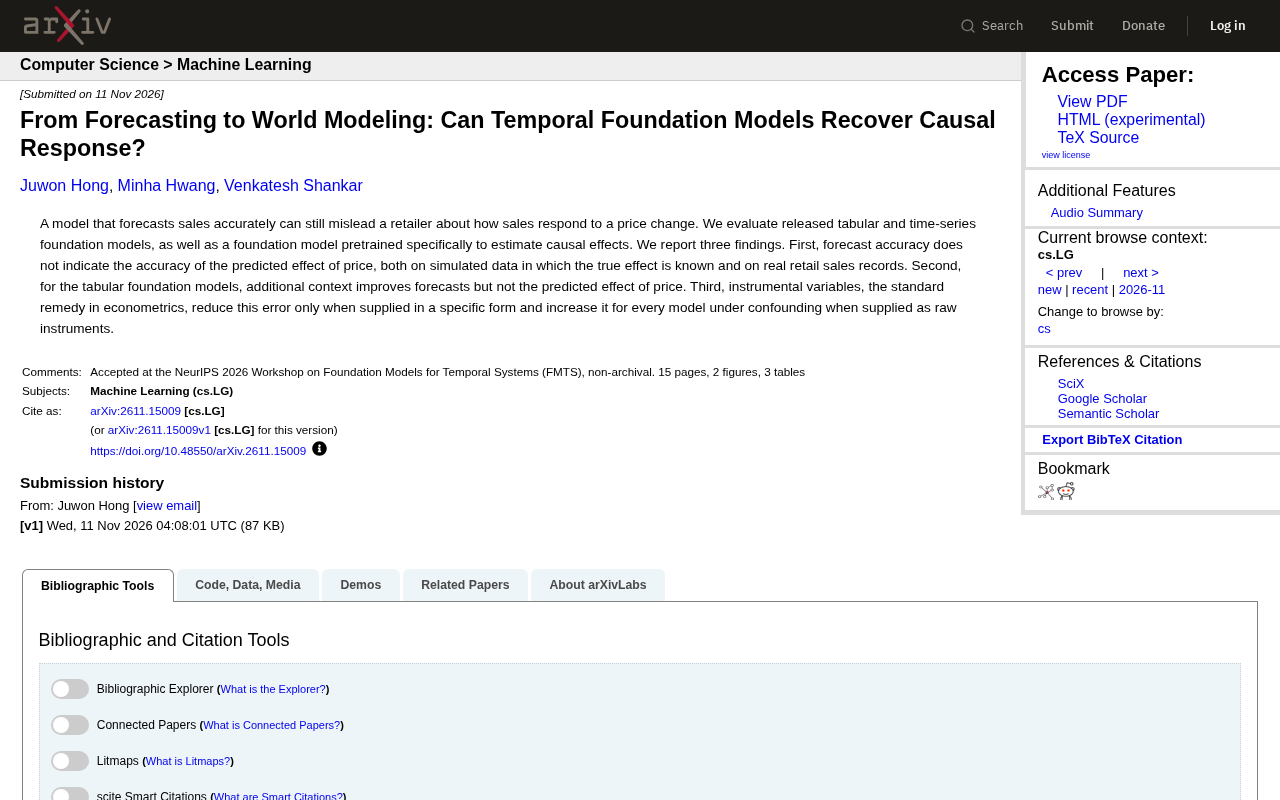
The paper *From Forecasting to World Modeling* systematically evaluates tabular foundation models, time series foundation models, and specialized causal pretrained models against traditional econometric methods. The core conclusion: forecast accuracy is decoupled from price effect estimation precision, holding on both simulated data with known true effects and real retail sales records. For tabular models, more context improves forecasting but not causal estimation; instrumental variables reduce error only in specific forms and increase error when provided raw with confounders present. The authors caution that retail pricing and promotion optimization cannot treat forecast error as an endorsement of causal reliability, and causal estimation requires independent calibration via simulated environments or A/B tests.
The Disconnect Between Forecast Accuracy and Causal Effects
A model that can precisely predict sales volume may give a completely wrong answer when asked "how much will sales grow if we cut prices by 10%?" This intuitive contradiction is the core finding of the paper From Forecasting to World Modeling: Can Temporal Foundation Models Recover Causal Response?
The researchers systematically evaluated released tabular foundation models, time series foundation models, and a foundation model specifically pretrained for causal effect estimation, comparing them against traditional econometric methods. The conclusion is sharp: forecast accuracy does not indicate a model's precision in estimating price effects. This holds true on two types of data simultaneously—one being simulated data with known true effects, the other being real retail sales records. For enterprises relying on AI for pricing decisions, this finding is worth pausing to consider.
Why "Predicting Well" Doesn't Equal "Understanding Causality"
The learning objective of time series foundation models is to fit the generative process of historical data, which is essentially associational: given historical context, what is the most likely future value? Causal effects, on the other hand, require answering counterfactual questions—what would sales have been if the price had been different at the time. The training signals for these two are completely different.
A model can perfectly establish shortcut associations on confounders (such as promotional activities, seasonal demand, competitor pricing), thereby making very accurate predictions, while its estimate of the causal slope of price is severely biased. The paper discusses this under the framework of "from forecasting to world modeling": a true world model needs the ability to respond under interventions, not just extrapolation capability.
Counterfactuals and interventions are the core language of causal inference. Counterfactuals refer to "the outcome that would be seen at the same moment, on the same unit, if a different treatment were taken"; they cannot be directly observed and can only be identified through assumptions (such as unconfoundedness, positivity, consistency, etc.). Intervention (the do-operator) emphasizes actively changing a variable and severing its normal dependence on other variables, rather than passively observing its covariation with other variables. Time series forecasting models the observational distribution (P(Y\mid X)), while pricing decisions concern the interventional distribution (P(Y\mid do(X))); the two can only coincide when strong assumptions are satisfied. Understanding this distinction helps in judging why a model that fits historical data extremely well may still systematically deviate on the question of "if price changed."
Confounders refer to third types of factors that simultaneously affect the treatment variable (such as price) and the outcome variable (such as sales), for example promotions, seasonality, competitor pricing, or store traffic. They create non-causal correlations in observational data, causing models to learn "shortcut associations." In prediction tasks, exploiting confounding structure often improves fit; but in causal tasks, if confounders are not adjusted for, the estimate of the price coefficient will be biased. Common adjustment methods include regression adjustment, matching, propensity scores, instrumental variables, and experimental design, but each method relies on different identification assumptions and cannot be automatically "guessed correctly" by the model.
Three Key Findings
Finding 1: Forecast Precision Is Decoupled from Price Effect Precision
The authors verified on both simulated data (with known true effects) and real retail data that models with high forecast accuracy are not more accurate in their estimates of price effects. This means that using forecast error as a model selection criterion may systematically select models with worse causal inference capability.
Finding 2: More Context Improves Forecasting but Not Causal Estimation
For tabular foundation models, adding contextual information improves forecast performance but does not help with predicting price effects. One possible explanation is that additional context primarily enhances the model's ability to fit confounding structure rather than its ability to identify intervention mechanisms. This is a bucket of cold water on the naive expectation that "giving the model more data will yield better causal conclusions."
Finding 3: Instrumental Variables Are Not a Panacea
Instrumental variables are a standard remedy in econometrics, but the paper finds that they reduce error only in specific forms; when provided in raw instrumental variable form and confounders exist, they instead increase the error of all models. This finding warns against directly "feeding" econometric tools to foundation models—how a tool is used matters as much as the tool itself.
Instrumental variables are a classic method in econometrics for handling confounding and endogeneity. A qualified instrumental variable must satisfy relevance (correlated with the treatment variable) and exogeneity (affects the outcome only through the treatment variable and is uncorrelated with unobserved confounders). In price–sales scenarios, cost shocks, weather, or upstream supply fluctuations are often used as candidate instruments. Two-stage least squares (2SLS) is a common implementation: the first stage uses the instrument to predict price, and the second stage uses the predicted price to explain sales. The validity of instrumental variables is highly dependent on the specific form and assumptions; directly inputting raw instrumental variables as features into a forecasting model is not equivalent to completing causal identification and may instead introduce new bias.
Implications for Practitioners
First, do not treat the accuracy of a sales forecasting model as an endorsement of the reliability of pricing decisions—these two things are not empirically bound together. Second, the evaluation of causal effects requires independent validation, preferably calibrated in simulated environments with known true effects or in A/B tests. Third, the capability of foundation models on causal tasks is still in its early stages; the very existence of specialized causal pretrained models indicates that general forecasting models are insufficient to cover this need.
From an industry perspective, retail pricing, promotion optimization, demand elasticity estimation, and similar scenarios are rapidly introducing AI tools, and the evidence presented in this paper shows that the boundaries of model capabilities need more refined characterization: forecasting is forecasting, causality is causality.
Frequently Asked Questions
Q: Can a model with high forecast accuracy be directly used for pricing decisions?
Not directly equivalent. The paper finds on both simulated data and real retail records that forecast accuracy does not indicate the precision of price effect estimation; pricing decisions require additional causal validation.
Q: Can giving the model more context improve causal estimation?
For tabular foundation models, more context improves forecasting but does not improve the prediction of price effects.
Q: Can instrumental variables fix this problem?
They reduce error only in specific forms; when provided in raw instrumental variable form and confounders exist, they instead increase the error of all models.
One-line Summary
The forecast precision of time series foundation models does not indicate their precision in estimating causal price effects.
Paragraph Summary
The paper From Forecasting to World Modeling systematically evaluates tabular foundation models, time series foundation models, and specialized causal pretrained models, comparing them against traditional econometric methods. The core conclusion is: forecast accuracy is decoupled from the precision of price effect estimation, and this phenomenon holds simultaneously on simulated data with known true effects and on real retail sales records. For tabular foundation models, adding context improves forecasting but not causal estimation; instrumental variables reduce error only in specific forms, and when provided in raw form with confounders present, they instead increase the error of all models. The authors accordingly caution that retail pricing and promotion optimization cannot treat forecast error as an endorsement of causal reliability; causal estimation needs independent calibration in simulated environments or A/B tests.
Related articles

Snapchat Opens AI Assistant Lens Building: Supports Claude Code and Cursor
Snapchat lets Lens creators describe AR filters in natural language, with AI assistants like Claude Code and Cursor handling the full build process, greatly lowering the AR creation barrier.

Is the Planck Length the Smallest Distance? Why Physicists Are Skeptical
The Planck length is often called the smallest distance in the universe, but science videos point out this claim has never been experimentally confirmed. This article explains the origins of the Planck length, the obstacles of microscope thought experiments, and what it really tells us—the scale at which quantum gravity becomes unavoidable, not spacetime pixels.

AI Agents Drive Spend Management: Payhawk Raises $280M
Payhawk raises $280M at a $2B valuation. The 2018-founded enterprise finance platform uses AI agents to track and manage expenses and procurement. This article analyzes its product evolution, valuation signals, and impact on the spend management space.