ActMem: Decoupling Memory Reasoning from Perception for More Precise Long-Horizon Robot Manipulation

ActMem decouples memory reasoning from perceptual grounding, leading on multiple robot manipulation benchmarks.
ActMem is a memory-augmented Vision-Language-Action (VLA) framework for long-horizon robot manipulation, inspired by cognitive science's distinction between memory and perception. It decouples the two: a latent memory chain-of-thought infers the current subtask in hidden-state form and conditions a flow-matching action expert, while perception attention lets the action expert attend directly to the current view; efficient memory CoT inference cuts long-history overhead via cross-decision computation reuse without changing outputs. It achieves 71.1% task success on RoboMemArena (7.5 points above the strongest baseline), 73.8% average success on MIKASA-Robo, and 68.8% average success on real-world memory tasks (10.0 points ahead).
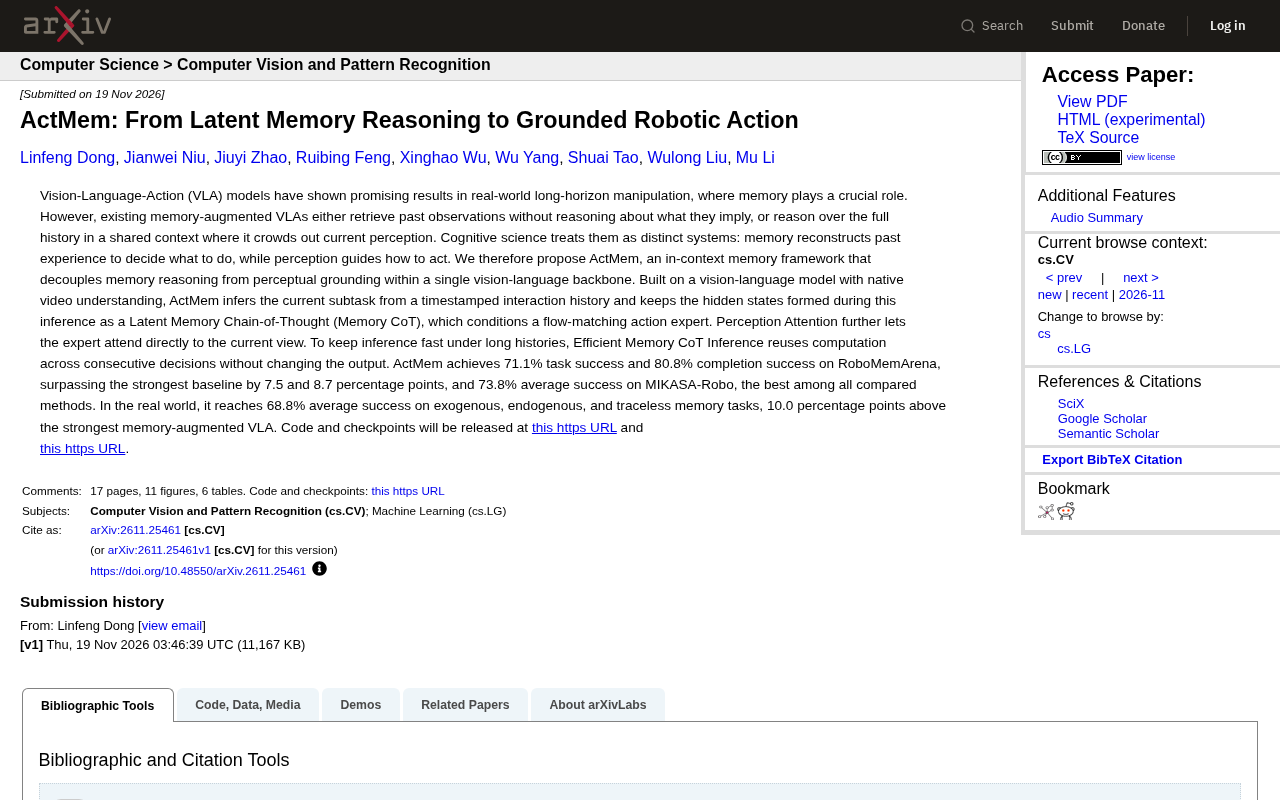
Vision-Language-Action (VLA) models have shown promise in real-world long-horizon manipulation tasks, where memory plays a critical role. However, existing memory-augmented VLAs have notable shortcomings: they either retrieve past observations directly without reasoning about their meaning, or they reason over the full history within a shared context, crowding out current perception. The recently proposed ActMem framework draws inspiration from cognitive science, decoupling memory reasoning from perceptual grounding, and achieves leading results across multiple benchmarks.
Memory and Perception: Insights from Cognitive Science
Cognitive science treats memory and perception as two distinct systems: memory reconstructs past experience to decide "what to do," while perception guides "how to do it." Existing memory-augmented VLAs often conflate the two — either concatenating historical observations directly into the context as retrieved snippets without deep reasoning about their meaning, or letting the full history compete with current perception for attention in the same context, diluting the current visual information.
ActMem's core idea is precisely to separate these two processes: let memory focus on reasoning about the current subtask, and let perception focus on guiding the specific action. This preserves the depth of historical reasoning while avoiding interference from historical information with current perception.
Core Design of ActMem: Latent Memory Chain-of-Thought and Perception Attention
ActMem is built on a vision-language model with native video understanding capabilities and comprises three key components.
Latent Memory Chain-of-Thought (Memory CoT)
ActMem infers the current subtask from timestamped interaction history and retains the hidden states formed during reasoning, constituting a "latent memory chain-of-thought." These hidden states serve as conditioning information fed into a flow-matching action expert. Unlike explicit textual reasoning, the memory CoT in hidden-state form retains richer contextual information without occupying a large context window.
Flow matching is a class of generative modeling methods that, like diffusion models, belongs to the continuous-time generative framework, but its training objective is to directly regress the probability flow velocity field from the noise distribution to the data distribution rather than performing iterative denoising. In robot action generation, the flow-matching action expert takes the current state and task condition (here, the hidden states of the memory CoT) as input and transforms Gaussian noise into action sequences by solving an ordinary differential equation. Compared with diffusion policies, flow matching typically requires fewer sampling steps to generate high-quality actions and has lower inference latency, making it better suited for real-robot deployment requiring high-frequency closed-loop control. ActMem conditions this expert on hidden states rather than text, enabling action generation to absorb historical context that is difficult to fully express in language.
Perception Attention
To allow the action expert to attend directly to the current visual input, ActMem introduces a perception attention mechanism that lets the action expert bypass the intermediate results of memory reasoning and compute attention directly over the current view. This amounts to preserving a perceptual shortcut during action generation, ensuring that "how to do it" is always based on the latest environmental state.
Efficient Memory CoT Inference
Reasoning speed over long histories is critical for practical deployment. ActMem uses Efficient Memory CoT Inference to reuse computation across consecutive decisions without changing the output, thereby significantly reducing the computational overhead of long histories while maintaining reasoning quality.
Computation reuse across consecutive decisions is particularly meaningful in long-horizon robot tasks: between adjacent decision steps, only a small number of frames at the end of the historical interaction sequence change, so the key-value cache (KV cache) of preceding tokens can in principle be reused. If forward inference over the full history is performed from scratch at every step, the computation grows linearly or even quadratically with history length, and the actual control frequency in long-horizon tasks drops rapidly. ActMem's Efficient Memory CoT Inference exploits this temporal redundancy to skip redundant computation while keeping the output exactly identical to full recomputation (lossless), compressing the overhead of long histories into an acceptable range. This design is akin to prefix caching in large-model inference, but requires additional handling of the boundary case where the memory CoT hidden states become invalid as new observations update.
Experimental Results: Leading on Multiple Benchmarks
On the RoboMemArena benchmark, ActMem achieves a 71.1% task success rate and an 80.8% completion success rate, outperforming the strongest baseline by 7.5 and 8.7 percentage points, respectively. On MIKASA-Robo, its average success rate is 73.8%, the best among all compared methods.
Real-world tests further validate its generalization ability: on exogenous, endogenous, and traceless memory tasks, ActMem reaches an average success rate of 68.8%, 10.0 percentage points higher than the strongest memory-augmented VLA. These results show that decoupling memory reasoning from perceptual grounding yields consistent gains across diverse memory tasks.
The three metrics in the paper have distinct meanings: task success rate refers to the proportion of episodes in which the agent completes the overall long-horizon task within a given episode; completion success rate measures the average proportion of individual subgoals achieved within a task—even if the overall task fails, partially completed subgoals still count, so this value is typically higher than the task success rate. The gap between the two reflects how "close to success" the model is—a smaller gap indicates that failures tend to occur near the end of the task rather than from early disorientation. In addition, RoboMemArena and MIKASA-Robo respectively focus on memory-dependent manipulation in simulated environments and multi-task generalization evaluation, while the real-world experiments categorize tasks by exogenous memory (external cues in the environment), endogenous memory (one's own action history), and traceless memory (requiring inference from observations that have disappeared)—the three call upon memory mechanisms differently, and this categorized evaluation helps pinpoint the specific sources of the method's advantages.
Significance and Outlook
ActMem's value lies in providing a structured way of using memory: memory is no longer simple historical retrieval or context stacking, but is transformed into a latent reasoning representation that guides current decisions. Perception attention ensures that action generation is always anchored to current observations. This architecture—"separating reasoning from perception while coordinating them within a single backbone"—offers a new path to solving the memory problem in long-horizon robot manipulation.
The research team states that code and model checkpoints will be open-sourced, which is expected to drive further exploration in memory-augmented VLA. For researchers and developers interested in robot manipulation, VLA models, and memory mechanisms, ActMem's design approach is worth continued attention.
One-line Summary
ActMem decouples memory reasoning from perceptual grounding, leading on multiple robot manipulation benchmarks.
Paragraph Summary
ActMem is a memory-augmented Vision-Language-Action (VLA) framework for long-horizon robot manipulation, inspired by cognitive science's distinction between memory and perception. Addressing the problem that existing methods either retrieve historical observations directly or let the full history compete with current perception for context attention, ActMem decouples memory reasoning from perceptual grounding: a latent memory chain-of-thought infers the current subtask in hidden-state form and conditions a flow-matching action expert, while perception attention lets the action expert attend directly to the current view, ensuring actions are anchored to the latest environmental state; efficient memory CoT inference reduces long-history overhead through cross-decision computation reuse without changing outputs. It achieves a 71.1% task success rate on RoboMemArena, 7.5 percentage points above the strongest baseline; a 73.8% average success rate on MIKASA-Robo; and a 68.8% average success rate on real-world exogenous, endogenous, and traceless memory tasks, leading by 10.0 percentage points.
Related articles

GLM-5.4 vs. Opus and Neon: How Far From the Top?
No official benchmarks for GLM-5.4. Based on a YouTube deep test and developer trials, we analyze its gap vs. Claude Opus 5.5 and Gemini Neon, the speed bottleneck from marathon-style thinking, and its real position in enterprise agent scenarios.

From Gobbler to Sloppy Joe: The Hit-Making Playbook of a New Jersey Deli Institution
NYT Cooking visits Milburn Deli in New Jersey to break down the hit logic behind the Gobbler turkey sandwich and the local Sloppy Joe: bread sliced to order, house-made sauces, a group shout culture, and customer co-creation behind six locations.
In the Age of AI Programming, When Do You Still Need to Write Code by Hand?
Is handwritten code still valuable once AI programming agents are widespread? This article outlines three scenarios where handwriting is essential—learning, style development, and prototype validation—and provides a division-of-labor framework between AI and humans to help developers balance efficiency and skill growth.