AdaBPE: How Dynamic Frequency Thresholds Optimize Tokenization for Mixed Corpora

AdaBPE improves BPE tokenization with dual length- and type-adaptive frequency thresholds, boosting encoding efficiency for LaTeX and other domain languages.
The article introduces AdaBPE, an improved tokenization method. Traditional BPE treats spaces as fixed boundaries and greedy frequency merging favors short patterns, causing multi-word expressions to split and low-frequency structured languages like LaTeX to lack dedicated vocabulary. AdaBPE introduces dual adaptive frequency thresholds: longer tokens get lower thresholds to offset short-pattern bias, and formal languages (like LaTeX) receive more lenient thresholds for independent vocabulary quotas. On five pure LaTeX, pure natural language, and mixed datasets, AdaBPE improves domain encoding efficiency and downstream model performance without harming general language performance. The framework can extend to code, math formulas, and other formal languages, but type classification automation and threshold transferability remain to be validated.
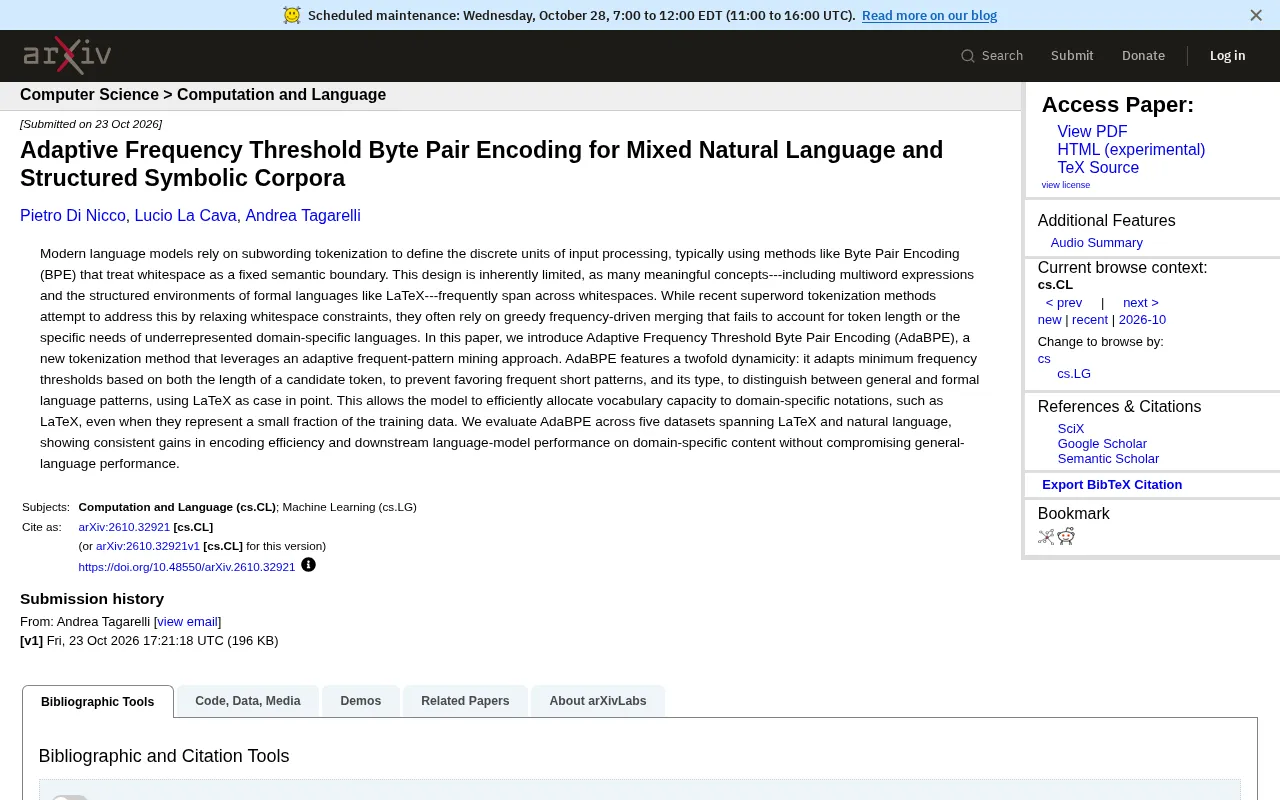
The first step a language model takes when processing input is tokenization. Byte Pair Encoding (BPE), the dominant method, has long treated spaces as an insurmountable semantic boundary. This assumption is acceptable for natural language, but it falls short when facing multi-word expressions or structured symbolic languages like LaTeX—many meaningful units exist precisely across spaces. A recent paper proposes AdaBPE, which attempts to redefine the merge logic of tokenization using adaptive frequency thresholds.
The Boundary Dilemma of Traditional BPE
BPE's core operation is to count the frequency of adjacent symbol pairs and repeatedly merge the most frequent combinations. This greedy strategy is simple and effective, but it has two implicit flaws: first, spaces are treated as fixed split points, causing multi-word expressions like "New York" to be split into separate tokens, forcing the model to learn their association additionally; second, frequency-driven merging naturally favors short patterns—a bigram appearing 100 times will outrank a semantically more complete long pattern appearing 80 times in merge priority.
Recent superword tokenization methods attempt to relax the space constraint, but the paper points out that they still rely on greedy frequency merging, neither considering token length nor accounting for low-frequency but critical domain-specific language (DSL) symbols. For LaTeX code, which constitutes a tiny fraction of training data, standard BPE will almost never allocate dedicated vocabulary capacity to it.
BPE (Byte Pair Encoding) was originally a data compression algorithm, introduced to neural machine translation by Sennrich et al. in 2016 and subsequently becoming the mainstream tokenization method. Its process is: split text into character or byte sequences, count the frequency of all adjacent symbol pairs, merge the most frequent pair into a new symbol, and repeat until the vocabulary reaches a preset size. BPE starts merging from the character level, automatically discovering common subword units in the corpus, balancing vocabulary compactness with coverage of out-of-vocabulary words. However, this mechanism is entirely frequency-driven, and the preprocessing stage typically pre-splits by spaces, preventing merge operations from crossing space boundaries.
Superword tokenization refers to a class of tokenization methods that relax traditional word boundary constraints, allowing merges of multi-word expressions spanning spaces (such as "New York" or "in vitro"), enabling the tokenizer to directly produce tokens containing spaces. These methods aim to let models represent fixed collocations and phrases more efficiently, but most implementations still use greedy frequency merging without differentiating token length or domain type.
The Dual Dynamism of AdaBPE
AdaBPE's approach is straightforward: make the minimum frequency threshold dynamic. Specifically, it introduces two adaptive mechanisms.
The first addresses length. The longer a candidate token, the lower its frequency threshold. This counteracts BPE's preference for short patterns, giving long and complete structures like "\begin{equation}" a chance to enter the vocabulary rather than being split into fragments like "\begin", "{", and "equation".
The second addresses type. The system distinguishes general natural language patterns from formal language patterns (the paper uses LaTeX as an example), applying a more lenient threshold to the latter. Thus, even if LaTeX constitutes only a small fraction of the mixed corpus, its unique notation can obtain an independent vocabulary quota without competing with high-frequency English words for merge opportunities.
The paper describes this idea as "adaptive frequent pattern mining," essentially adding a dynamic filter before BPE's merge loop: first adjust the admission threshold based on the length and category of candidate patterns, then perform merging.
Formal language, as opposed to natural language, refers to languages generated by precisely defined grammar rules, such as programming languages, LaTeX typesetting markup, mathematical formulas, and SQL. Its characteristics are symbol density, strict structure, and semantics determined by syntax trees rather than word order. In mixed corpora, formal language content typically accounts for a very low proportion, but its token distribution differs greatly from natural language—many symbols (such as backslashes, curly braces, and underscores) are rare in natural text, and standard BPE splits them into single-character fragments, resulting in low encoding efficiency and making it difficult for models to learn structural patterns. AdaBPE assigns more lenient merge thresholds to formal language as an independent "type," precisely to solve this vocabulary quota competition problem.
Experimental Design and Results
The authors evaluate AdaBPE on five datasets, covering pure LaTeX, pure natural language, and mixed scenarios. Results show stable improvements in encoding efficiency on domain-specific content—the same text is compressed into fewer tokens; downstream language models also outperform baselines on LaTeX-related tasks, while general natural language performance does not degrade.
What is noteworthy about this result is the "no compromise" aspect: typically, optimizing the vocabulary for domain data encroaches on the representation space for general language, but AdaBPE maintains a balance between the two in mixed corpora through type-aware threshold allocation.
Encoding efficiency in the tokenization context is typically measured by "tokens per character" or compression ratio: the fewer tokens the same text is encoded into, the higher the efficiency. Fewer tokens mean the model can process more content within a fixed context window while reducing attention computation and inference costs. For structured languages like LaTeX, efficient encoding is particularly critical—if "\begin{equation}" is split into multiple fragments, the model needs additional levels of composition to recover its structural meaning, wasting capacity and increasing learning difficulty. AdaBPE's improvement in encoding efficiency on domain-specific content directly manifests as shorter token sequences for the same LaTeX source code.
Implications for Tokenization Research
AdaBPE's value extends beyond LaTeX. It proposes an extensible framework: as long as a "type" can be defined for a class of patterns, a custom frequency threshold can be designed for it. This means that in the future, when facing code, mathematical formulas, or even multilingual mixed corpora, tokenizers need not rely on a single fixed rule but can dynamically adjust merge strategies by content type.
Of course, the paper currently uses only LaTeX as a case of formal language, and the degree of automation in type classification and the transferability of the specific form of the threshold function to other DSLs remain to be further validated. But the direction itself is clear: tokenizers need finer-grained awareness, and adaptive thresholds are a lightweight and effective lever.
One-line Summary
AdaBPE improves BPE tokenization with dual length- and type-adaptive frequency thresholds, enhancing encoding efficiency for domain languages like LaTeX.
Paragraph Summary
The article introduces AdaBPE, an improved tokenization method. Traditional BPE treats spaces as fixed boundaries, and greedy frequency merging favors short patterns, causing multi-word expressions to be split and low-frequency structured languages like LaTeX to struggle to obtain dedicated vocabulary. AdaBPE introduces dual adaptive frequency thresholds: longer candidate tokens get lower thresholds to counteract short-pattern preference, and formal languages (like LaTeX) receive more lenient thresholds to obtain independent vocabulary quotas in mixed corpora. On five pure LaTeX, pure natural language, and mixed datasets, AdaBPE improves encoding efficiency and downstream model performance on domain content without degrading general language performance. The article suggests the framework can extend to other formal languages such as code and mathematical formulas, but automation of type classification and transferability of threshold functions remain to be validated.
Related articles

T3 Code: The Open-Source AI Coding Assistant's Comeback Story
T3 Code is an open-source AI coding assistant that unifies subscriptions like Codex and Claude, with powerful remote control and parallel task management.

Never Elected, Yet Ruled New York for 30 Years: The Ultimate Case Study in the Mechanics of Power
Robert Caro's biographies reveal how unelected Robert Moses ruled New York for 30 years through legal drafting and public authorities, and how Lyndon Johnson built leverage as a "powerless" Senate Majority Leader. Unpacking the underlying logic of accumulating and sustaining power.

The CPython 3.10 Recursion Trap and Synthetic Recovery in TokenGuard, an LLM Circuit Breaker
TokenGuard's author recounts a recursion crash caused by OrderedDict.pop in CPython 3.10 and introduces v0.3.0's Loop Nudge synthetic recovery, inline DLP scanning, and other new LLM agent circuit-breaker capabilities.