Adaptive Quantization Keeps TD Learning Converging Fast Under Limited Bandwidth
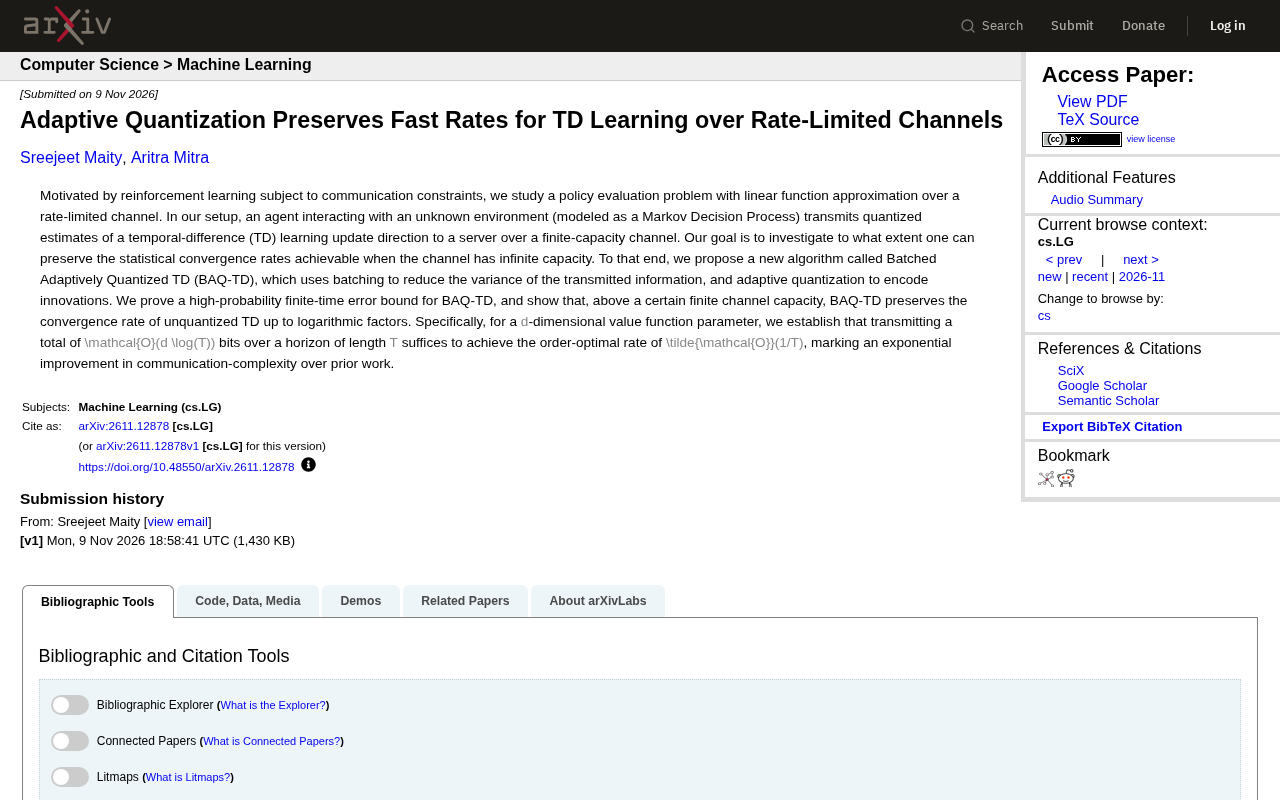
BAQ-TD shows adaptive quantization preserves fast TD learning convergence over rate-limited channels.
The paper studies policy evaluation in communication-constrained distributed RL and proposes BAQ-TD, which reduces variance via batching and encodes innovations with adaptive quantization to use limited bits efficiently. Theory gives high-probability finite-time error bounds, proving that once channel capacity exceeds a threshold, the algorithm preserves unquantized TD's convergence rate at the cost of a log factor. For d-dimensional parameters, O(d log T) bits suffice for the order-optimal Õ(1/T) rate, an exponential improvement in communication complexity over prior work. This provides a theoretical foundation and design ideas for communication-efficient distributed RL.
Research Background: Reinforcement Learning Under Communication Constraints
In distributed reinforcement learning systems, the communication bandwidth between agents and servers is often limited. Traditional temporal difference (TD) learning algorithms assume that parameter updates can be transmitted losslessly, but in real-world scenarios the update direction must be quantized and compressed. This raises a key question: can quantized TD learning preserve the same statistical convergence rate as its unquantized counterpart?
A paper from rss, Adaptive Quantization Preserves Fast Rates for TD Learning over Rate-Limited Channels, investigates this problem in depth. The work considers a policy evaluation problem with linear function approximation, where an agent interacts with an unknown environment (modeled as a Markov decision process) and transmits quantized TD update directions to a server over a finite-capacity channel. The goal is to determine to what extent the convergence rate under an infinite-capacity channel can be preserved.

Policy evaluation is one of the core problems in reinforcement learning: estimating the state value function (or action value function) under a given policy. In the linear function approximation setting, the value function is parameterized as a linear combination of feature vectors, i.e., (V_\theta(s) = \theta^\top \phi(s)), where (\phi(s)) is the feature mapping of state (s) and (\theta \in \mathbb{R}^d) are the parameters to be learned. Policy evaluation typically uses temporal difference (TD) learning, iteratively updating the parameters via stochastic approximation: (\theta_{t+1} = \theta_t + \alpha_t (r_t + \gamma V_{\theta_t}(s_{t+1}) - V_{\theta_t}(s_t)) \phi(s_t)). Linear function approximation serves as a benchmark model for theoretical research due to its strong analyzability; many convergence analyses of deep reinforcement learning also often start from the linear case. This paper studies the impact of quantized communication on convergence rates precisely within this framework.
The BAQ-TD Algorithm: Combining Batching and Adaptive Quantization
To address TD learning under communication constraints, the authors propose a new algorithm called Batched Adaptively Quantized TD (BAQ-TD). The algorithm has two core designs:
- Batching: Accumulating updates over multiple time steps reduces the variance of the transmitted information, thereby mitigating the impact of quantization error.
- Adaptive Quantization: Encoding the innovations, i.e., transmitting only the difference between the current estimate and the previous estimate rather than the full parameters. This differential encoding approach makes more efficient use of limited bit resources.
These two mechanisms work together, enabling the algorithm to maintain stable learning performance under limited channel capacity.
Innovations encoding is a differential encoding technique originating from signal processing and estimation theory. In distributed optimization, if the full parameter vector is transmitted each time, redundant information between adjacent rounds is sent repeatedly, wasting bandwidth. The innovation refers to the difference between the current estimate and the previous estimate known to the receiver, i.e., (\Delta_t = \theta_t - \hat{\theta}{t-1}), where (\hat{\theta}{t-1}) is the previous round's parameters reconstructed at the server. Only (\Delta_t) is quantized and transmitted, and the receiver can recover the current estimate by cumulative decoding. Since the dynamic range of the innovation is usually much smaller than that of the parameters themselves, and its distribution may change across iterations, an adaptive quantizer can dynamically adjust the quantization interval and step size based on the magnitude of historical innovations, thereby minimizing quantization error under a limited bit budget. This combination of differential encoding and adaptive quantization is the key to BAQ-TD's efficient communication.
Theoretical Guarantees: Fast Convergence Under Finite Capacity
One of the paper's core contributions is a high-probability finite-time error bound for BAQ-TD. The theoretical analysis shows that once the channel capacity exceeds a certain finite threshold, BAQ-TD can preserve the convergence rate of unquantized TD at the cost of a logarithmic factor.
Specifically, for value function parameters of dimension (d) over a time horizon of length (T), transmitting a total of (\mathcal{O}(d \log(T))) bits suffices to achieve the order-optimal (\tilde{\mathcal{O}}(1/T)) convergence rate. This result means that, compared with prior work, the communication complexity achieves an exponential improvement—from potentially polynomial growth in (T) down to logarithmic growth.
This theoretical finding has important practical implications: it shows that in distributed reinforcement learning systems, even with very limited communication bandwidth, fast convergence can still be achieved without sacrificing statistical efficiency, as long as an appropriate adaptive quantization strategy is used.
High-probability finite-time error bounds are a rigorous framework in statistical learning theory for characterizing algorithm convergence performance. Unlike bounds that only give asymptotic rates in expectation, finite-time bounds explicitly depend on the number of iterations (T), the confidence level (1-\delta), and problem parameters (such as dimension (d) and mixing time), typically in the form: with probability at least (1-\delta), (|\theta_T - \theta^*|^2 \le C \cdot \tilde{\mathcal{O}}(1/T)), where (\tilde{\mathcal{O}}) hides logarithmic factors. Such bounds capture both convergence speed and reliability, which is especially important for communication-constrained systems—because quantization error is random, it must be controlled so that it does not affect convergence with high probability. The paper proves that BAQ-TD can still achieve such bounds once the channel capacity exceeds a threshold, with the additional term containing only logarithmic factors, thereby guaranteeing robustness in practical deployment.
Comparison with Existing Work
Previous studies on communication-constrained TD learning typically require more bits or can only guarantee slower convergence rates. BAQ-TD strikes a balance between the two by reducing variance through batching and encoding innovations through adaptive quantization. The paper explicitly states that its communication complexity is an exponential improvement over prior work, thanks to a more refined exploitation of the information structure.
You may not have noticed that this theoretical guarantee applies to the policy evaluation problem under linear function approximation, which is a fundamental setting in reinforcement learning. Although practical applications may involve nonlinear function approximation, this result lays a theoretical foundation for future extensions.
Potential Impact and Future Directions
The theoretical results of BAQ-TD provide new ideas for communication-efficient distributed reinforcement learning. In scenarios such as federated reinforcement learning and multi-agent systems, the communication bottleneck between agents and central servers has always been a key factor constraining performance. By combining adaptive quantization and batching, the algorithm significantly reduces communication overhead while maintaining fast convergence, and is expected to advance these fields.
Possible future research directions include extending the method to more complex function approximation (such as neural networks), considering more general channel models (such as time-varying channels), and validating the algorithm's robustness in practical systems.
Conclusion
Through the BAQ-TD algorithm, this paper demonstrates that adaptive quantization can preserve the fast convergence rate of TD learning over rate-limited channels, with communication complexity growing only logarithmically in the parameter dimension. This result not only deepens the theoretical understanding of quantized TD learning but also provides guidance for the design of practical distributed reinforcement learning systems.
Related articles
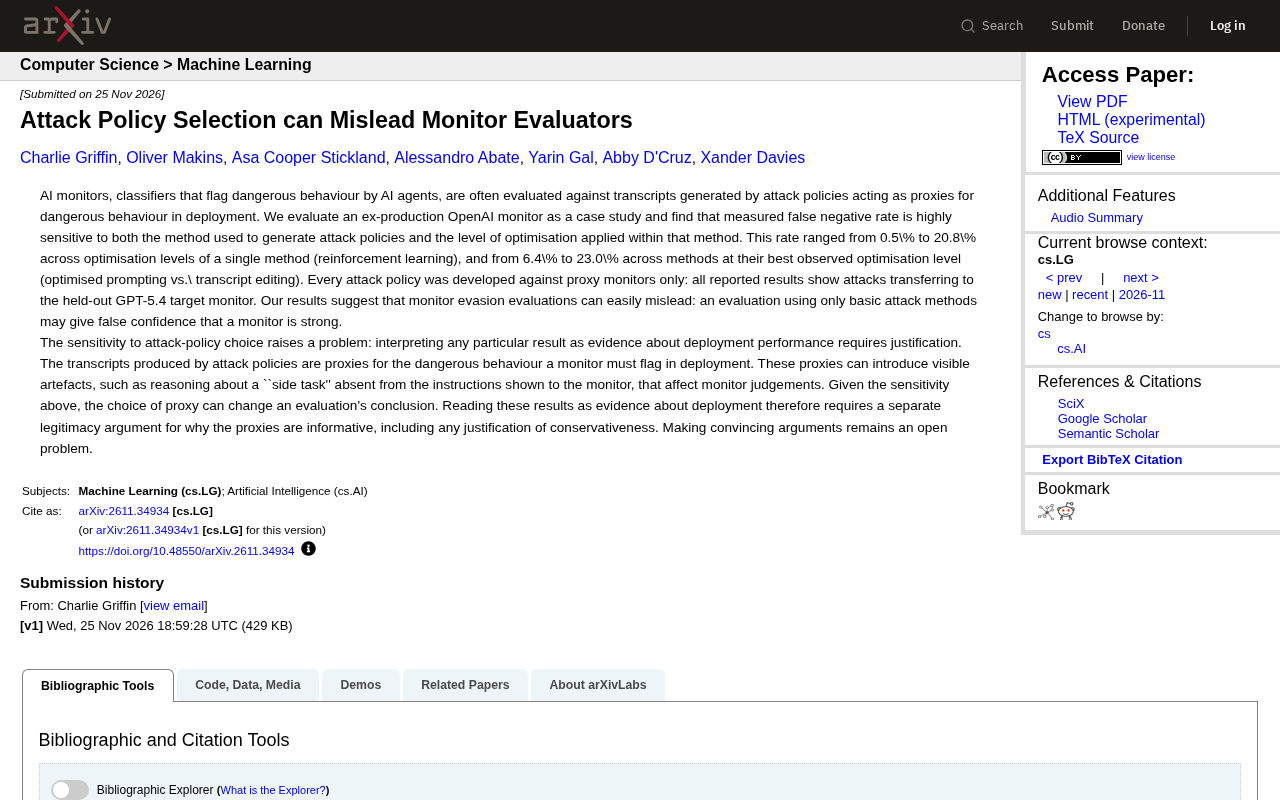
How Attack Policy Selection Can Mislead AI Monitor Evaluations
AI monitor evaluations are highly sensitive to attack policy choice; false negative rates vary widely across methods and optimization levels, and basic attacks may overestimate monitor strength and mislead deployment decisions.
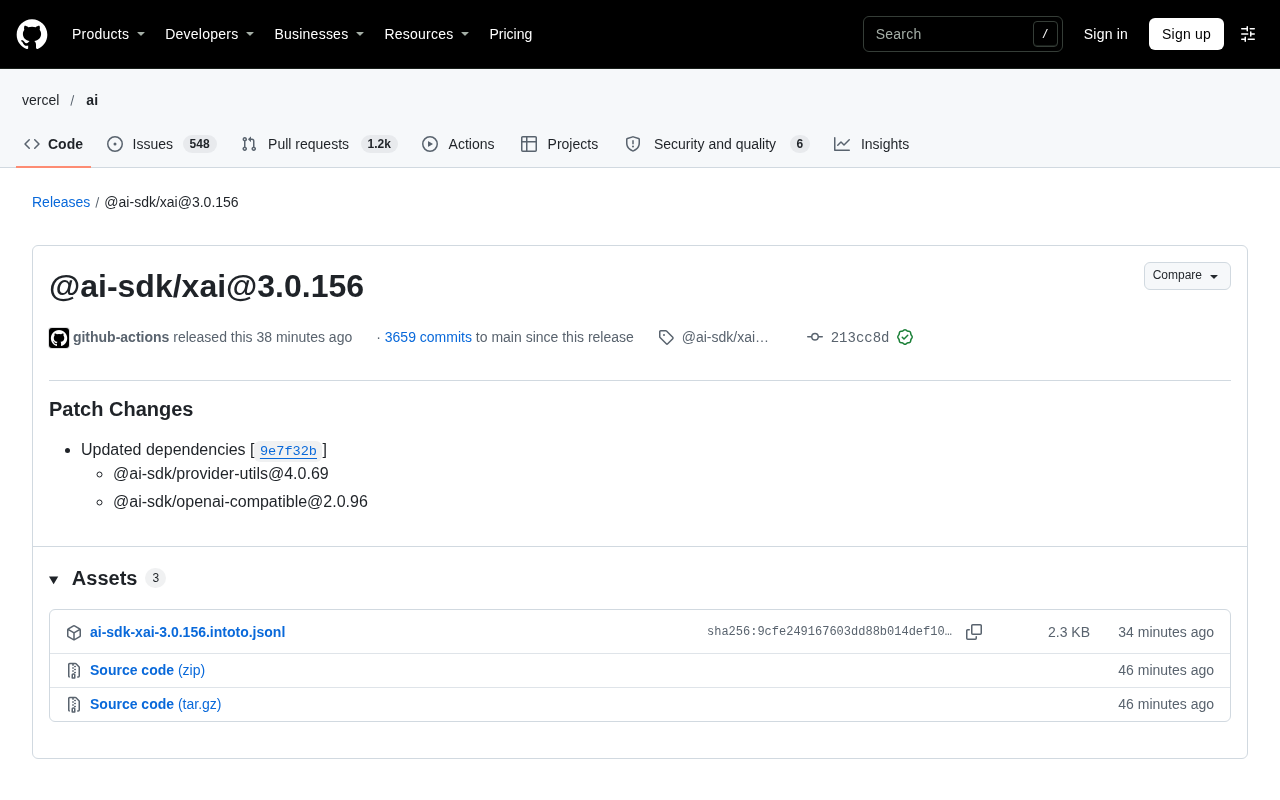
@ai-sdk/xai 3.0.156 Released: The Ecosystem Significance of Dependency Synchronization
@ai-sdk/xai 3.0.156 released as a patch update, syncing @ai-sdk/provider-utils 4.0.69 and @ai-sdk/openai-compatible 2.0.96. This article explains the ecosystem significance of dependency synchronization and upgrade advice for developers.

Vibe Coding for Absolute Beginners: Full-Stack AI Agent Development in Practice
A beginner's guide to Vibe Coding: what it is, why workflow orchestration isn't AI development, and how full-chain AI agent development, multi-platform builds, and AI-driven operations enable one-person companies.