Vibe Coding for Absolute Beginners: Full-Stack AI Agent Development in Practice

Vibe Coding lets people direct AI to write code, moving toward full-chain engineering for solo product building.
The article introduces Vibe Coding—where developers use natural language to direct AI in generating pages, integrating databases, testing, and even producing docs and promotional content. It stresses that workflow tools like Coze or n8n are only basic play; true industrial deployment relies on an "AI + code + agents + engineering" system connecting requirements, design, development, testing, deployment, and operations. Using Claude Code, MCP, Skills, Figma, and UniApp as examples, it points toward one-person-company product capability.
AI is evolving from a tool into an entirely new form of productivity. In the past, building a product required collaboration across multiple roles—product managers, designers, frontend and backend engineers, testers, and operations staff. Now, a single person can potentially complete the entire workflow with the help of AI. In the course introduction, Bilibili creator "分镜影院" (Storyboard Cinema) argues that the future of software development is being completely restructured by AI, and the core concept carrying this change is Vibe Coding.
What Is Vibe Coding?
The core of Vibe Coding can be summed up in one sentence: instead of humans writing code, humans direct AI to write code. You simply tell AI what page you want, what it should look like, and how the features should work—and AI can generate the page, write the code, connect to the database, run automated tests, fix bugs, produce documentation, and even generate promotional copy and short videos.
The significance of this model lies in flattening the technical barrier. In the past, many people had ideas but lacked the ability to bring them to life—they needed to understand design, frontend, backend, databases, servers, and even operations. AI is gradually lowering these barriers, shifting the development paradigm from "humans adapting to code" to "AI understanding human language."
Avoiding the Pitfall: Workflow Orchestration Is Not AI Development
Many people assume that AI development means building a few nodes and running a few flows on platforms like Coze, Dify, or n8n, and consider themselves to have mastered AI development. The creator explicitly points out that these are only basic AI applications. The real core direction capable of industrial-grade deployment, developing complex systems, and building future AI products is the "AI + code + agents + engineering" system.
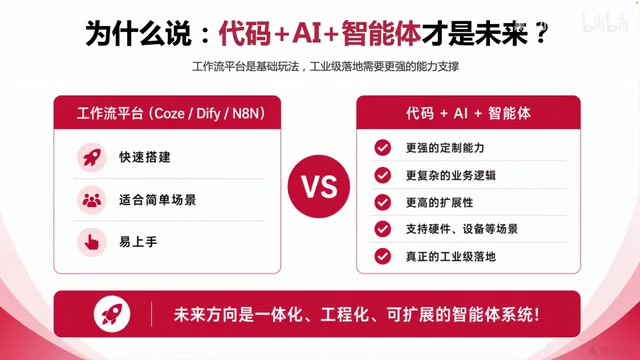
What will truly have value in the future isn't simple chatbots, but AI-type applications—AI e-commerce, digital humans, automation systems, AI enterprise platforms, and so on. These products will ultimately all come back to engineering capability. The course's two goals follow from this: first, to help learners master Vibe Coding and AI engineering product deployment, rather than stopping at being able to use a few AI tools; second, to point toward monetization, because the future will see a surge of one-person companies, AI entrepreneurs, and super-individuals. For many people, the way forward may no longer be finding a job, but building products with AI.
MCP (Model Context Protocol) is an open protocol proposed by Anthropic to standardize how large language models connect to external data sources and tools. You can think of MCP as the "USB interface" of the AI world: in the past, every AI tool had to write separate integration code for each data source, whereas MCP defines a unified calling specification that lets models access file systems, databases, APIs, or third-party services in a consistent way. In an AI collaborative development system, MCP enables coding agents like Claude Code not only to read code but also to proactively query documentation, operate repositories, and invoke external tools—upgrading "chat-style Q&A" into "executable engineering collaboration."
Skills (agent skills) refer to encapsulating reusable professional capabilities into modules that AI can invoke when needed—for example, "generate a compliant API document" or "execute a complete regression test." Skills and MCP work together: the former addresses "what it can do," while the latter addresses "what it can connect to," and together they form the infrastructure of agent engineering.
Full-Chain Closed Loop: A Complete Process from Requirements to Operations
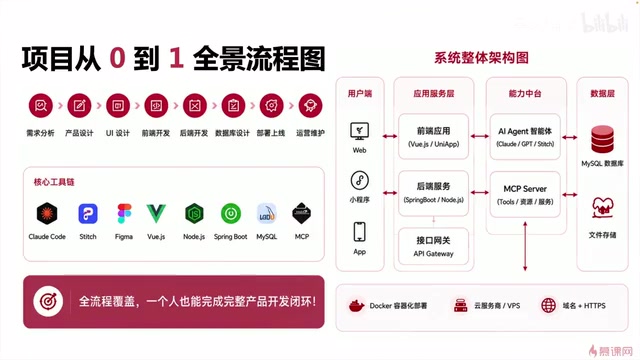
A real product isn't just about hand-writing code. The complete zero-to-one process includes requirements analysis, UI design, page development, backend logic, databases, testing, deployment, and operations/promotion—all of which need to be connected. The biggest feature of this course is the full-chain closed loop—not building a simple demo, but guiding learners through building a complete product.
In terms of system architecture, future software development is no longer about isolated capabilities but AI collaborative development. Tools like Claude Code, Stitch, MCP, Skills, and Figma work in coordination, and AI is no longer just chatting—it genuinely participates in design, development, testing, optimization, and operations. This is precisely the direction of AI engineering.
Claude Code is a command-line coding agent launched by Anthropic. It runs in the terminal and can directly read project files, execute commands, modify code, and run tests—rather than just providing code snippets. Compared with web-based chat, Claude Code's advantage lies in having "project-level context"—it can understand the structure of the entire repository, retrieve files as needed, and verify results after modifications, making it closer to a collaborator who can deliver tasks.
Stitch is an AI interface design tool launched by Google that can generate UI design mockups from natural language descriptions or sketches and export code usable by frontend teams, bridging design and development. Figma is a mainstream collaborative design platform whose AI capabilities and plugin ecosystem make it an important link in the design-to-code pipeline. The significance of combining these tools is that design, coding, and testing are no longer disconnected stages but are connected by AI within a unified context—this is the concrete embodiment of "AI collaborative development" mentioned in the article.
Multi-Platform Development and AI Operations: Two Pieces of the One-Person Company Puzzle
In the past, developing multi-platform products was very painful—one set for the web, one for the app, and yet another for mini programs. Now AI has dramatically lowered the barrier to multi-platform development. The course teaches UniApp, combining AI code generation with component reuse to achieve develop once, run everywhere. This is also an important reason why one-person companies are becoming possible in the future.
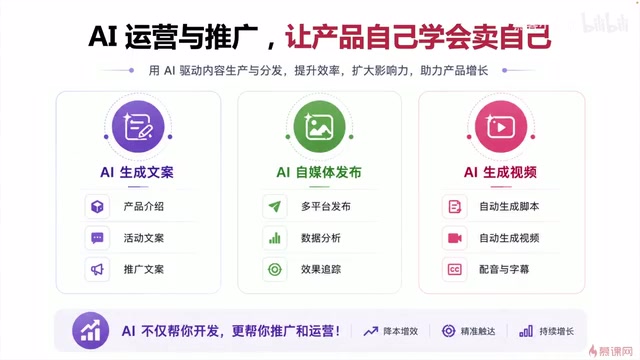
Many people think product development is the end of the story, but the real difficulty is promotion. AI has already entered the operations domain: automatically generating WeChat official account articles, promotional copy, video scripts, and even automatically generating product promotional videos. AI can help you promote your product, letting the product promote itself. The truly capable people of the future will definitely be those with dual capabilities in development and AI operations.
UniApp is a cross-platform development framework based on Vue syntax; a single codebase can be compiled into WeChat mini programs, H5, iOS, Android, and some desktop applications. Its core value lies in using conditional compilation and a unified component system to shield platform differences, so developers only need to make minor adaptations for platform-specific features. When AI participates in code generation, the value of cross-platform is further amplified: AI-generated page logic can be reused across multiple platforms, and components and styles can be adjusted in batches, significantly reducing the labor cost of "develop once, run everywhere." It's worth noting that cross-platform frameworks still have boundaries in performance-sensitive scenarios and in calling platform-native capabilities, so specific platform limitations need to be assessed during engineering deployment.
What You'll Gain After Learning
According to the course design, learners will acquire the ability to independently develop products, full-chain AI collaboration skills, AI engineering skills, multi-platform development skills, and AI automated operations skills—ultimately pointing toward the ability to "build products solo." AI will eliminate a large amount of repetitive labor while also giving rise to a large number of super-individuals, one-person companies, and AI entrepreneurs. Opportunities belong to those who prepare in advance.
It's important to view this objectively: the above capability goals come from the course provider's statements, and actual results depend on the learner's investment and practice. Vibe Coding lowers the entry barrier, but engineering deployment still requires understanding requirements decomposition, system design, and quality control—AI is an amplifier, not a replacement.
One-line Summary
Vibe Coding lets people direct AI to write code, moving toward full-chain engineering for solo product building.
Paragraph Summary
The article centers on the course introduction by Bilibili creator "分镜影院" (Storyboard Cinema), introducing the concept of Vibe Coding: developers no longer hand-write code but use natural language to direct AI in completing page generation, database integration, testing and bug fixing, and even documentation and promotional content production. The article emphasizes that building workflows on Coze, Dify, or n8n is only basic play; true industrial-grade deployment depends on the "AI + code + agents + engineering" system, which requires connecting requirements analysis, UI design, development, testing, deployment, and operations into a complete closed loop. The course uses the collaboration of tools like Claude Code, MCP, Skills, and Figma as examples, and uses UniApp combined with AI code generation to achieve develop once, run everywhere, while also incorporating AI operations into the capability scope—ultimately pointing toward one-person-company-style independent product capability.
Related articles
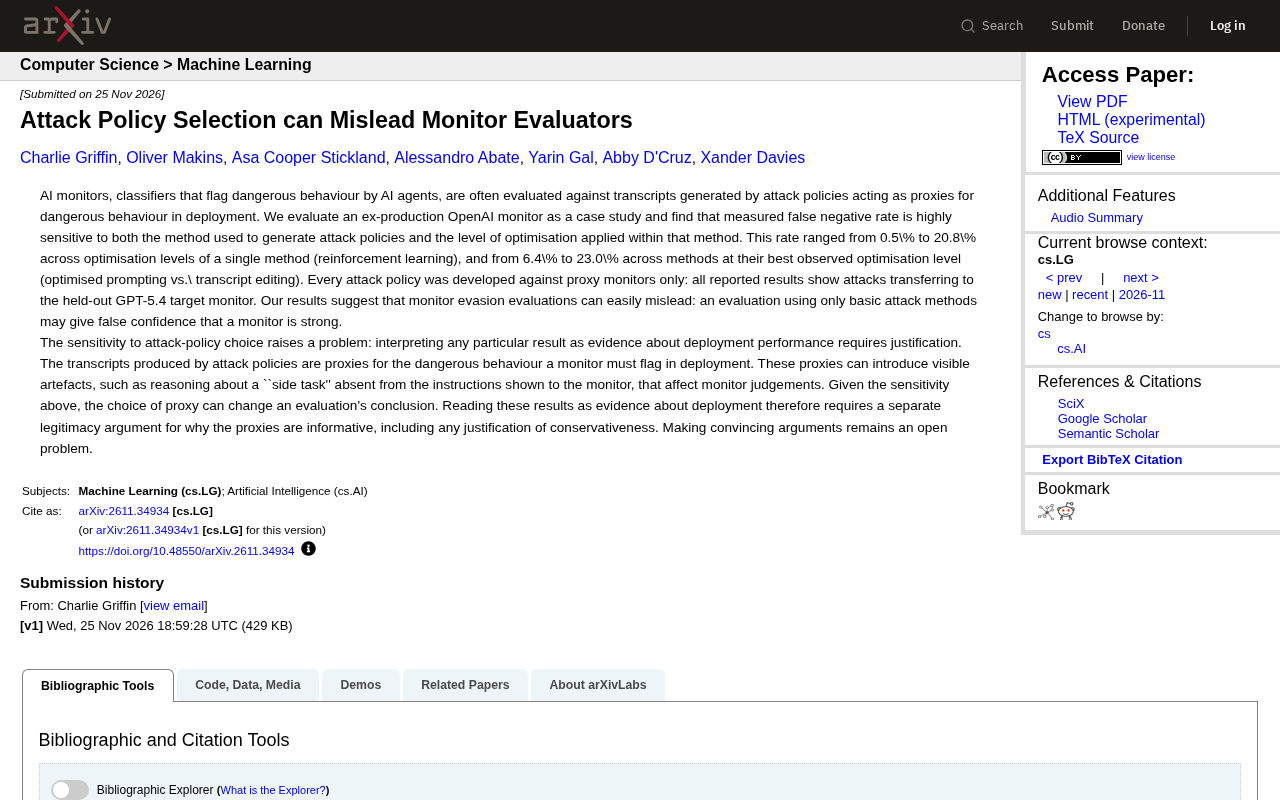
How Attack Policy Selection Can Mislead AI Monitor Evaluations
AI monitor evaluations are highly sensitive to attack policy choice; false negative rates vary widely across methods and optimization levels, and basic attacks may overestimate monitor strength and mislead deployment decisions.
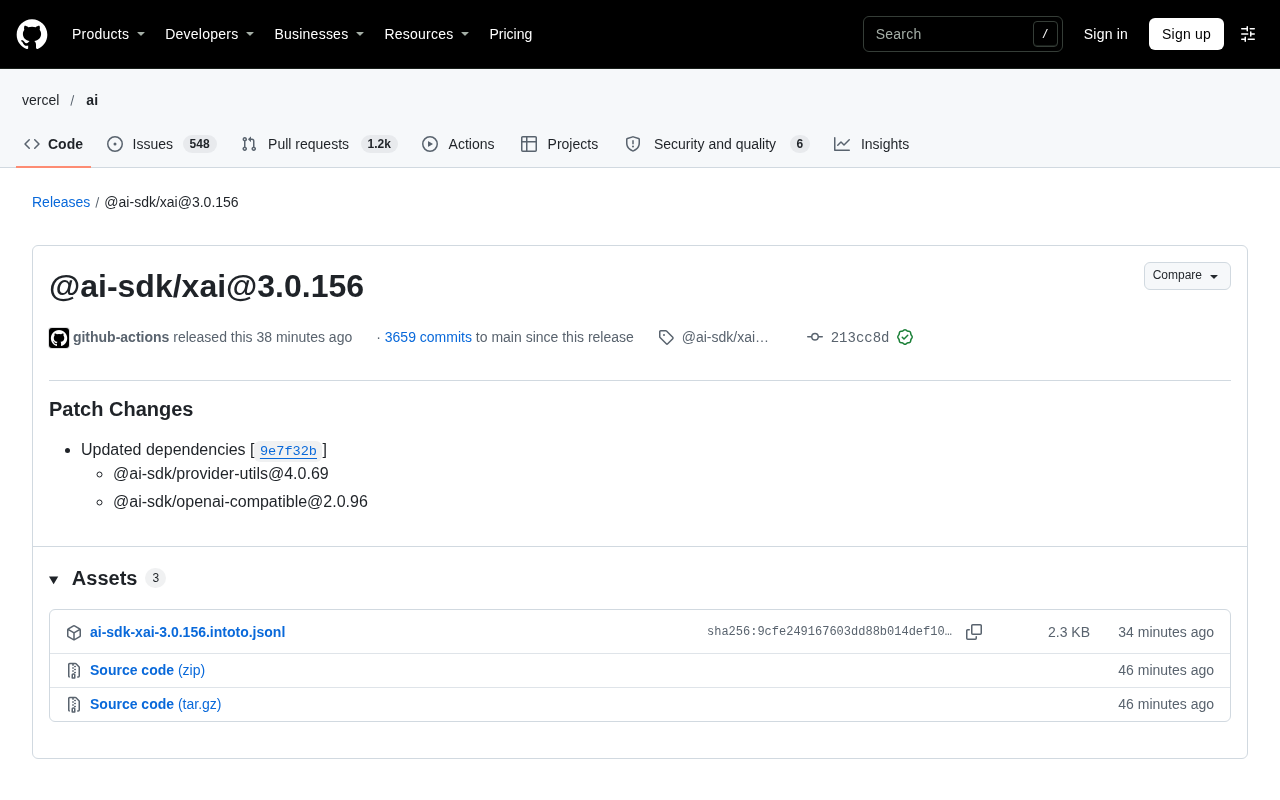
@ai-sdk/xai 3.0.156 Released: The Ecosystem Significance of Dependency Synchronization
@ai-sdk/xai 3.0.156 released as a patch update, syncing @ai-sdk/provider-utils 4.0.69 and @ai-sdk/openai-compatible 2.0.96. This article explains the ecosystem significance of dependency synchronization and upgrade advice for developers.

Surge of Ask HN Posts on Hacker News Raises Community Concerns
A "Tell HN: Lots of Ask HNs again" post appears on Hacker News, with users discussing how the rise of Ask HN question posts affects the platform's content structure, community governance, and ranking mechanisms.