Adobe and Google Deep Integration: PDF Editing and AI Creation Tools Seamlessly Integrated
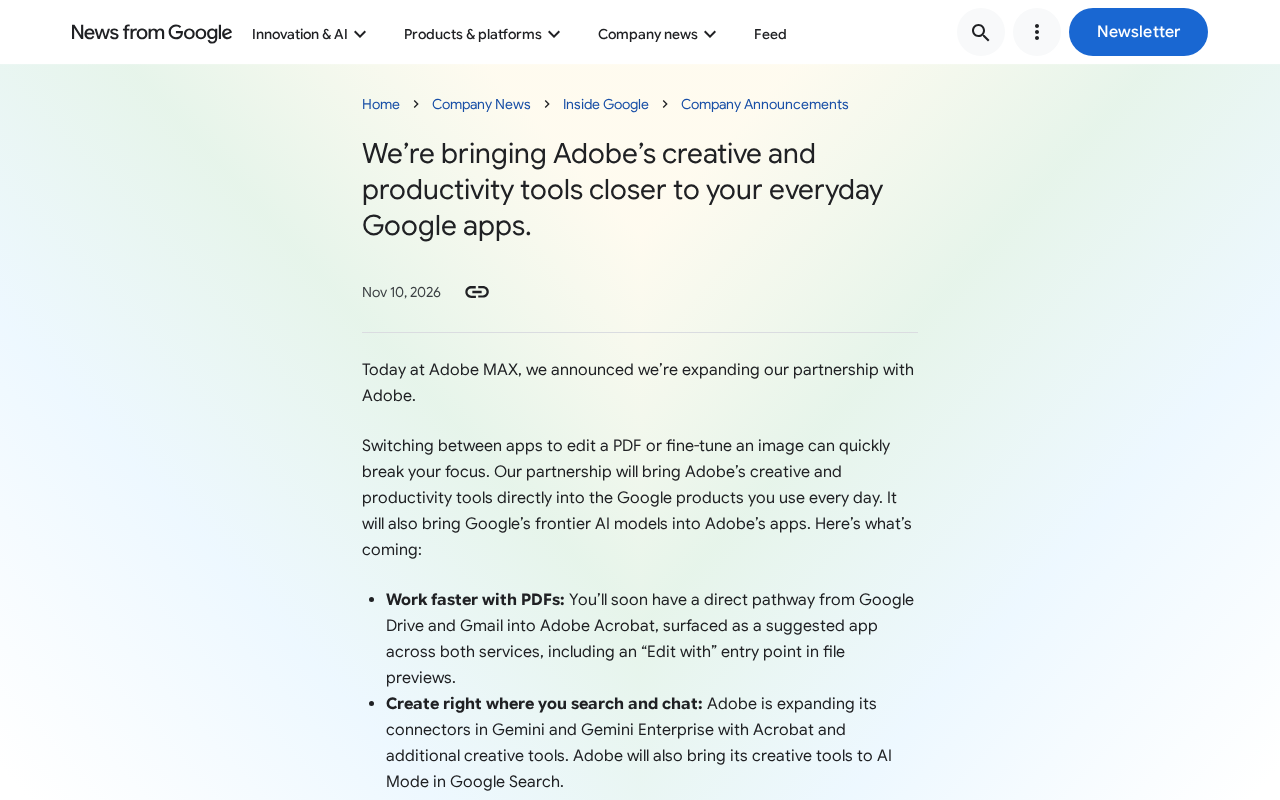
Adobe and Google connect workflows, bringing PDF editing into Drive and Adobe AI into Gemini.
Adobe and Google announced an integration allowing users to edit PDFs directly in Google Drive without downloading and switching to external tools like Acrobat, and to invoke Adobe's creative and document-processing AI capabilities within Gemini's chat interface. The article argues both integrations point to the same logic: embedding professional capabilities into high-frequency scenarios to reduce hidden costs such as re-login, format conversion, and version confusion caused by cross-app switching. From an industry perspective, Gemini is evolving from a Q&A bot into an aggregation layer for scheduling professional tools, and integration between professional software vendors and platform ecosystems may influence users' actual choices more than pure feature competition. Currently, official disclosures focus on capabilities; specific availability, rollout pace, and account region requirements have not been fully detailed.
Adobe and Google are pushing creative and productivity tools into the Google apps people use every day. According to a Google official blog post, the partnership lets users edit PDFs directly in Google Drive and use Adobe's AI capabilities within Gemini. This isn't a simple feature add-on—it's two major productivity ecosystems connecting at the underlying workflow level.
Partnership Core: PDF Editing and AI Capabilities Embedded
The two key touchpoints of this integration both target users' highest-frequency use cases.
Edit PDFs Directly in Google Drive
In the past, opening a PDF in Drive typically only allowed preview; editing required downloading the file, switching to Adobe Acrobat or another tool, then uploading it back to Drive. The new integration embeds PDF editing capabilities directly into the Drive interface, reducing the friction of shuttling files between apps. For teams accustomed to collaborating with Google Workspace, this means the document processing chain is significantly shortened.
PDF (Portable Document Format) is a document format introduced by Adobe in 1993, originally designed to keep document layout consistent across different devices. Because of its cross-platform stability, PDF has become the de facto standard for formal documents such as contracts, invoices, and reports. However, PDF was designed for "final presentation" rather than "editability"; its text, images, and fonts are often compressed or embedded as fixed layouts, and direct editing requires reverse-engineering the document structure—a technical barrier far higher than that of flow-based documents like Word. This is why PDF editing has long depended on professional tools like Acrobat and why web-based experiences have been limited. Embedding PDF editing in Drive means Google and Adobe need to accomplish PDF parsing, layer reconstruction, and incremental saving within the browser—not just a simple wrapper.
Call Adobe AI within Gemini
The other capability is integrating Adobe's AI tools into Gemini. Users can invoke Adobe's creative and document-processing capabilities right in Gemini's chat interface without switching to Adobe apps. The logic behind this: AI assistants are becoming a unified entry point, and the capabilities of professional tools are being aggregated as "plugins."
According to the Google official blog, the goal of this partnership is to "bring Adobe's creative and productivity tools closer to the Google apps you use every day." The wording is restrained, but the direction is clear—embed professional capabilities into high-frequency scenarios rather than requiring users to leave high-frequency scenarios for professional capabilities.
Adobe's generative AI system centers on the Firefly series of models, primarily covering creative tasks such as text-to-image, image expansion, generative fill, and style repaint, with an emphasis on licensed and compliant training data, claiming safe use in commercial scenarios. In addition, Adobe extends AI capabilities to document processing, such as intelligent summarization, Q&A, and structured extraction of PDF content. Integrating such capabilities into third-party assistants via APIs or plugins is one of Adobe's strategies in recent years to advance the "platformization of AI capabilities." For Gemini, integrating external professional models avoids the cost of developing all vertical capabilities in-house; for Adobe, it reaches a broader user base without requiring users to install Creative Cloud.
Why This Integration Deserves Attention
Workflow Fragmentation Is a Real Pain Point
Modern knowledge workers' daily routines often span multiple apps: email in Gmail, documents in Docs, design in Adobe, and storage in Drive. Every cross-app jump comes with the risk of re-login, format conversion, and version confusion. The Google-Adobe integration is essentially about reducing these hidden costs. PDF editing entering Drive and Adobe AI entering Gemini both turn "must switch" into "done in place."
AI Assistants Are Becoming a Capability Aggregation Layer
Gemini integrating Adobe AI reflects a broader trend: AI assistants are no longer just Q&A bots but are gradually evolving into a scheduling layer that invokes various professional capabilities. Users don't need to remember which feature is in which software—they just describe their intent to the assistant. For Adobe, this means its AI capabilities gain a traffic entry point in the Google ecosystem; for Google, Gemini's capability boundaries are expanded, and user stickiness increases accordingly.
The typical implementation of AI assistants as a "capability aggregation layer" is the function calling and tool use mechanism: after identifying user intent in a conversation, the large model automatically selects and invokes external service interfaces, then organizes the results into a natural language reply. This architecture allows the assistant to not have all features built-in but to act as a dispatcher, invoking professional tools as pluggable capability units on demand. The cost is reliance on stable APIs, clear permission boundaries, and data flow specifications—how user documents are encrypted between Google and Adobe and whether they are used for model training often determines whether enterprises can adopt it. This is also the compliance aspect that receives the most attention when such cross-ecosystem integrations are implemented.
Complementarity of the Two Ecosystems
Google's strength lies in collaboration and cloud infrastructure; Adobe's strength lies in the professional depth of creative tools and document processing. Their user bases overlap heavily, but previously they operated independently. This integration doesn't require users to migrate platforms but builds bridges between existing apps, lowering the adoption barrier.
Practical Impact on Users and the Industry
For ordinary users, the most direct change is that handling PDFs no longer requires installing or subscribing to separate desktop software; the editing entry point in Drive lowers the barrier to use. For teams, files can be modified without leaving Drive, version management is more centralized, and collaboration chains are shorter.
From an industry perspective, this partnership also provides a sample: integration between professional software vendors and platform ecosystems may determine users' actual choices more than pure feature competition. When professional capabilities are embedded in apps users already open every day, the "open rate" advantage of standalone tools is weakened, while the ecosystem's "time spent" advantage is amplified.
Currently, official disclosures focus on capabilities; specific availability, rollout pace, and account requirements have not been fully detailed. Before trying it, users should check whether their region and account type are within the supported range.
Summary
This Adobe-Google integration embeds PDF editing and Adobe AI into Drive and Gemini respectively, pointing in the same direction: put professional capabilities where users already are. For users, it's workflow simplification; for the industry, it's another confirmation of the ecosystem integration trend.
Related articles
Claude Fable 5.2 Hands-On: Top Intelligence but Absurdly Expensive
Anthropic releases Claude Fable 5.2 and Mythos 5.2, topping the Artificial Analysis intelligence leaderboard with big gains in scientific reasoning, strong game and hardware design, but max mode costs ~$26.54 per task. Hands-on game, circuit board design, and pricing advice.

1,000 AI Agents Formalize Fermat's Last Theorem in 30 Hours, Anthropic Releases New Claude Models
Anthropic releases Claude Fable 5.2 and Mythos 5.2: 1,000 agents formalize Fermat's Last Theorem in 30 hours, coding costs halved, plus hardware design and physics.

Claude Fable 5.2 Released: A Thousand AI Agents Build a Bootable OS in 8 Days
Anthropic releases Claude Fable 5.2 and Mythos 5.2—same model, two safety tiers. Demo shows 1,000 AI agents build a bootable OS in 8 days, formalize Fermat proof in 30 hours, score 64.6 beating Gemini 4 Carbon, price cut 20%.