After Posting to Hacker News, My Site Was Flooded by AI Crawlers
A developer posted to Hacker News and was flooded by AI training crawlers, crashing their site—revealing a new dilemma for independent site operators in the AI era.
After a developer shared their project on Hacker News, their website was scraped by a flood of AI training crawlers at near-DDoS levels, far exceeding normal traffic. Unlike traditional search engine crawlers, these AI crawlers often ignore robots.txt, don't throttle their crawl rates, are hard to identify, and tend to scrape entire sites. HN's popularity signal gets recognized by crawler systems as a high-value target, creating a traffic amplification effect that forces independent developers to bear both real user spikes and crawler burdens simultaneously. The article outlines three categories of countermeasures—server-level (CDN bot management, rate limiting), content-level (robots.txt optimization, content poisoning), and community-level—and points out that clear legal norms for AI training data acquisition are lacking, leaving website operators facing a deep cost-benefit mismatch.
A developer shared a link to their project on Hacker News, only to have their website pushed to the brink of collapse by a flood of AI crawlers in a matter of minutes. This is not an isolated incident—it's a new kind of traffic predicament facing independent website operators in the AI era.
Incident Recap: A Traffic Avalanche Triggered by a Single HN Post
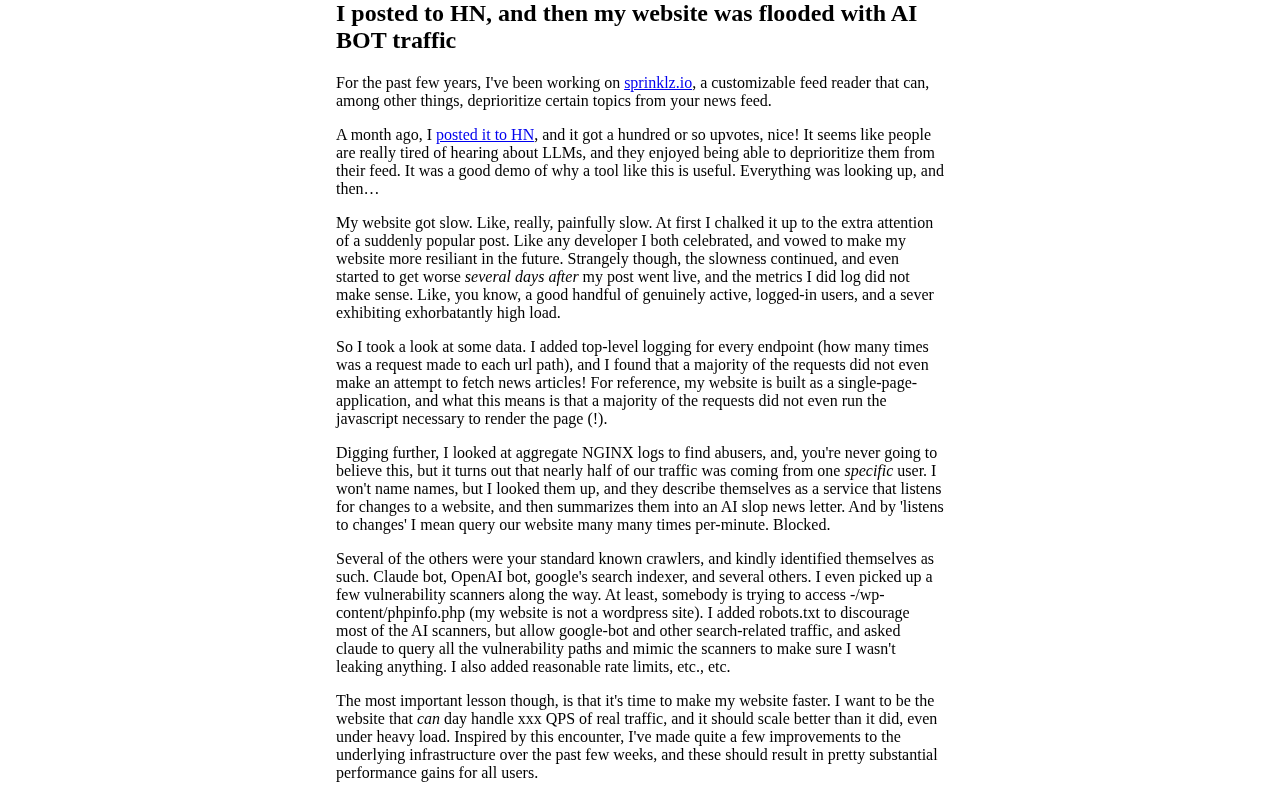
The developer published an article or tool introducing their website on Hacker News (HN for short). As a bellwether for the global tech community, HN did bring in a large surge of real user visits within a short period. But what happened next was unexpected: the site's access logs showed that the massive volume of requests was not coming from human readers, but from a variety of AI training crawlers.
These crawlers behave in ways that are fundamentally different from traditional search engine spiders like Googlebot. They don't honor robots.txt conventions, they don't self-throttle their request rates, and they scrape website content with an intensity that borders on a DDoS attack.
For independent developers, this means a double blow: on one hand, they must handle the normal traffic spike from HN, and on the other, they must absorb the additional burden from AI crawlers. Many small websites run on server configurations that simply cannot withstand this level of concurrent requests.
The Fundamental Differences Between AI Crawlers and Traditional Crawlers
The core purpose of traditional search engine crawlers is to index web content so it can be displayed to users in search results. They typically:
- Respect the robots.txt protocol
- Throttle their crawl rates to avoid putting excessive pressure on target sites
- Identify themselves in their User-Agent
- Provide webmaster tool documentation for site administrators
But the AI training crawlers that have emerged en masse present an entirely different ecosystem. Their goal is to collect as much training data as possible, not to provide search services to users. This leads to:
Disregard for website resources. Some AI crawlers don't read robots.txt, or even if they do, they don't comply. They don't consider a site's capacity when crawling.
Identity masking and ambiguity. Many AI crawlers have vague User-Agent information, making it very difficult for site owners to determine whether a visitor is a human user or a bot.
Astonishing crawl depth. Unlike search engines that mainly crawl key pages, AI crawlers tend to scrape every link and every piece of content on a website.
This disparity puts website operators in a passive position. You can't communicate with the operators of these crawlers through conventional means, nor can you predict when they might suddenly launch a large-scale crawl.
robots.txt is a plain text file located in a website's root directory. Since 1994, it has been voluntarily adopted by the search engine industry to tell crawlers which pages can be crawled and which should be avoided. It is not a technically enforced mechanism—servers do not actively block requests that violate the declaration, relying entirely on the crawler's voluntary compliance. For a long time, mainstream search engines (Google, Bing, etc.) have generally followed the protocol strictly because they need to maintain good relationships with the web ecosystem. However, AI training crawler operators have no such reciprocal relationship with websites: they don't depend on search result referrals, so they aren't bound by the industry tacit agreement behind robots.txt. This is the crux of the current controversy—a mechanism built on a "gentlemen's agreement" becomes nearly ineffective when facing new players with no incentive to comply.
Why HN Became the "Trigger" for AI Crawlers
Hacker News's influence in the tech community makes it a unique traffic gateway. When a post hits the HN front page, it receives a large number of clicks and discussions from real users. But at the same time, AI crawler operators also closely monitor high-value content sources like HN.
Once a link gains attention on HN, crawler systems identify it as a "worth crawling" target. The logical chain from there is clear: an HN popularity signal triggers a crawler priority boost, crawlers concentrate their visits on the target website, and the site slows down or even goes down due to traffic overload.
This creates a paradox: developers voluntarily share content on HN to gain exposure, but that exposure may actually render their site unusable due to AI crawler intervention. For independent projects relying on HN to acquire their first batch of users, this paradox is especially lethal.
Strategies Website Operators Can Adopt
Facing the onslaught of AI crawlers, website operators are not entirely powerless. Here are some measures that have been gradually proven effective in practice:
Server-Level Protection
Using CDN services with bot management features, such as Cloudflare, allows filtering before requests reach the origin server. Cloudflare's Bot Fight Mode and Super Bot Fight Mode can identify and block some malicious crawler traffic. For independent developers on a tight budget, Cloudflare's free tier already provides basic protection.
Configuring rate limiting is also essential. Through reverse proxies like Nginx or Caddy, you can restrict request frequency from a single IP or IP range, returning a 429 status code when the threshold is exceeded.
Rate Limiting is a mechanism that controls the number of requests per unit of time on the server side. Common implementations include: token bucket algorithms based on IP address (allowing N requests per second, with excess requests queued or rejected), sliding window counting (e.g., no more than 100 requests per minute), and differentiated policies for specific paths or User-Agents. Nginx's limit_req module and Caddy's built-in rate limiting directives can implement basic versions. The key parameter is "burst tolerance"—setting it too strictly will inadvertently affect normal users' concurrent loading, while setting it too loosely won't stop crawlers. In practice, you typically need to combine log analysis to first observe the normal traffic baseline, then set thresholds accordingly, and pair them with 429 status codes and Retry-After response headers to encourage compliant crawlers to slow down.
Content-Level Strategies
Some site owners have begun adopting "content poisoning" strategies, returning meaningless or misleading content to known AI crawlers. This approach is ethically controversial, but it is widely discussed in the tech community.
A gentler approach is optimizing robots.txt to explicitly disallow AI training crawlers from scraping. Although compliance depends on the crawler operator's voluntary cooperation, this at least provides a basis for potential future legal or industry regulations.
So-called "Content Poisoning / Prompt Injection" refers to websites returning page content embedded with hidden instructions or false information when AI crawlers are detected. The principle is: if crawlers use this data for model training, it may contaminate the training corpus—at best degrading model output quality, at worst inducing specific behaviors in the model. The tech community is deeply divided on this—supporters view it as legitimate self-defense against unauthorized scraping, while opponents point out that it could affect legitimate research, harm the public data ecosystem, and is difficult to precisely distinguish between "malicious AI crawlers" and "benevolent indexers." Additionally, this strategy may violate computer fraud laws in some jurisdictions. Currently, it is more of a gesture of protest than a mature engineering solution.
Community-Level Action
The HN community itself is also discussing this issue. Some developers have begun publicly sharing their AI crawler traffic data to push the industry toward greater awareness. This collective action may ultimately lead to more standardized crawler codes of conduct.
The Bigger Picture: Where Are the Boundaries for AI Training Data Acquisition
This incident reflects a fundamental unresolved question: where are the boundaries of AI companies' rights to acquire training data?
The current legal framework for regulating web crawlers is incomplete. Traditionally, crawler issues have been governed mainly through the robots.txt protocol and website terms of service, but these are industry conventions rather than legal mandates. As the demand for AI training explodes, the binding force of industry conventions has become increasingly weak.
From the perspective of website operators, the content they create is being scraped for free by AI companies for model training, yet they must bear the resulting server costs and security risks themselves. This mismatch between costs and benefits is at the heart of the current controversy.
Some content creators have begun to organize, demanding that AI companies pay reasonable fees for acquiring their training data. But in the absence of clear legal grounds, individual website operators have very limited bargaining power.
Takeaways for Independent Developers
This incident serves as a wake-up call for independent developers. In the current internet environment, simply deploying a website online is no longer enough—you also need to consider the traffic risks posed by AI crawlers in advance.
A few specific suggestions: configure CDN and rate limiting before launching your project; monitor your site for abnormal traffic patterns and distinguish between human visits and bot visits; and where conditions allow, consider using protection services specifically designed for AI crawlers.
More fundamentally, independent developers need to realize that in the AI era, traffic no longer equals users. You think the visits brought by HN are potential users, but a significant portion of them may just be data collectors for AI companies. This shift in perception is crucial for correctly evaluating the effectiveness of your project's promotion.
Related articles

CSS Anchor Positioning: A New UI Positioning Approach Without JavaScript
A deep dive into CSS Anchor Positioning: from anchor-name and position-anchor to the anchor() function, position-area shorthand, position-try-fallbacks, anchor-size, and upcoming anchor queries.

New AI Chart Interaction: Continuous Follow-up Questions and Visualization in Conversation
Explore a new AI interaction method for continuously generating charts in conversation. Use the /visualize command to ask follow-up questions and visualize answers in the same chat window, improving data analysis efficiency.

Cursor Merges Into X Subscription: Paid Plans Share Unified Usage Pool, Grok Model Coding Usage Doubled
Cursor joins The X Subscription with a unified usage pool and doubled Grok coding quota. Third-party models shift to API pricing. Existing users can keep or migrate plans.