Agent Engineer Learning Roadmap: From Zero to Production-Ready Deployment
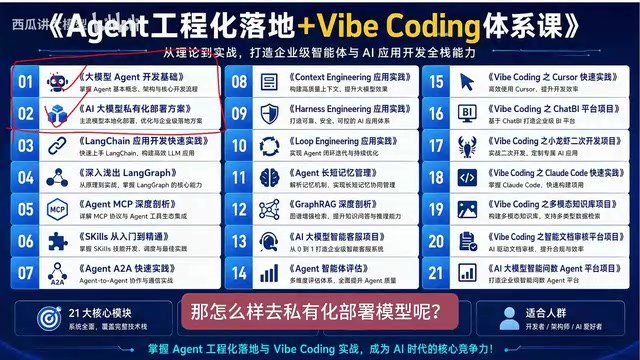
A production-focused Agent engineering course built around LangGraph, MCP, GraphRAG, and Vibe Coding methodology.
Designed by a team with four years of LLM startup experience and 130+ deployed projects, this Agent engineer course argues that the real barrier isn't building agents — it's shipping them reliably. The curriculum splits into two tracks: the first uses LangGraph as its core framework, covering MCP/A2A protocols, context/control/loop engineering, GraphRAG, and a 100,000-line intelligent customer service capstone; the second focuses on Vibe Coding with Cursor and Claude Code, emphasizing legacy codebase transformation and a transferable methodology over specific tools. Suitable for beginners, career switchers, students, and job seekers.
From Big Data to AI: One Practitioner's Bet on the Future
This Agent engineer learning roadmap comes from a team lead who has spent nearly four years building AI/LLM startups. According to the author, the team has served over 70 companies and delivered more than 130 large model application projects. That kind of hands-on track record shapes the entire curriculum — it leans heavily toward production engineering rather than concept demos.
Two core convictions drive the course design: first, that every programmer will eventually be an Agent developer, and the real barrier isn't "can you build an agent" but "can you ship it in a production-grade way"; second, that AI-assisted programming (Vibe Coding) is fundamentally reshaping how developers work. These two convictions form the backbone of the curriculum — the first half covers agent engineering, the second half covers AI programming methodology.
Agent Engineering: From Fundamentals to Frameworks
The first two modules lay the groundwork. Module one covers LLM pre-training principles and how to build agents by calling model APIs. Module two addresses private deployment solutions for enterprises with strict data security requirements.
The real focus, however, is on development frameworks. The author notes that while LangChain and LangGraph have officially merged on the surface, they're still treated separately in practice. LangChain is covered relatively quickly and woven into later project work, while LangGraph — the core tool for building single-agent and multi-agent systems — gets a thorough, dedicated breakdown. This prioritization reflects the team's judgment from real-world deployments.
Built on top of these frameworks, the course covers three key deployment solutions: MCP, Skills, and A2A. The author describes all three as critical technical protocols in today's agent deployment landscape and promises in-depth coverage.
Background: MCP (Model Context Protocol) is an open protocol introduced by Anthropic to standardize how large models interact with external tools and data sources — think of it as the "USB standard" for AI applications. A2A (Agent-to-Agent) is Google's inter-agent communication protocol that allows agents to discover each other, delegate tasks, and pass results — the foundational infrastructure for multi-agent systems. Skills typically refers to how agent capabilities are packaged: wrapping specific functions (search, computation, API calls) into reusable capability modules. Together, these three form the mainstream protocol layer for agent deployment today: MCP solves model-to-tool connectivity, Skills solves modular capability reuse, and A2A solves agent-to-agent collaboration.
Three Engineering Methodologies: Context, Control, and Loop
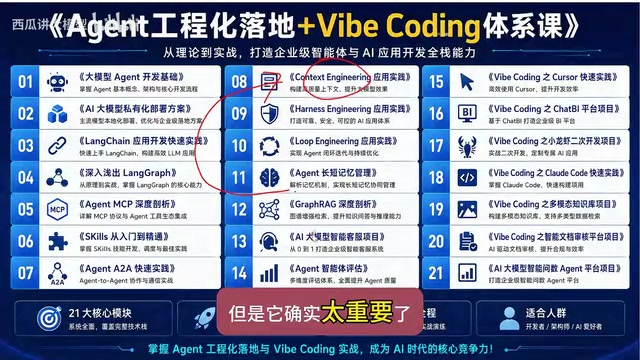
One notable design choice in the course is treating "engineering" as its own dedicated topic. The author introduces three engineering frameworks:
- Context Engineering: Focused on building high-quality context to improve LLM output quality — one of the most widely discussed directions in Agent development today.
- Control Engineering (驾驭工程): Addresses how to keep agents running stably, reliably, and safely over extended periods.
- Loop Engineering: Enables agents to iterate in a closed loop — continuously optimizing and self-improving.
These three methodologies are positioned as hard-won lessons from real project work, not just a stack of technologies. Around context engineering specifically, the course includes a dedicated module on agent long-term and short-term memory management — technically an extension of context engineering, but treated as a standalone topic given its importance, with hands-on implementation included.
On the RAG front, the course focuses on the RAG + Knowledge Graph (GraphRAG) approach. Based on the team's deployment experience, the author judges this combination to deliver meaningfully higher accuracy, while also laying the technical groundwork for subsequent projects.
Background: GraphRAG is an enhanced RAG approach proposed by Microsoft. Its key improvement over traditional RAG is incorporating knowledge graph structures alongside vector retrieval. Standard RAG retrieves text chunks by vector similarity but struggles to capture relationships between entities or multi-hop reasoning chains. GraphRAG first extracts entities and relationships from documents into a graph structure; during retrieval, it can leverage both vector similarity and graph edge traversal for relational reasoning — significantly improving accuracy on multi-hop QA tasks. The tradeoff is higher cost to build and maintain the knowledge graph, making it best suited for enterprise knowledge bases where accuracy is critical and the document corpus is relatively stable.
Project-Driven Learning: A 100,000-Line Intelligent Customer Service System
The first major engineering project is a LLM-powered intelligent customer service system. The rationale for choosing this use case is its universality — the deployment patterns and techniques learned here transfer cleanly to other projects.
This is not a demo. It's a full production implementation exceeding 100,000 lines of code, walking students through requirements analysis, architecture design, skill assessment, tech stack selection, model stress testing, and all the way through to deployment, testing, and go-live. The entire flow covers the complete lifecycle of a real agent project from scratch to production.
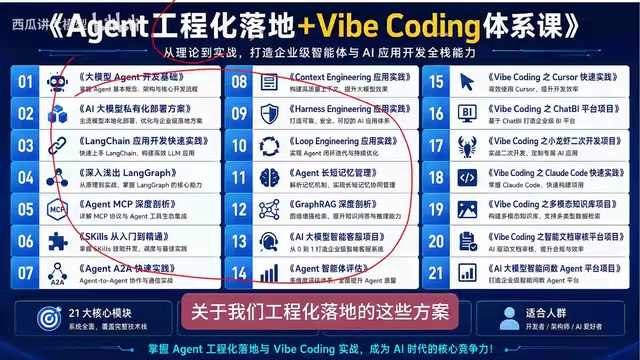
The course wraps up this section with a point the author emphasizes as easy to overlook: agent evaluation. Finishing development doesn't mean you're ready to ship. Evaluation is both a course highlight and a genuine challenge — and it matters enormously for developers who care about production stability.
AI Programming: Greenfield Development and Legacy Codebase Transformation
The second half of the course focuses on Vibe Coding (AI-assisted programming), also delivered through a project-driven approach. The author deliberately designs for different project scenarios:
One type is greenfield development — for example, a menu-editing project that simulates building an agent from scratch. The other type is legacy codebase transformation — taking an existing project with hundreds of thousands of lines of code (like a crawfish ordering system) and applying AI programming techniques to it. This design directly addresses a real pain point: most real-world projects aren't built from scratch, but iterated on top of massive existing codebases.
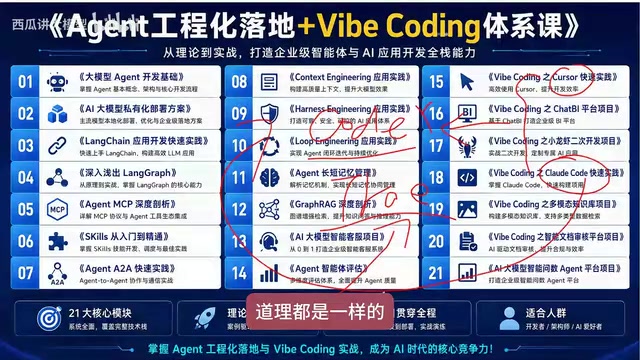
The course highlights two primary tools — Cursor and Claude Code — but the author repeatedly stresses that the real deliverable is the AI programming methodology, not the tools themselves. Once you internalize the methodology, switching to Codex, the domestic tool Trae, or any other tool is straightforward — the underlying logic is the same. The course closes with a comprehensive capstone project of over 100,000 lines that, according to the author, has high reuse value in the industry and is strong material for a résumé.
Background: Vibe Coding is a concept introduced by OpenAI co-founder Andrej Karpathy in early 2025, describing a development mode driven by natural language intent where AI automatically generates code. Developers take on more of a "director" role — describing requirements, reviewing output, and iterating through feedback — rather than writing code line by line. Cursor is one of the most representative Vibe Coding tools today, deeply integrating LLM-powered code completion, multi-file editing, and contextual understanding. Claude Code is Anthropic's command-line AI programming tool, particularly strong at handling complex multi-file codebases. The course's emphasis on "methodology over tools" reflects a key insight: tools evolve rapidly, but the mental framework for decomposing tasks, managing context, and validating AI output has a much longer shelf life.
Who Is This Course For?
The course is positioned for a fairly broad audience:
- Complete beginners: The course starts from zero — no prior LLM experience required.
- Practitioners with some background but limited project depth: Developers looking to sharpen their LLM development skills.
- Career switchers: Especially frontend, Java, QA, and DevOps engineers looking to transition into agent development — the structured curriculum and heavy project load suit this need well.
- University students and graduate students: Looking to strengthen project experience and job market competitiveness.
- Job seekers: The author's view is that landing a job ultimately comes down to résumés and projects — interviewers care about whether your projects are impressive and whether there are interesting technical points to discuss. Projects in the course — including the intelligent customer service system, smart document processing, intelligent Q&A, and multimodal knowledge base — are all résumé-worthy.
Summary
This course has a clear thesis: build two core competencies — production-grade agent engineering and AI-assisted programming — using real, large-scale projects to connect the technical stack of LangGraph, MCP, A2A, context engineering, and GraphRAG. Compared to courses that focus purely on theory, it places stronger emphasis on production stability, evaluation, and legacy codebase transformation — the hard parts of real-world work. For anyone looking to enter Agent development, this kind of roadmap offers genuine reference value. That said, its promotional nature is worth keeping in mind — actual teaching quality should be assessed based on the course content itself.
Related articles
From Enterprise Practice to a Reusable Template: Lessons from Building an AI Agent
A developer shares an open-source AI Agent template built from an enterprise project, covering natural language data Q&A, analysis, auto-generated PPTs, and email distribution.
Nintendo's Open-World Design Evolution: Breaking Down Fire Emblem Fortune's Weave
Nintendo brings the open-world design philosophy of Breath of the Wild to Fire Emblem with the massive Switch 2 title Fortune's Weave. Here's what it means.
AI-Generated Food Photos Are Ruining Menus: How the Uncanny Valley Kills Appetite
AI-generated food images are flooding restaurant menus and delivery apps, but uncanny details kill appetite instead of sparking it. Here's why the uncanny valley effect hurts brands.