agent-mcts: Adding Monte Carlo Tree Search to Claude Code
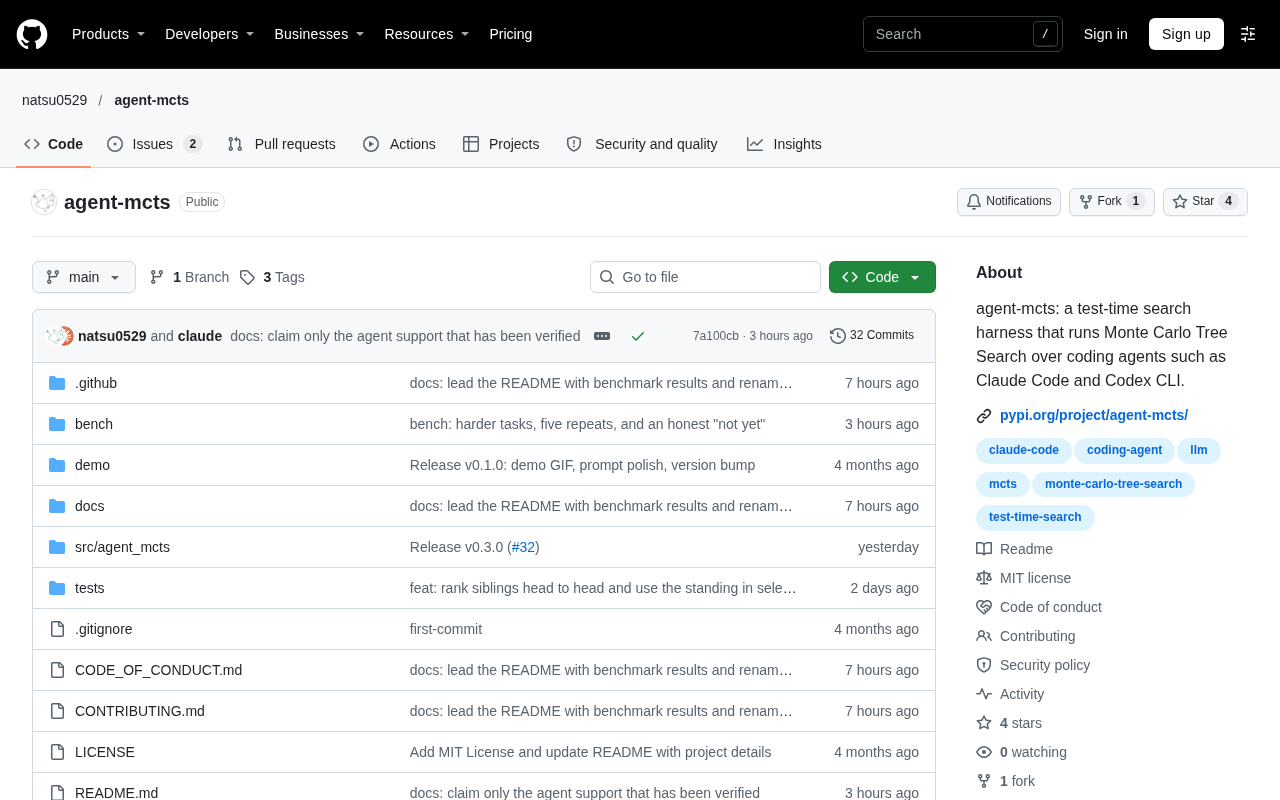
agent-mcts layers MCTS on top of Claude Code, turning coding agent action selection into an explicit search problem.
The article introduces agent-mcts, a new Show HN project on Hacker News that introduces Monte Carlo Tree Search on top of Claude Code, turning a coding agent's "what to do next" decision from single-step greediness into explicit search. It analyzes why: programming tasks have strong long-range dependencies and irreversible operations, and traditional ReAct-style linear advancement easily falls into local optima; MCTS builds a search tree through selection, expansion, simulation, and backpropagation, enabling fuller comparison among candidate actions but incurring extra model invocation costs. Using Claude Code as the foundation reuses its code understanding and tool invocation capabilities, but branch-heavy search challenges existing interfaces and state snapshots. With only 5 points and 0 comments and no public evaluation, the author recommends tracking it as a sample of the "search-enhanced agent" direction, using reproducible evaluation, cost and latency, and state representation as three observation metrics.
As AI coding assistants rapidly gain adoption, how to move code generation from "one-shot output" toward a "searchable decision process" has become a new direction of exploration in the developer community. A project called agent-mcts appeared in the Show HN section of Hacker News, and its core idea is to layer Monte Carlo Tree Search (MCTS) on top of Claude Code, turning the action selection of a coding agent into an explicit search problem.
Project Positioning: Bringing a Search Algorithm into the Coding Agent
The name agent-mcts already makes its technical path clear: agent refers to the coding agent, and MCTS is Monte Carlo Tree Search. This algorithm is well known in game-playing AI, and its defining feature is that it evaluates the long-term payoff of different branches through extensive simulated sampling rather than relying on single-step greedy decisions. By choosing to build on top of Claude Code, the project means that the underlying code understanding, tool invocation, and file editing capabilities are still provided by Claude Code, while agent-mcts is responsible for the decision layer of "what to do next."
Based on the disclosed information, this is a typical early-stage Show HN project: it received 5 points at launch with no comments yet. Projects like this are usually open-sourced by individual developers or small teams during experimental exploration, and their value lies more in inspiring ideas than in maturity. It reflects a trend worth watching—competition among agent frameworks is shifting from "which model to integrate" to "how to organize reasoning and action."
Why MCTS: The Structural Difficulty of Agent Decision-Making
The essential difference between programming tasks and casual conversation is that programming involves a large number of long-range dependencies and irreversible operations. Edit the wrong file or delete the wrong piece of code, and subsequent steps may require multiplied cost to fix it. Traditional ReAct-style agents advance linearly through "thought—action—observation," evaluating only the current best solution at each step, which makes them prone to getting stuck in local optima or going further and further down a wrong branch.
MCTS is introduced precisely to alleviate this problem. Through the four stages of selection, expansion, simulation, and backpropagation, it builds a search tree in the action space and uses simulation results to update the value estimates of each node in reverse. In theory, this allows the agent to compare multiple candidate actions more thoroughly, making it especially suitable for programming scenarios where multiple viable repair paths exist and trade-offs are needed. Of course, the extra model invocation cost brought by search is also a real price, and whether the project can strike a balance between effectiveness and cost currently has no public evaluation data to judge by.
The ReAct pattern is the reasoning framework adopted by most current coding agents, with the full name Reasoning and Acting. It has the model alternately generate "Thought" and "Action" at each step, and then decide the next step based on the "Observation" returned by the environment, forming a linear trajectory. This pattern is simple in structure and easy to implement, but its decisions are greedy—the model selects only the action that looks optimal based on the current context, does not actively explore other possibilities, and has no backtracking capability. Once a step is chosen incorrectly, subsequent steps can only rely on the model to notice and remedy it on its own, and errors easily accumulate in long-range, multi-file programming tasks. MCTS and ReAct are not mutually exclusive; the former can be seen as adding a layer of forward-looking evaluation to the action-selection stage of the latter, replacing single-step greedy judgment with statistical results from multiple simulations.
The four stages of MCTS are specifically: Selection, which moves down from the root node along the tree policy, prioritizing nodes that are "high in exploitation value and underexplored," commonly using the UCT formula to balance the two; Expansion, which adds one or more candidate actions as child nodes at a leaf node; Simulation/Rollout, which quickly runs through a path starting from the new node to obtain an outcome estimate; and Backpropagation, which passes the simulation result back along the path to update the visit counts and average values of the nodes along the way. For coding agents, the simulation stage is usually completed through LLM reasoning or lightweight execution, so every search step generates additional model calls—this is the fundamental reason why search-enhanced approaches cost significantly more than linear agents, and it is also a metric that must be watched when evaluating such projects.
The Two Sides of Claude Code as a Foundation
Using Claude Code as the underlying execution engine is a key architectural choice of this project. Claude Code itself has strong capabilities in codebase understanding, command execution, and multi-file editing, providing reliable action primitives for the upper-layer search. Developers do not need to build the tool invocation layer from scratch and can focus their energy on search strategy and state representation.
The other side is coupling risk. The search layer needs to frequently obtain intermediate states, roll back, or fork execution paths, while Claude Code's interaction interface may not be designed for this kind of high-frequency, branch-heavy invocation pattern. How to achieve efficient state snapshots and branch management under existing interface constraints is very likely the core engineering problem the project needs to solve. The source material does not disclose specific implementation details, which also reminds readers: architectural descriptions at the Show HN stage tend to be conceptual, and actual usability remains to be verified at the code level.
State snapshots and branch management are key engineering requirements that distinguish search-based agents from linear agents. MCTS needs to preserve multiple parallel candidate paths at the same moment and be able to restore the workspace to a historical node during backtracking before trying another branch. For a codebase, this means versioning the file system, command execution side effects, and dialogue context separately: files can be isolated with git branches or temporary worktrees, command side effects need to be sandboxed, and context must be trimmable and replayable by node. If the underlying interface supports only unidirectional, stateful sessions, implementing these capabilities will be very costly. This is also an implicit benchmark for judging the engineering maturity of agent-mcts—the source material does not mention related mechanisms, so readers should treat them as items to be verified.
Community Signals and Viewing Perspective
The initial feedback of 5 points and 0 comments indicates that the project has not yet entered broad discussion. In the context of Hacker News, the popularity distribution of Show HN posts is highly uneven, and a cold start in the early stage does not mean low technical value; more commonly, a project needs time to accumulate use cases and documentation. For developers interested in the AI coding toolchain, agent-mcts is more worth tracking as a sample of the "search-enhanced agent" direction rather than immediately putting into production use.
To judge whether such a project is worth continued attention, three signals can be considered: whether it publishes reproducible evaluation results, whether it addresses search cost and latency issues, and whether it has formed a clear state representation scheme. These three determine whether MCTS in coding agents is merely a bonus or infrastructure that truly changes the way problems are solved.
Conclusion
agent-mcts stitches a classic search algorithm together with contemporary coding agents, pointing to a larger question: as model capabilities gradually converge, differences among agents will come more from how reasoning is organized. This project currently has limited information and shallow community feedback, but the proposition it raises is worth recording—adding a search tree to code generation may be closer to the real needs of engineering practice than simply switching to a stronger model.
One-line Summary
agent-mcts layers MCTS on top of Claude Code, turning the action selection of a coding agent into an explicit search problem.
Paragraph Summary
The article introduces agent-mcts, a new project on Hacker News Show HN whose core is to introduce Monte Carlo Tree Search on top of Claude Code, turning the coding agent's decision of "what to do next" from single-step greediness into explicit search. The article analyzes the motivation behind this idea: programming tasks have strong long-range dependencies and irreversible operations, and traditional ReAct-style linear advancement easily falls into local optima; MCTS builds a search tree through selection, expansion, simulation, and backpropagation, enabling fuller comparison among multiple candidate actions, but it brings additional model invocation costs. Using Claude Code as the foundation allows reuse of its code understanding and tool invocation capabilities, but branch-heavy search poses challenges to existing interaction interfaces and state snapshot capabilities. The project currently has only 5 points and 0 comments and lacks public evaluation; the author suggests tracking it as a sample of the "search-enhanced agent" direction and using reproducible evaluation, cost and latency, and state representation as three observation metrics.
Related articles

Anthropic Goes Public: AI Bubble or Buying Opportunity?
Anthropic lists on Nasdaq, opening about a third above its IPO price. We break down the $81.3B raise, $1.5T offering valuation, and $2T market valuation, plus Claude's growth and $567M quarterly operating loss.

Why the FBI's AI Hacker Warning Hinges on a Single Word from Microsoft
FBI says AI tool Artex attacked 2,250+ organizations, but the citation trail leads to Microsoft's wording of "attempted sign-ins." The gap between attempts and breaches reveals the attack's true scale.
Fable 5.2 Powers the Creation of Getsumen Express: A Browser-Based Lunar and Martian Exploration Game
A developer used Fable 5.2 to build Getsumen Express, a browser game where players explore the Moon and Mars, scan real landmarks, shoot aliens, and ride an interstellar train. Built on Three.js and WebGPU for about $730, it showcases AI-assisted development.