Agent Office: A Deep Dive into the Slack-like Collaboration Platform for AI Agents

Agent Office builds a Slack-like collaboration hub for AI agents, tackling multi-agent communication and orchestration challenges.
Agent Office is an emerging project that aims to create a Slack-like collaboration platform for AI agents. It addresses core challenges in multi-agent systems including structured communication protocols, shared state management, cost control through circuit breakers and token budgets, and observability for enterprise trust. Positioned within a rapidly growing space alongside OpenAI's Assistants API and Anthropic's MCP protocol, it represents the industry trend toward specialized agents collaborating to solve complex tasks.
When AI Agents Need an "Office"
As large language models take a quantum leap in capabilities, AI Agents are evolving from single-task executors into autonomous, collaborative "digital employees." An AI agent refers to a software system capable of perceiving its environment, making autonomous decisions, and executing actions to achieve goals. Early AI agents were mostly rule-driven simple automation programs, such as chatbots or RPA scripts. But as large language models like GPT-4 and Claude have demonstrated powerful reasoning, planning, and tool-use capabilities, the new generation of AI agents can understand complex instructions, decompose tasks, call external APIs, and dynamically adjust strategies based on feedback — this capability leap has transformed agents from "tools that execute single commands" into "digital employees capable of autonomously completing multi-step complex workflows," giving rise to the need for multi-agent collaboration infrastructure.
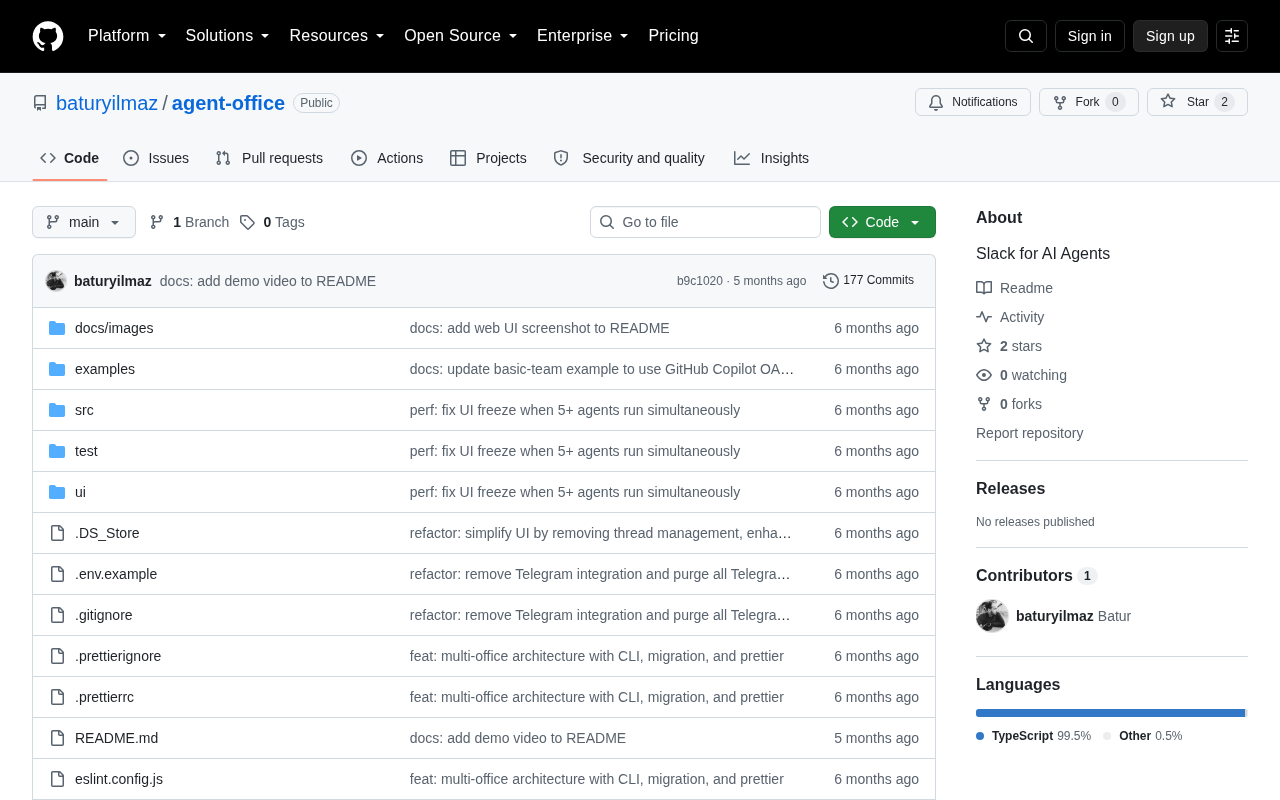
A project called Agent Office that appeared on Hacker News is targeting precisely this trend — it aims to build a Slack-like collaboration and communication platform for AI agents.
The project author positioned it on the Show HN board as "Slack for AI Agents" and candidly acknowledged that its concept is similar to another tool called Grok Bot, but that their project started earlier. While the project hasn't gained much traction yet (only 6 upvotes and 1 comment), the product thinking it reflects is worth exploring in depth.
Why Agents Need a Dedicated Collaboration Layer
Human teams need tools like Slack and Teams because distributed collaboration requires a unified hub for messages, tasks, and context. Since its launch in 2013, Slack has rapidly become the standard tool for enterprise team collaboration. Its core value lies in unifying scattered communication channels (email, instant messaging, file sharing) into a channel-centric information flow. More importantly, through its open integration ecosystem — Webhooks, Bot APIs, and the App Directory — Slack allows third-party tools to seamlessly plug in, making it the "nerve center" of workflows.
When we replace "team members" with a group of specialized AI agents, the same needs emerge:
- Message routing: How do different agents efficiently pass tasks and results between each other?
- Context sharing: How do multiple agents maintain consistent conversation state and memory?
- Observability: How do humans monitor what these agents are doing and whether they've gone off track?
- Human-AI collaboration: How do humans intervene in decisions at critical junctures?
The core proposition of Agent Office is precisely to migrate this "collaboration infrastructure" from human teams to agent teams. It chose Slack as its analogy because of this "hub-centric" product paradigm: a unified entry point connecting all participants (whether human or AI), providing traceable context and flexible workflow orchestration capabilities.
Agent Office's Product Positioning and Core Philosophy
From its naming and positioning, Agent Office is not yet another monolithic agent framework (like AutoGPT or a simple LangChain wrapper), but rather focuses on being a communication hub for multi-agent collaboration.
The Product Ambition Behind the "Office" Metaphor
Naming the product "Office" rather than simply a "chat tool" implies richer product ambitions. A real office encompasses more than just instant messaging:
- Role specialization: Different agents play different functional roles (e.g., product, development, testing, customer service)
- Workflow orchestration: Tasks flow between roles, forming complete business loops
- Persistent records: All collaboration processes are traceable and auditable
This aligns with the "Multi-Agent Systems" (MAS) direction that has been hotly discussed in academia. MAS is a classic research direction in distributed artificial intelligence, traceable back to the 1980s. Core research questions include coordination mechanisms between agents (such as Contract Net Protocol, auction mechanisms), communication language standards (such as FIPA-ACL), and how to achieve global objectives in decentralized environments.
In industry, Microsoft's AutoGen framework allows developers to define multiple LLM agents with different roles for conversational collaboration; CrewAI emphasizes "role-playing" and "task delegation" patterns; LangGraph provides graph-based state machines for orchestrating agent workflows. These frameworks each have their own focus, but collectively point to a trend: a single large model cannot handle all tasks — specialized division of labor plus collaboration is the solution for complex problems. What distinguishes Agent Office from these frameworks is its emphasis on a Slack-like interaction interface, allowing humans to intuitively understand the agents' "workspace" as if observing a real work group.
Competition with Grok Bot
The author's proactive mention of Grok Bot indicates that competitors have already emerged in this space. This is itself a positive signal — when multiple independent explorers appear in a direction, it often means there's a real market need behind it. For Agent Office, "starting earlier" is a first-mover advantage, but in terms of product maturity, ecosystem integration, and user experience, actual performance will ultimately speak for itself.
Core Technical Challenges in Multi-Agent Collaboration
Building a "Slack for agents" sounds intuitive, but faces numerous engineering challenges in implementation.
Communication Protocols and State Management
When humans use Slack, message semantics are understood by the human brain. Communication between agents, however, requires structured protocols — messages are not just text but may also include task instructions, tool call results, confidence levels, and other metadata. Designing a communication format that is both flexible and reliable is the technical core of such platforms.
In traditional distributed systems, message passing is typically based on mature middleware like RabbitMQ, Kafka, or gRPC. But AI agent communication needs to additionally carry semantic layer information: task priorities, execution constraints, input/output schemas for tool calls, confidence scores, and summaries of conversation history. The industry has not yet formed a unified standard. Anthropic's MCP (Model Context Protocol) was an early attempt to standardize the interaction between models and external tools, while OpenAI's Function Calling and Assistants API provide another paradigm. An ideal agent communication protocol needs to balance machine parsability (structured JSON/Protobuf) with human readability (for debugging and auditing), while supporting both synchronous and asynchronous communication modes.
Additionally, when multiple agents run concurrently, managing shared state and avoiding "context drift" and information inconsistency is a major challenge. This is similar to consistency problems in distributed systems, but more thorny in the AI context — because each agent's "state" includes not only structured data but also its internal conversation context window, which itself has length limits and cannot be perfectly compressed.
Cost Control and Runaway Risk Prevention
Once a multi-agent system is running, it can easily fall into the trap of "infinite conversations" — agents repeatedly exchanging messages without converging to a final result, leading to staggering token consumption and costs. Taking GPT-4 as an example, its API pricing is approximately $30 per million input tokens and $60 per million output tokens (as of mid-2024). In a multi-agent scenario, assuming 5 agents exchange 20 rounds of messages around a task, with each round averaging 2,000 tokens, a single task execution could consume 200,000 tokens, costing approximately $6-12. If the system lacks convergence mechanisms, agents may fall into "rumination loops" — endlessly restating, clarifying, or arguing without substantive progress, and token consumption could grow exponentially.
Therefore, a mature Agent Office-type product must have built-in circuit breaker mechanisms, budget controls, and human intervention points to prevent system runaway. Specific implementations typically include: round limits (Circuit Breaker), token budget allocation, task timeout termination, and semantic similarity-based "dead loop detection" — when the system detects that recent rounds of messages are highly semantically similar, it automatically triggers termination or escalation mechanisms.
Observability Is a Hard Requirement for Enterprise Adoption
For enterprise users, an AI system that cannot be monitored cannot be trusted. A Slack-style interface naturally offers observability advantages: humans can trace back every step of an agent's decision chain as easily as scrolling through chat history. This is perhaps the deeper reason Agent Office chose "Slack" as its reference point.
In production environments, observability means more than just "being able to see what happened." It also needs to support: decision attribution (why did the agent make this choice), performance bottleneck identification (which step took the longest), anomaly detection (whether agent output deviates from expected ranges), and compliance auditing (in regulated industries like finance and healthcare, every decision step needs to be explainable and traceable).
Industry Trends in the Agent Collaboration Space
While Agent Office is an early-stage project, the space it occupies is heating up rapidly. From OpenAI's Assistants API and Anthropic's MCP protocol to the emergence of various multi-agent orchestration frameworks, the industry is forming a consensus: the next phase of AI application form will be multiple specialized agents collaborating to complete complex tasks.
OpenAI's Assistants API, launched in late 2023, provides persistent Threads, file retrieval, code interpreter, and other capabilities, enabling developers to build agents with long-term memory and tool-use abilities. Anthropic's MCP (Model Context Protocol) takes a different approach — it defines an open standard that specifies how AI models discover, connect to, and call external data sources and tools, similar to building a "USB interface standard" for AI agents. MCP's open-source nature gives it the potential to become a universal protocol for agent interoperability. These two represent different ecosystem strategies: OpenAI tends toward a closed loop within its own platform, while Anthropic attempts to establish cross-platform connection standards through open protocols. Part of the value of collaboration platforms like Agent Office lies in whether they can be compatible with and bridge these different protocol ecosystems.
In this picture, "agent collaboration platforms" play a critical role akin to an operating system. Whoever can provide the most stable, easiest-to-use, and most controllable collaboration layer has the opportunity to become the infrastructure of the AI-native era.
However, we should remain clear-headed: many projects including Agent Office are still at the proof-of-concept and early exploration stage. True value validation depends on whether they can stably deliver results in real business scenarios, rather than merely remaining at the level of "cool-looking" demos.
Recommendations for Developers and Technical Decision-Makers
For developers and technical decision-makers, it's advisable to approach such tools with an observation and small-scale experimentation mindset:
- Pay attention to whether their communication protocols are open to avoid being locked into a single ecosystem. Prioritize platforms that support open protocols like MCP to ensure flexibility for future migration and interoperability.
- Focus on evaluating cost control and human intervention capabilities. Assess whether the platform provides token budget management, round limits, and clear human approval node configuration.
- Evaluate observability and debugging experience, as this directly determines production environment usability. An ideal platform should provide complete execution traces, visual agent interaction graphs, and real-time anomaly alerting mechanisms.
The "collaboration era" of AI agents is just beginning. The explorations of pioneers like Agent Office, regardless of their ultimate success or failure, are accumulating valuable practical experience for this path forward.
Related articles

CSS Anchor Positioning: A New UI Positioning Approach Without JavaScript
A deep dive into CSS Anchor Positioning: from anchor-name and position-anchor to the anchor() function, position-area shorthand, position-try-fallbacks, anchor-size, and upcoming anchor queries.

New AI Chart Interaction: Continuous Follow-up Questions and Visualization in Conversation
Explore a new AI interaction method for continuously generating charts in conversation. Use the /visualize command to ask follow-up questions and visualize answers in the same chat window, improving data analysis efficiency.

Cursor Merges Into X Subscription: Paid Plans Share Unified Usage Pool, Grok Model Coding Usage Doubled
Cursor joins The X Subscription with a unified usage pool and doubled Grok coding quota. Third-party models shift to API pricing. Existing users can keep or migrate plans.