Agent Performance Evaluation: A Three-Layer Framework and Engineering Implementation Guide

A three-layer framework for evaluating AI Agents: outcomes, execution quality, and system performance.
Unlike standard LLM benchmarking, evaluating AI Agents requires a multi-dimensional approach. This guide breaks down a three-layer evaluation framework: the outcome layer (task success), the process layer (trajectory quality, tool accuracy, self-correction), and the system layer (latency, cost, stability). It also covers three automated evaluation methods and engineering solutions to common challenges like error cascades and non-deterministic results.
Why Agent Evaluation Differs from Standard LLM Benchmarking
Evaluating a standard LLM is relatively straightforward — it essentially comes down to judging the quality of text generation. But an Agent is an entirely different kind of system: it can autonomously plan, engage in multi-turn interactions, invoke tools, and dynamically adjust its execution strategy based on environmental feedback. Think of it as a "digital employee."
AI Agents are autonomous decision-making systems built on top of large language models. Their core architecture typically consists of four components: a perception module, a planning module, a memory module, and an action module. Unlike single-turn LLMs, Agents operate through the ReAct (Reasoning + Acting) paradigm or AutoGPT-style loop frameworks, decomposing complex goals into multi-step subtasks and dynamically calling external tools (such as search engines, code interpreters, and database interfaces) during execution. This "plan → execute → observe → re-plan" loop gives Agents the ability to handle complex real-world tasks — and it's precisely this capability that makes evaluation so challenging.
When you evaluate an employee, you don't just look at whether they delivered the final result. You also care about whether their working process is efficient, reliable, and cost-effective. By the same token, Agent evaluation must cover multiple dimensions — outcomes, process, system health, and cost — rather than a simple pass/fail judgment.
This is also where candidates can differentiate themselves in interviews: answering with just "check if the task completed" comes across as shallow and incomplete.
Layer 1: Outcome Layer — Did the Task Actually Get Done?
The outcome layer is the baseline threshold for evaluation. The core metric here is Task-level Success Rate.
Typical scenarios include:
- Whether a complete, compliant weekly report was generated
- Whether the order status in the database was successfully updated
- Whether the written code passes all test cases
Achieving the intended result is a prerequisite for an Agent to be considered usable. But focusing only on outcomes has obvious blind spots.

A compelling example illustrates this well: two Agents both complete the same task — one does it efficiently in three steps, while the other takes over thirty steps with repeated failed tool calls. The "outcome" is identical, but the actual capability gap is enormous. This is exactly why looking at results alone is never enough — you have to go deeper into the process layer.
Layer 2: Process Layer — Evaluating Execution Quality and Planning Capability
The process layer is also known as Trajectory Evaluation. It focuses on how the Agent does things, and covers three core metrics.
Trajectory evaluation draws from the concept of trajectory analysis in reinforcement learning. In the context of Agent evaluation, it refers specifically to quality analysis of complete execution sequences. Several representative academic benchmarks — including WebArena, AgentBench, and ToolBench — treat execution trajectories as a core evaluation dimension. The challenge with trajectory evaluation is that the same task may have multiple equivalent optimal paths, making "what counts as a high-quality trajectory" an inherently open question. In engineering practice, this is typically addressed by combining expert-annotated reference trajectories with automated similarity metrics (such as edit distance or subsequence matching) to quantify trajectory quality.
Tool Call Accuracy
This is the most common source of production failures — selecting the wrong tool or passing incorrect parameters. A mature Agent should accurately select the appropriate tool and pass the right arguments, preventing chain failures at the source.
Execution Path Efficiency
Reducing redundant queries and unnecessary operations directly lowers latency and API call overhead. The "3 steps vs. 30 steps" contrast mentioned earlier is fundamentally a reflection of execution path efficiency.
Self-Correction Capability
This is the dimension that best demonstrates an Agent's level of intelligence: when an error occurs, can it read the logs, correct parameters, and re-plan? An Agent with this capability is the closest thing to a truly autonomous digital employee.

Being able to clearly articulate these three points in an interview demonstrates real-world engineering experience — not just theoretical knowledge.
Layer 3: System Layer — Determining Production Viability
The system engineering dimension determines whether an Agent can actually be deployed in production. There are three key metrics here:
- End-to-end execution latency: Does the overall response speed meet business requirements?
- Token consumption and third-party API call costs: Is the operational cost sustainable?
- Stability across repeated runs: Are results reproducible and behavior consistent?
Token consumption is a core component of Agent system operating costs. Taking GPT-4o as an example, input costs roughly $2.50 per million tokens, and a complex Agent task can consume tens of thousands of tokens in a single run. When an Agent involves multi-turn conversations, long-context memory, and multiple tool calls, the cumulative token effect becomes highly significant. Common cost optimization strategies in engineering practice include: context compression (summarization), using retrieval-augmented generation instead of passing full context, dynamically routing to cheaper smaller models based on task complexity, and setting hard token budget limits to prevent runaway consumption from abnormal tasks. Establishing a robust cost monitoring system is a prerequisite for taking an Agent from prototype to production.
A realistic takeaway: even if an Agent can complete its tasks, one with high latency and excessive resource consumption simply cannot be deployed in real business environments.
The entire framework can be distilled into one sentence: Outcomes measure task completion; process measures execution quality; system measures total operational cost.
Three Automated Evaluation Approaches
Once you have evaluation dimensions, you need concrete testing methods. Three automated approaches are proposed here, listed in decreasing order of reliability:
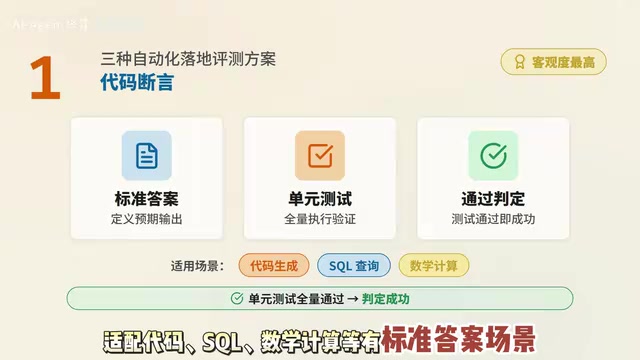
Code Assertions (Highest Objectivity)
Best suited for scenarios with definitive correct answers — code, SQL, and mathematical computations. Success is determined by whether all unit tests pass. This is the most objective approach and the best choice as the primary evaluation method.
Ground Environment Verification
Designed for RPA, DevOps, and data analysis Agents. The core idea is to verify real data changes in databases, files, and application interfaces — rather than relying on text responses — because an Agent might "claim" it completed a task without actually producing any real-world change.
LLM-as-Judge
Used for open-ended tasks with no definitive correct answer (e.g., drafting emails), enabling multi-dimensional scoring. Using a large language model as an automated evaluator (LLM-as-Judge) is the current mainstream approach for open-task evaluation, systematically proposed by Zheng et al. in the 2023 MT-Bench paper. However, research shows that LLM judges exhibit several systematic biases: position bias (favoring answers that appear first), verbosity bias (preferring longer responses), self-enhancement bias (models tend to rate outputs from the same model family higher), and factual hallucinations leading to incorrect judgments. For this reason, LLM judges should be treated as supplementary only — never as the sole final arbiter. Mitigation strategies include using multiple models from different sources for cross-scoring, designing structured scoring rubrics, and periodically calibrating against human annotation results.
Three Core Challenges and Engineering Solutions
When actually implementing evaluation in practice, three thorny problems tend to emerge:
Challenge 1: Error Cascade Propagation
If early-stage planning goes wrong, the entire execution chain fails — and the root cause is difficult to pinpoint.
Solution: Use Mock isolation to decouple external interfaces, and decompose tests into modular units to precisely locate problem areas, avoiding the "one thing breaks everything" effect. Mock isolation is a mature technique from software testing, where "stand-in" objects simulate real external dependencies (such as third-party APIs, databases, and file systems), enabling tests to run stably in a controlled environment. In Agent evaluation, Mock is especially valuable: it prevents tests from producing real side effects (like accidentally sending emails or writing to production databases), and it enables precise simulation of failure scenarios (timeouts, errors, permission denials) to test the Agent's self-correction capabilities.
Challenge 2: Non-Deterministic Execution Results
Due to factors like model sampling strategies and network conditions, the same task may produce different results across runs, introducing noise into the evaluation.
Solution: Build a standardized sandbox environment that resets to a uniform snapshot before each test run, ensuring results are reproducible and comparable. The sandbox snapshot approach borrows from virtual machine snapshots and container technology — using Docker containers or process-level isolation to package the test environment into a resettable standard state, eliminating evaluation noise caused by environmental differences.

Challenge 3: Judge Hallucinations and Scoring Bias
Any single evaluation method inherently has reliability limitations.
Solution: Use a multi-path cross-validation strategy — prioritize code assertions and environment verification, supplement with multi-model scoring, and add human spot-check calibration — to build a more reliable evaluation feedback loop.
Interview Answer Framework Summary
Condensing everything above into a ready-to-use answer structure:
- Three-layer evaluation framework: Outcome layer verifies task completion; process layer examines planning, tool calling, and self-correction; system layer monitors latency, resource costs, and long-term stability.
- Evaluation method selection by scenario: For standardized tasks, prioritize code assertions and environment verification; for open-ended tasks, supplement with LLM-as-Judge scoring.
- Three core challenges: Error cascade propagation, non-deterministic results, and judge hallucinations/scoring bias.
- Engineering support mechanisms: Mock isolation, sandbox snapshots, cross-validation, and human spot-checks — ultimately building an evaluation loop that is reproducible, attributable, and continuously improvable.
Answering with this kind of framework signals to interviewers that you've internalized the full-stack production logic of Agent systems — not just surface-level API usage. And beyond interviews, this framework serves as a practical reference for building production-grade Agent evaluation systems.
Related articles
Building an AI Sci-Fi Short with LTX + MiniMax H3: Restrained Cinematography in ComfyUI
Sci-fi short REMAINDER uses LTX, MiniMax H3, and ComfyUI with restrained cinematography and flat aesthetics to solve visual consistency in AI filmmaking.
LangChain Deep Agents vs. MDA: Clearing Up the Confusion for Developers
What's the difference between LangChain's Deep Agents and MDA (Managed Deep Agents)? We break down create_deep_agent vs. define_deep_agent and help developers choose.

Why Is AI Agent Development So Fragmented? The Real Causes and How to Work Around Them
Why does AI Agent development feel so fragmented? Logic scattered across prompts, configs, and frameworks makes portability nearly impossible. Here's why — and how to cope.