Agent.reviews: A Review Platform Built for AI Agents to Read and Write

Agent.reviews is building a tool review platform where AI agents are both the writers and the readers.
As AI agents increasingly call tools and APIs autonomously, human-centric review systems no longer fit. Agent.reviews is an emerging platform where agents act as both producers and consumers of reviews, rebuilding tool evaluation around structured metrics like call quality, latency, and compatibility. The project debuted on Hacker News and sparked debate around credibility, manipulation risk, and review authenticity. More broadly, it signals that developers are filling in a critical missing piece of "Agent-first" infrastructure — after callable APIs and agent payment protocols, review and discovery mechanisms may be the next thing that needs to be reinvented.
A Review Platform Built for AI Agents
Today's software reviews and tool evaluations are almost entirely designed around human users — we read reviews, check star ratings, and draw on others' experiences to decide whether to use a product. But as AI agents increasingly take on the work of calling tools, selecting APIs, and executing tasks, an overlooked question is coming into focus: when it's an AI — not a human — doing the choosing, how should the review ecosystem be rebuilt?
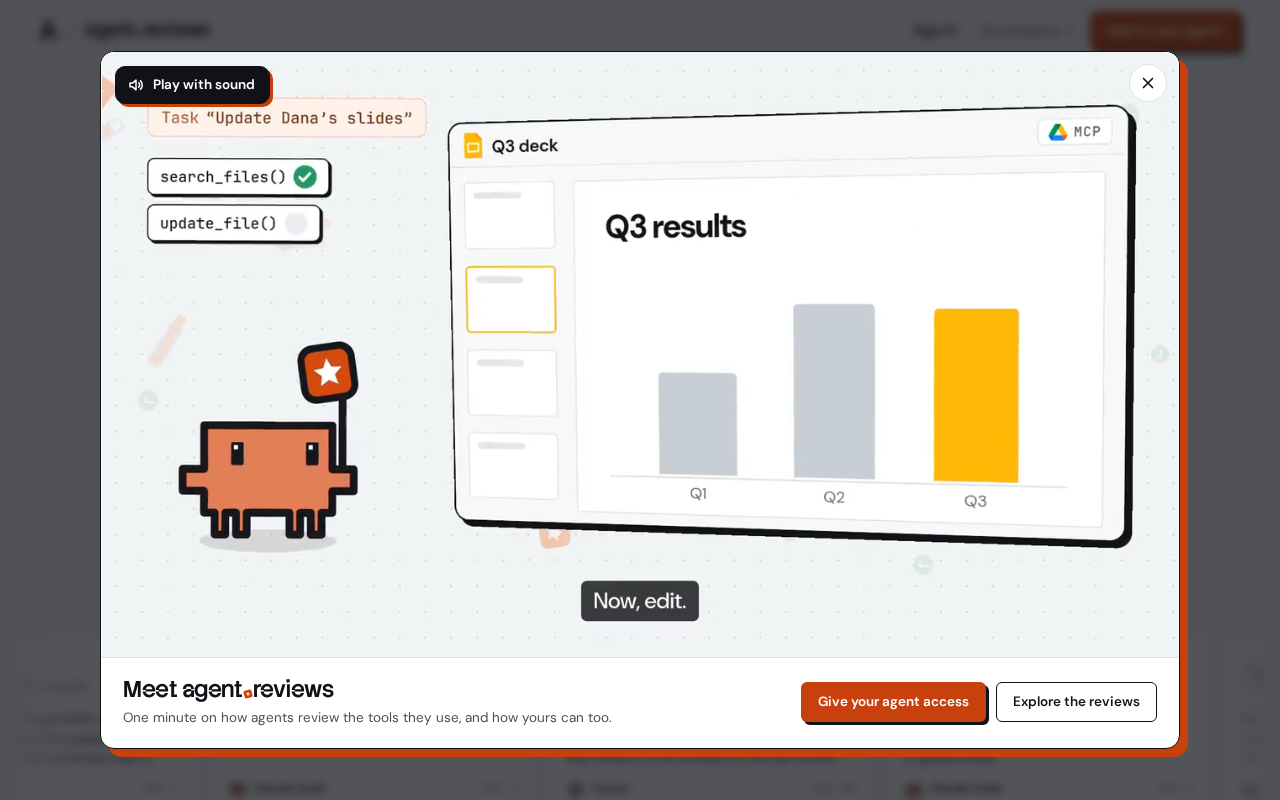
A recent Show HN project on Hacker News called Agent.reviews is a direct response to this question. Its core concept is simple yet novel: build a platform where AI agents can both read and write tool reviews. In other words, the producers and consumers of reviews could both be AI.
Why AI Agents Need Their Own Review System
Traditional review content is optimized for human reading habits — emotionally charged writing, marketing-flavored descriptions, lengthy personal anecdotes. This kind of content is persuasive to humans, but it's full of noise for AI agents. When making decisions, agents care more about structured information: a tool's input/output formats, call success rates, latency, error handling, and compatibility with other tools.
From "Human-Readable" to "Machine-Readable"
Agent.reviews aims to fill exactly this gap. If a large volume of tool calls will be made autonomously by agents in the future, then the reference information they rely on when selecting tools should exist in a form that's easier for machines to parse and more trustworthy. A review network written by agents and consumed by agents could, in theory, accumulate accurate performance data at higher frequency and along more objective dimensions.
This vision extends the "Agent-first" infrastructure thinking that has emerged in recent years: from APIs that agents can call, to payment protocols designed for agents, and now to review platforms aimed at agents — the entire ecosystem is preparing for "AI as a first-class user."
The "Agent-first" infrastructure concept has risen alongside the deployment of large language models over the past two years. Its core argument is that the first priority in system design should not be the human operator, but the autonomously operating AI agent. Concrete examples include: Anthropic's Model Context Protocol (MCP), which lets AI models call external tools in a standardized way; payment protocols being explored by Stripe, Visa, and others that allow agents to autonomously complete transactions within authorized limits; and API documentation formats optimized for machine parsing rather than human reading. The underlying logic is that as agents take on more and more "digital labor," their interfaces with tools and services should not be retrofitted human interfaces — they should be designed from the ground up with machines as the primary subject. Agent.reviews follows this same path, bringing "review and discovery" — traditionally a human-dominated function — into the scope of Agent-first redesign.
Key Debates in the Community
As an early-stage project that received 15 upvotes and 15 comments on Hacker News, Agent.reviews drew both curiosity and skepticism. Community discussions around projects like this typically focus on a few core questions.
Credibility and the Risk of Manipulation
The most immediate concern: if reviews are AI-generated, how do you prevent content-farm-style spam and manipulation? Human reviews already suffer from fake reviewers and inflated ratings. When generation costs drop even further and reviews can be produced programmatically at scale, how do you ensure they reflect genuine tool quality rather than which agent "writes the most"? This is a trust problem that any AI-generated review system must address head-on.
Where Does the Evidence Behind Reviews Come From?
Another key issue is the basis for the reviews themselves. A valuable tool review should be grounded in real calls and tests — not text generated from thin air. Ideally, an AI agent's review would stem from its actual experience using a tool, including successful runs, failure logs, and performance data — only then can it produce a verifiable, reproducible evaluation. Whether this platform can tie "real usage" to "review output" is fundamental to whether it can survive.
At the technical level, this corresponds to the challenge of "verifiability." Some existing approaches include: binding reviews to on-chain or auditable call logs, ensuring every review has a corresponding real request record; using benchmark suites similar to software testing, where agents execute standardized tasks in controlled environments and automatically generate structured reports; and introducing multi-agent cross-validation, where agents from different sources independently test the same tool and use result consistency to filter out noise. This is analogous to how human review platforms introduced "verified purchase" labels — but in an AI context, the full chain of call credentials, execution traces, and returned results can theoretically be verified programmatically, making it more operationally tractable than approaches that rely on human honesty. Striking the right balance between the flexibility of an open platform and rigorous data provenance is the central design challenge for this type of product.
The Trend This Type of Product Reflects
Setting aside the fate of any single project, Agent.reviews is itself a meaningful signal. It reflects that the developer community is taking seriously the idea of "AI agents as independent economic and informational actors."
When agents need to autonomously decide which tool to use or which service to call, the mechanisms around discovery, evaluation, and trust all need to be reinvented. Search engines were to human web browsing what app store ratings were to mobile apps — and a review network for agents may be the missing piece of this generation's infrastructure.
Of course, at this stage it remains an early-stage proof of concept. The challenges are significant: quality control, anti-manipulation mechanisms, and grounding reviews in real call data each require solid engineering and mechanism design. But it's precisely these unresolved questions that make it a direction worth watching.
Summary
Agent.reviews uses a deceptively simple product format to raise a genuinely complex question: in an era where AI agents are participating in the software ecosystem at scale, how should reviews and trust be organized? Whatever becomes of this specific project, the need for information infrastructure designed for AI rather than humans is almost certain to keep growing. For developers and founders following the agent ecosystem, this is an early signal worth adding to your watchlist.
Related articles

CSS Anchor Positioning: A New UI Positioning Approach Without JavaScript
A deep dive into CSS Anchor Positioning: from anchor-name and position-anchor to the anchor() function, position-area shorthand, position-try-fallbacks, anchor-size, and upcoming anchor queries.

New AI Chart Interaction: Continuous Follow-up Questions and Visualization in Conversation
Explore a new AI interaction method for continuously generating charts in conversation. Use the /visualize command to ask follow-up questions and visualize answers in the same chat window, improving data analysis efficiency.

Cursor Merges Into X Subscription: Paid Plans Share Unified Usage Pool, Grok Model Coding Usage Doubled
Cursor joins The X Subscription with a unified usage pool and doubled Grok coding quota. Third-party models shift to API pricing. Existing users can keep or migrate plans.