Agent + Skill Architecture: A Practical Guide to AI-Driven End-to-End Automated Testing

Build zero-code AI-driven API automation testing using Agent+Skill architecture with Claude Code.
This guide explains how to leverage the Agent+Skill architecture to build an AI-driven API automation testing framework. It covers environment setup with Claude Code and Node.js, LLM selection and Token cost control, and walks through the four core steps: API analysis, automatic test case generation, script execution, and structured report output — all without writing code.
Introduction: When Automated Testing Meets AI
In the software testing world, test automation has always been a core strategy for boosting efficiency. However, traditional automation frameworks typically require writing large amounts of code, placing high demands on testers' programming skills. Now, with the maturation of AI Agents and Skill mechanisms, a completely new approach is emerging — fully code-free, AI-driven automation that handles the entire workflow from test case generation to test report output.
The Agent (intelligent agent) mentioned here refers to an AI system with autonomous planning, decision-making, and execution capabilities. Unlike simple conversational AI, it can break complex tasks into multiple sub-steps and complete them one by one. Skills are atomic capability modules that an Agent can invoke — for example, "parse Swagger documentation," "generate pytest scripts," or "send HTTP requests." The core idea behind the Agent + Skill architecture is: the Agent handles task orchestration and flow control, while Skills handle specific execution. Together, they work like an assembly line to automatically complete complex end-to-end workflows. This architecture gained rapid adoption in the second half of 2024 as major model providers matured their Function Calling and Tool Use capabilities, becoming one of the mainstream paradigms for AI application deployment.
This article provides a detailed walkthrough of how to build a purely AI-driven API automation testing framework using Claude Code + MiniMax and other large language models, while exploring the practical value and implementation path of this approach.
Core Philosophy: Why Zero-Code AI Automated Testing Is Feasible
Three Major Pain Points of Traditional Automated Testing
The limitations of traditional automated testing are quite obvious:
- High code barrier: Testers need to master programming languages like Python or Java, plus be familiar with frameworks like pytest and unittest
- High maintenance cost: Test scripts require frequent modifications whenever APIs change
- Time-consuming test case design: Converting API documentation into test cases is tedious and prone to missing edge cases
The AI-driven approach completely upends this workflow. Through the Agent + Skill architecture, AI can automatically handle API analysis, case generation, script execution, and report output — testers only need to provide API information and business context.
The Essential Difference Between Manual and Automated Test Cases
There's a critical point that's often overlooked in practice: manual testing and automated testing cases are fundamentally different. Manual test cases focus on business logic validation and exploratory testing, while automated test cases prioritize repeatable execution, data-driven design, and assertion precision.
Specifically, manual test cases are typically described in natural language with a three-part structure of "preconditions — steps — expected results," allowing testers to flexibly adjust and explore during execution. Automated test cases, on the other hand, must have strict determinism: input data must be precise down to specific values, assertion conditions must be quantifiable (e.g., HTTP status code equals 200, a specific field in the response body equals a particular value), and the execution order and data dependencies between cases must be explicitly defined. Additionally, automated cases need to account for engineering concerns like data cleanup (teardown), environment isolation, and idempotency. When AI generates automated cases using a manual-case mindset, the resulting scripts often can't be executed directly — this is the root cause of many failed AI testing initiatives.
When generating test cases, AI needs to clearly distinguish between these two scenarios to produce truly executable automated cases.
Environment Setup: Lightweight Configuration with Claude Code + Node.js
Installation Steps for Two Core Tools
Setting up the entire AI automated testing environment is very lightweight — you only need to install two tools:
- Node.js: As the base runtime environment, it supports Windows, Mac, and Linux. Simply download from the official website and double-click to install
- Claude Code: Installed with a single npm command
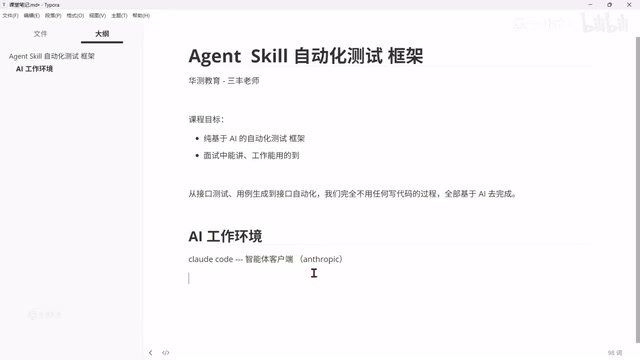
Why choose Claude Code? Because Anthropic is the creator and promoter of several core technical specifications in the current AI toolchain, including the Skill and MCP (Model Context Protocol) standards we frequently reference.
MCP (Model Context Protocol) is an open standard released by Anthropic in late 2024, designed to establish a unified communication protocol between AI models and external tools and data sources. Before MCP, integrating each AI tool with external systems required custom development, leading to severe ecosystem fragmentation. MCP defines a standardized interface specification that allows AI Agents to invoke external capabilities — such as database queries, API requests, and file operations — through a unified protocol. Similar to how the USB protocol unified hardware interfaces, MCP is unifying the capability interfaces of AI tools. Thousands of MCP Servers have already been developed by the community, covering a wide range of scenarios from GitHub and Jira to various databases. Using tools from the industry standard-setter means better compatibility and forward-looking design.
Model Selection and Token Cost Control
Many people share a common concern about AI tools: Token consumption is too expensive.
To understand this issue, you first need to grasp the concept of Tokens. A Token is the basic unit of measurement for how large language models process text — in Chinese, one character typically corresponds to 1-2 Tokens. LLM API calls are billed separately for input Tokens and output Tokens, and pricing varies dramatically across models — GPT-4o costs roughly 1/3 of GPT-4-turbo, while domestic models like MiniMax and DeepSeek are even cheaper, with some scenarios costing as little as a fraction of a cent per call. Under pay-as-you-go pricing, a complete API testing workflow (including API analysis, case generation, and script execution) might consume tens of thousands of Tokens, translating to a few cents to a few yuan in RMB. Monthly subscription plans offer fixed quotas and are better suited for frequent users. Understanding Token economics is a prerequisite for reasonably controlling AI tool costs.
Here are some practical recommendations:
- Use monthly subscription plans (such as Token Plan, Coding Plan, etc.) — around 49 RMB per month is sufficient for daily use
- The MiniMax M3 model offers strong cost-effectiveness for API testing scenarios
- Domestic LLM providers have essentially all completed API compatibility with tools like Claude Code, so availability is not a concern
"Don't let someone else's horror stories about Token consumption scare you away from trying. If you never get hands-on, you'll always be watching others do it and never learn anything new."
This perspective is worth serious reflection for every tech professional.
Four Core Steps of AI-Driven API Testing
Step 1: API Analysis
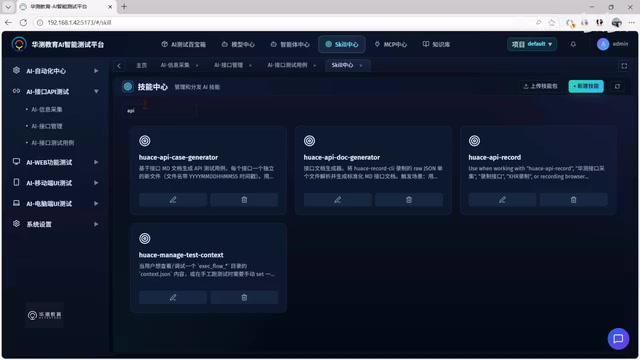
Even if your company lacks comprehensive API documentation, AI can analyze API structure and parameter relationships through packet capture data, Swagger files, or code repositories, automatically mapping out request methods, parameter types, and dependencies.
Step 2: Automatic Test Case Generation
Based on the API analysis results, AI automatically generates test cases covering normal flows, exception scenarios, and boundary values. The generated cases are directly oriented toward automated execution, with explicit input data and expected assertions.
Step 3: Automated Test Script Execution
AI converts cases into executable test scripts and runs them automatically — no manual coding required.
Step 4: Structured Test Report Output
After execution, a structured test report is automatically generated, containing key information such as pass rates, failure details, and error logs.
Why Prioritize API Automation Over UI Automation
Choosing API automation as the entry point for AI testing is a very practical decision:
- UI automation has complex environment dependencies: Mobile platforms span iOS, Android, HarmonyOS, mini-programs, and more — each requiring extensive platform-specific dependencies
- API automation environments are lightweight: Only HTTP request capabilities are needed, with no dependency on specific browser drivers or emulators
- API testing is better suited for AI processing: API inputs and outputs are structured data (JSON/XML), which AI can understand and generate with higher accuracy
From a tech stack perspective, the comparison becomes even clearer: the core dependencies for API automation testing are HTTP client libraries (like Python's requests or JavaScript's axios) and assertion libraries, with structured JSON/XML data as the test target. UI automation's tech stack is far more complex — Web testing requires Selenium/Playwright with browser drivers, Android requires Appium + Android SDK + emulators or real devices, iOS requires XCUITest + Xcode environment, and HarmonyOS requires DevEco Studio with its dedicated testing framework. Each additional platform multiplies the configuration and maintenance costs. Furthermore, UI element locators (XPath, CSS selectors, Accessibility IDs, etc.) are inherently unstable — frontend redesigns will almost certainly break locators, making UI automation maintenance costs far higher than API automation. AI's accuracy in processing structured data is also significantly higher than in handling semi-structured information like UI element locators.
This doesn't mean AI can't do UI automation — rather, for rapid validation and deployment scenarios, API automation is the best starting point.
Impact of AI Testing Skills on Career Development
AI Testing from a Productivity Competition Perspective
Here's a very realistic point: When developers are all using AI to write code, testers can't claim they can't use AI. This isn't a technology choice issue — it's a productivity competition issue.
Regarding concerns about enterprise data security, large models can be deployed privately, running in intranet environments where data never leaves the enterprise boundary. Current mainstream private deployment options include: using open-source models (such as Llama, Qwen, DeepSeek, etc.) with inference frameworks like vLLM or Ollama for local deployment; or adopting private versions offered by commercial model providers. On the hardware side, running a 70B-parameter model typically requires at least 2 A100 GPUs (80GB VRAM), while lightweight 7B-14B models can run on a single consumer-grade GPU. While private deployment solves data security concerns, it also introduces challenges around model capability limits, operational costs, and version updates — enterprises need to balance security against model capability. So the excuse that "the company doesn't allow AI" no longer holds up technically.
"It's like selling soy milk — if you insist on grinding it by hand because you think machine-ground soy milk isn't good or safe enough, ask yourself: can your hand-ground soy milk actually support your family?"
AI is the next generation of productivity tools, and it can permeate every aspect of testing work — from requirements analysis and case design to script writing and defect reporting. Every stage has room for AI to deliver value.
Interview Advantage: Demonstrating Hands-On AI Testing Experience
From a career development perspective, AI-related skills have become a hard requirement for testing positions. Whether in interviews or daily work, being able to demonstrate real-world examples of "how you used AI to improve testing efficiency" has become a key differentiator among candidates. Mastering AI automated testing solutions built on the Agent + Skill architecture is undoubtedly a powerful advantage.
Conclusion: Taking Action Beats Watching from the Sidelines
The Agent + Skill-based AI automated testing framework represents an important evolutionary direction in the testing field. Its core value lies not in completely replacing traditional automation frameworks, but in dramatically lowering the entry barrier and maintenance costs of automated testing.
For testing professionals, now is the best time to learn and practice AI testing tools. Tool costs have dropped to just tens of yuan per month, and the technology ecosystem is increasingly mature. Instead of watching others' Token consumption screenshots online, get hands-on and run through a complete AI testing workflow yourself — from API analysis to test reports — and experience firsthand the efficiency revolution that AI brings.
Related articles

The Truth Behind Codex 'Build a Website in 5 Minutes': AI Isn't Creating Sites—It's Helping You Copy Them
Exposing the truth behind viral Codex 5-minute website videos: creators aren't building original sites with AI—they're copying shared prompts or scraping others' work. Learn AI coding tools' real limits.

Getting Started with AI Agent Development: A Complete Guide from Concept to Practice
A comprehensive guide to AI Agent architecture and development, covering automated marketing, intelligent customer service, and investment analysis scenarios with single and multi-agent collaboration.

The Truth Behind Codex 'Build a Website in 5 Minutes': AI Isn't Creating Sites — It's Helping You Copy Them
Exposing the truth behind viral Codex 5-minute website videos: creators aren't building original sites with AI — they're copying shared prompts or scraping others' work.