Microsoft's Six-Pillar Framework for Productionizing AI Agents
Microsoft's six-pillar framework: the bottleneck to productionizing agents is architecture and organization, not model capability.
Based on Microsoft's Path to Production for Agents course, this article explains why impressive AI agent demos rarely reach stable production. Teams that find the right approach see value in about 12 weeks. The six-pillar framework—Center of Excellence, governance, landing zone, security and trust, AgentOps, and optimization—offers actionable steps and real enterprise cases.
AI agent demos are easy to make impressive, but putting one into a real production environment and keeping it running reliably is another matter entirely. In the Path to Production for Agents course series, Adelina Balasha, Microsoft's global lead for AI application and agent delivery strategy, draws on experience with hundreds of customers and partners to propose a six-pillar framework for going from experimentation to scaled deployment. The core thesis: what blocks agents from shipping is almost never model capability—it's architecture and organizational issues.
The gap between demo and production
Balasha opens with a common predicament: it's easy to build an AI demo that wows everyone in the conference room, but hard to bring that same agent into production and keep it running well. The data shows that teams who find the right approach see real value in about 12 weeks (roughly three months), while teams that don't are still struggling a year later—or quietly giving up.
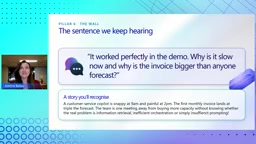
The source of this gap isn't that the model is too old or too small. Production means potentially tens of thousands of concurrent users, behavior that isn't fully predictable, tools that execute real actions, and answers that were safe yesterday starting to drift tomorrow. These problems are fundamentally architectural and organizational, which means they can be solved—as long as there's a roadmap to follow.
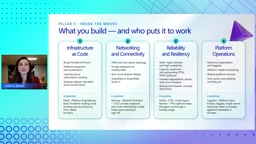
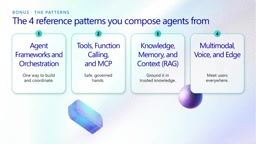
Balasha's framework has six pillars, each representing a wall teams hit on the road to production, with 3–4 practical actions under each that can be started immediately. There's also a foundational capability running through all six pillars: reusable agent architecture patterns.
Pillar 1: AI Center of Excellence
The most common refrain: "We have 40 AI pilots and not one in production." Every team does its own thing, leadership keeps asking about the return on AI investment, and nobody can answer. One bank spread roughly 40 pilots across a dozen teams, with three teams each building the same policy Q&A bot; at the quarterly review, the CFO stumped everyone with a single question.
Breaking through this wall requires four sub-items: business strategy alignment (deciding what to build and why), technical direction (setting standards everyone follows), enablement (spreading capability rather than hoarding it), and community and operating model.
One retail bank's approach was to set up a single-entry business strategy committee: any agent idea goes through this funnel before a single cent is spent. In the first quarter, the committee found multiple teams duplicating the same use case and merged them, killed eight low-value experiments, and accelerated two use cases with clear ROI. The CFO's quarterly review went from "mystery ledger" to "managed portfolio," and the first priority agent reached production in 10 weeks.
An insurer had six teams building agents six different ways. The Center of Excellence published a reference architecture and an approved pattern catalog, and new projects started by cloning from the accelerator instead of a blank page. When the claims team needed a document triage agent, it was delivered in days rather than months—and because it conformed to standards, the ops team could take it over with no rework.
The KPIs for whether this pillar is working are straightforward: how fast an idea reaches production (ideally around three months), and how many pilots actually convert into production systems.
Pillar 2: AI Governance
AI governance is the connective tissue that makes AI trustworthy and traceable. The common refrain: "The auditors showed up and we couldn't explain what the agent did." A regulator might ask an insurer to explain why a claims triage agent made a particular decision three months ago—and teams often can't reconstruct which prompt was used, which model version, what data the agent saw, or who approved the action.
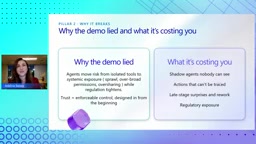
Agents shift risk from isolated tools to systemic exposure: permission sprawl, oversharing, untraceable behavior. The warning in the slide is blunt: there are shadow agents no one can see.
Shadow agents are AI agents built and put into use by business teams without IT or governance approval. They typically take shape quickly via low-code platforms, public APIs, or local scripts, bypassing security review and logging, so they're invisible on the asset inventory—yet they genuinely touch enterprise data and external systems. The risk with shadow agents is uncontrolled permissions, no audit trail, and no way to assign accountability when something goes wrong; in the event of a regulatory inquiry or data breach, the enterprise struggles to reconstruct the call chain. The governance response isn't a simple ban but a lightweight registration and sandbox channel, letting business teams experiment quickly under observability so shadow assets are gradually brought onto the official inventory.
Background note
MCP (Model Context Protocol) is an open protocol for standardizing how large models connect to external tools and data sources. In the traditional approach, every agent that needs to connect to a system requires its own private integration, and as tools multiply this becomes a maintenance burden; MCP unifies tool capability descriptions, invocation parameters, and return results into an interface models can understand, so the same tool can be reused by different agents and permissions and auditing happen in one layer. For enterprises, MCP reduces the duplicated cost of tool integration and provides a single entry point for governance—which tools are called by which agents can be recorded at the protocol layer rather than scattered across each team's code. This is precisely why framework orchestration and tool invocation are listed as reusable architecture patterns.
One-line Summary
Microsoft proposes a six-pillar framework arguing that the bottleneck to productionizing agents is architecture and organization, not model capability.
Paragraph Summary
Based on Adelina Balasha's Path to Production for Agents course series, the article examines the systemic obstacles to moving AI agents from demo to production. Creating an impressive demo is easy, but keeping an agent running reliably in production—with tens of thousands of concurrent users, tools executing real actions, and behavior that can drift—is hard. Teams that find the right approach see real value in about 12 weeks; those that don't are still struggling or giving up a year later. The framework has six pillars: AI Center of Excellence, AI Governance, AI Landing Zone, AI Security and Trust, AgentOps, and Solution Optimization, each corresponding to a wall plus 3–4 immediately actionable steps, with reusable agent architecture patterns as the foundation. Banking, insurance, and retail cases illustrate the effects of a single-entry business strategy funnel and publishing reference architectures.
Related articles
Military Analyst Breaks Down the Russia-Ukraine Strategic Bombing Dilemma
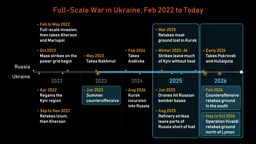
A military analyst on the Lex Fridman podcast dissects the Russia-Ukraine battlefield: Ukraine's ground performance is its best since summer 2023, while Russia faces diminishing returns and turns to strategic bombing — a strategy with a poor historical record of achieving political goals.
Codex Security: A Configuration Guide to Automatically Blocking Vulnerabilities at the PR Stage
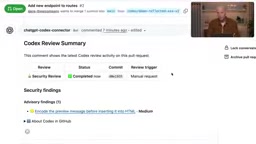
OpenAI engineers demonstrate Codex Security PR Reviews: automatically scan for vulnerabilities at the GitHub PR stage, have AI generate fix commits and re-verify, with repository-level automatic review and alert threshold configuration.

Daybreak Blue Application and Enablement: Complete Process Guide
Based on the official demo video, this guide details the Daybreak Blue application and enablement process, covering enterprise verification, intended use statements, role permission configuration, user access verification, and API key creation to help cybersecurity teams quickly onboard frontier AI models.