Agent Skills Deep Dive: A Complete Guide to Modular Agent Development Architecture

Agent Skills is Anthropic's modular architecture standard for building reusable, composable AI agent capabilities.
Agent Skills is not a tool or a competitor to MCP — it's an architectural framework for building modular AI agents. Each Skill package bundles instructions, metadata, and resources that agents load dynamically as needed. Released as an open standard by Anthropic in late 2025, it addresses enterprise pain points like bloated system prompts and duplicated development, and complements MCP at the protocol layer to form a complete agent development stack.
What Are Agent Skills
Agent Skills has become a hot topic in the AI developer community. However, much of the content circulating online misrepresents this concept — some even conflate it with MCP. This article cuts through the noise to explain what Agent Skills actually is and why it matters for enterprise-grade agent development.
At face value, "Agent Skills" means exactly what it says: skills that an agent possesses. But at a technical level, it's not a single feature — it's a development architecture for intelligent agents, a comprehensive technical solution.
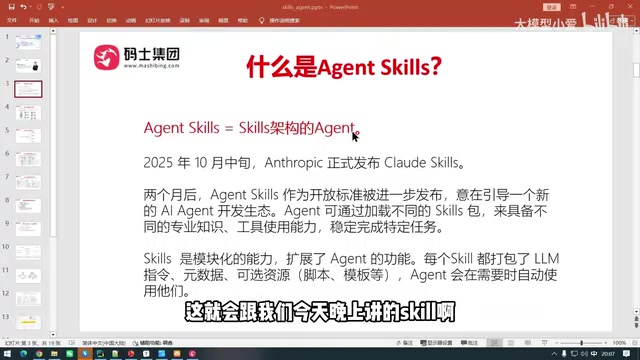
Simply put, if you're building an agent (which is ultimately a software system) for an enterprise, the choice of which technical approach and architecture to use is precisely what Agent Skills addresses. It answers the question: "What approach should I use to build an agent?"
The Common Misconception: Agent Skills vs. MCP
A widespread misconception exists in the industry: directly comparing Agent Skills with MCP. About 80% of online content presents comparison tables that pit Skills against MCP point by point — but this comparison is logically flawed.
The reason is simple: they operate at entirely different technical levels.
- Agent Skills is a technical framework and solution for agent development;
- MCP (Model Context Protocol) is a network communication protocol used during agent development.
One is an "architectural solution," the other is a "communication protocol" — they don't belong to the same category and can't be meaningfully compared. It's like comparing a complete software system to one of its communication interfaces.
To fully appreciate this distinction, it helps to understand MCP's technical nature. MCP is an open protocol proposed by Anthropic in November 2024. Its role in the AI tool-calling ecosystem is analogous to what HTTP is in the internet world. HTTP doesn't dictate what content a website should provide or what architecture it should use — it precisely defines the format of requests and responses between clients and servers, status code semantics, and header field specifications. This restrained "transport only, not content" design is what allows HTTP to support everything from static web pages to real-time streaming. MCP follows the same philosophy: it standardizes how context is passed between language models and external data sources and tools, specifying how to transmit and what format to use — but says nothing about how an agent should organize its capabilities. That's exactly what Agent Skills is designed to solve.
From a network layering perspective, MCP operates at the protocol layer between the transport and application layers of the OSI model. Its core responsibility is solving interoperability between heterogeneous systems. Agent Skills operates at a higher architectural abstraction layer, determining how an agent system's overall capabilities are organized: how capabilities are defined, encapsulated, discovered, and invoked. Far from competing, the two are deeply complementary — a Skill package can use MCP at the underlying layer to handle external tool communication, forming a layered "architecture calls protocol" technical stack. This is the essence of Separation of Concerns: the architecture layer focuses on "how capabilities are organized," the protocol layer focuses on "how data flows," and each layer only needs to expose a clean interface to adjacent layers while evolving independently.
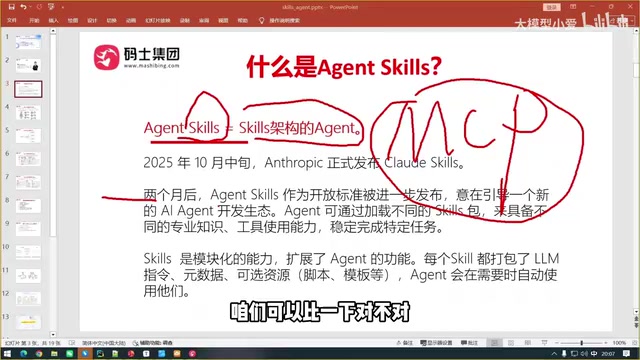
It's worth noting that both MCP and Agent Skills come from the same company — Anthropic, the developer of the Claude model series (Claude 3.5, 3.7, etc.). They share the same origin but have no direct technical competition with each other.
The Background Behind Agent Skills
Here's the Agent Skills timeline:
Initial Release
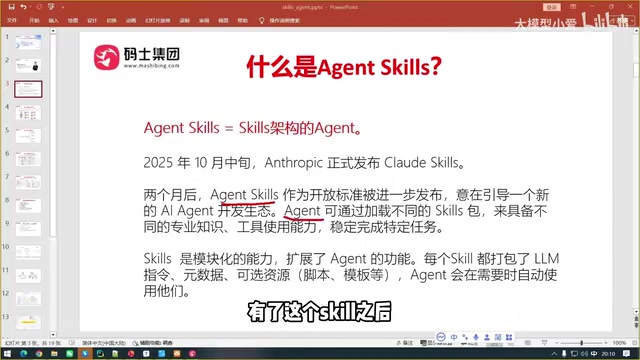
Anthropic officially introduced Agent Skills in mid-October 2025 as a new solution for agent development.
Open Standard Release
Just about two months later, in December 2025, Agent Skills was further released as an open standard, aimed at fostering a new AI development ecosystem.
Positioning Agent Skills as an open standard follows the same playbook as MCP's rollout. An open standard means any third-party developer, framework, or platform can implement compatible Skill packages based on the specification — rather than being locked into Anthropic's own products.
Historically, open standards have often been the turning point that takes a technology from the lab to industrial scale. Tim Berners-Lee's release of HTTP and HTML as open standards in 1991 directly sparked the explosive growth of the World Wide Web. The OpenAPI Specification (formerly Swagger) released in 2011 transformed RESTful API design from a collection of proprietary vendor practices into an industry lingua franca, fueling the API economy. These cases illustrate the core value proposition of open standards: by lowering interoperability costs for all participants, the total value of the ecosystem far exceeds what any single closed system could create — what economists call "Network Externality," where each additional participant increases the value for everyone else.
If Agent Skills achieves a similar effect, it will enable interoperability at the capability layer across different vendors and model systems. A Skill package written for one platform could theoretically be reused directly by other agents that are compatible with the standard, fundamentally breaking the current "siloed capabilities" landscape of AI platforms.
From concept to standard in just two months — this is a very cutting-edge technology. For developers, early adoption means a competitive edge, but it also means navigating an ecosystem that's still maturing.
The Core of Agent Skills: Modular Capabilities
The most fundamental value of Agent Skills is modularity. A familiar analogy for developers:
Agent Skills is like importing a jar package in Java, or importing a module in Python.
Modularity is one of the most enduring design principles in software engineering, with roots in the structured programming movement of the 1960s. As software systems grew in complexity, the "Software Crisis" became a recognized industry challenge — code was hard to maintain, logic was tightly coupled, and fixing one bug could break everything else. Computer scientists like Edsger Dijkstra advocated for "high cohesion, low coupling" — splitting systems into modules where each handles a single responsibility and communicates through well-defined interfaces.
This philosophy materialized into package management ecosystems across languages: Java's jar packages managed via Maven/Gradle, Python's pip packages forming the PyPI ecosystem, and npm's module registry with over 2 million packages making it the world's largest software registry. These mature practices collectively demonstrate modularity's core value: reusability, composability, and independent evolution.
Agent Skills brings this battle-tested paradigm into AI agent development, directly addressing a common and painful problem in enterprise projects: agent system prompts often run thousands of words long, hardcoding role definitions, task logic, tool descriptions, and business rules all in one place. This makes maintenance extremely difficult, wastes precious context window resources, and means any small change can cause unpredictable behavior across the whole system. The quantifiable cost is real: context window usage directly corresponds to API call costs. Redundant system prompts consume a fixed token budget on every conversation, growing linearly as the agent's capabilities expand. Modular loading means each conversation only needs to load the Skill packages relevant to the current task, potentially reducing context usage by 60–80% — a directly measurable operational cost saving.
How It Works
An agent can load different Skill packages to gain specialized knowledge and tool-calling capabilities for specific tasks. Each Skill can be packaged into three core components:
- Instructions: tells the model how to execute the task;
- Metadata: describes the skill's purpose and applicable scenarios;
- Resources: relevant files or data needed to complete the task.
The agent automatically and dynamically loads and invokes these Skills as needed. This design breaks apart and encapsulates what would otherwise be bloated, tightly-coupled agent functionality, turning each capability into an independent, reusable, composable module.
These three components deserve deeper examination. Instructions are the module's "business logic," defining what the Skill can do and how. Metadata acts as a "service catalog," enabling the agent to determine at runtime — through semantic matching — which Skill to invoke for a given task. This is essentially a natural-language-based dynamic service discovery mechanism. Unlike traditional microservice discovery based on DNS or service registries, it leverages the language model's own semantic understanding to make routing decisions without hard-coded call rules. This is a meaningful innovation: traditional service discovery requires the caller to explicitly know "I need to call service X," while semantic Skill routing allows the agent to autonomously infer "I need to load skill package Y" from a task description. Resources are analogous to traditional application configuration files or knowledge bases, providing the domain data needed for Skill execution.
From a system design perspective, this parallels Microservices Architecture — which decomposes monolithic applications into independently deployable small services, each focused on a single business domain. Agent Skills decomposes an agent's "cognitive capabilities" into independently encapsulated Skill packages, each focused on a specific task scenario. Both architectures embrace "divide and conquer" as their core philosophy to achieve long-term maintainability and extensibility.
What This Solves for Enterprise Agent Development
The benefits of a modular architecture for enterprise agent projects are clear:
- Extensible capabilities: adding new functionality means loading the corresponding Skill package, not refactoring the entire system;
- Dynamic on-demand loading: agents invoke skills as needed, avoiding resource waste from loading all capabilities upfront;
- Cross-project reuse: the same Skill package can be shared across multiple agent projects, reducing duplicated development effort;
- Lower maintenance costs: updating a single capability module doesn't affect the stability of the overall system.
From an enterprise IT governance perspective, these advantages go beyond pure technical gains. In large organizations, different business lines often need their own agents, but the underlying capabilities (data querying, report generation, compliance review) heavily overlap. The traditional approach is for each team to build independently, leading to fragmented capabilities, unsynchronized updates, and difficult security audits. Skill package reuse naturally maps to the "Shared Services" governance model in enterprise architecture — core capabilities developed and maintained by a dedicated team, consumed by business lines on demand. This governance model has proven itself in traditional IT (SOA's Enterprise Service Bus, platform engineering teams in cloud-native architectures), and Agent Skills naturally extends it to AI agent development.
How to Correctly Understand Agent Skills
Back to the original question — what exactly is Agent Skills? In one sentence:
Agent Skills is a technical solution that brings "modular capabilities" to agent development.
It doesn't compete with MCP, and it's not a specific tool. It's an architectural standard that defines how agents organize, load, and invoke their capabilities. Understanding this is the key to avoiding the misleading narratives circulating online.
Looking at Anthropic's overall strategy, there's a clear dual-track "protocol layer + architecture layer" layout in the agent technology space: first, MCP unifies the communication layer for tool calls, solving interoperability between heterogeneous systems; then, Agent Skills standardizes the architecture layer for capability organization, solving capability management within agent systems; combined with the Claude model series' continued improvements in multi-step reasoning and parallel tool use, this forms a vertically integrated "protocol + architecture + model" system.
This positioning aligns closely with historically successful technology platform strategies. Consider the Android ecosystem: Google controls the underlying communication specifications (Android's Binder IPC), the application development architecture (Jetpack component library), and the core runtime (Dalvik/ART). The three-layer coordination makes Android not just an OS, but a de facto standard for mobile application development. Anthropic's "protocol + architecture + model" layout pursues similar full-stack influence in the AI agent space: providing developers with a complete reference framework from low-level communication to high-level architecture.
For developers looking to enter the agent development space, mastering Agent Skills means understanding the construction paradigm for the next generation of AI applications. As Anthropic continues to promote it as an open standard, more frameworks and tools will build around it, forming a new development ecosystem.
Of course, conceptual understanding alone isn't enough to get started — hands-on code practice is essential to truly mastering Agent Skills. The recommendation is to build on this architectural understanding by writing Skill packages, loading them, and invoking them, to experience firsthand the practical benefits of modular architecture.
Key Takeaways
- Agent Skills is an architectural solution; MCP is a communication protocol. They operate at different technical levels, can't be directly compared, but can work together in deep collaboration;
- Modularity is the core value of Agent Skills, decomposing agent capabilities into reusable, independent Skill packages to solve the pain points of bloated system prompts and difficult maintenance;
- The open standard positioning gives Agent Skills the potential to become an industry-wide norm, breaking down AI platform capability silos;
- The "protocol + architecture + model" trinity is Anthropic's complete agent technology stack — understanding this system enables more forward-looking technology decisions.
Related articles

Transformer²: Achieving Co-Design of Robot Morphology and Control with a Unified Architecture
Deep dive into how Transformer² uses a unified Transformer architecture to integrate robot morphology design and motion control into one model, enabling task-driven end-to-end co-design for embodied AI.

Tutorial: Installing Tailscale on a Jailbroken Kindle to Create a Private Network Node
Learn how to deploy Tailscale on a jailbroken Kindle, turning an idle e-reader into a private network node. Covers cross-compilation, power optimization, and risk considerations.
Tutorial: Installing Tailscale on a Jailbroken Kindle to Create a Private Network Node
Learn how to deploy Tailscale on a jailbroken Kindle to turn an idle e-reader into a private network node. Covers cross-compilation, power optimization, and risk considerations.